Category Archives: Reflection Blogging

Reflection On New Models

Reading about social infrastructure in Eric Klinenberg’s Q&A  made me think of this quote from John Roedel:

“I have no patience for people who can watch the world burn and never wonder ‘How do I become rain?’”

This sentiment of “becoming rain” for a world on fire is what I feel we’re all here to do as librarians and information professionals who are dead-set on creating a safe, practical, relevant, welcoming, and supportive space for our patrons. So, how have libraries become rain for the folks who are drying out?

One thing that felt especially nourishing from this module were the Underground Flavour Group (UFG) and Kitchener Public Library (KPL) partnership and the Camden County Library System’s (CCLS) mobile kitchen. More importantly, it was the thought and care that went into these programs that moved me.

“My philosophy is, we find out what challenges a community faces and ask how can we help them,” – Linda Devlin, CCLS Director 

“Libraries have become a hub for the community connect with different programs and partnering with the UFG just made sense.” – Shirley Luu, KPL

These bolded parts “we find out,” “ask how we can help,” and “[it] just made sense” felt especially relevant! I feel like as a very fresh library professional with barely a year in library services in my back pocket, there are so many things I want to try! Trying and experimenting is definitely not a bad thing, but what will actually stick with the community is doing something that “makes sense” for them! Tying it back to the John Roedel quote, I feel like it’s especially important for us to be mindful of what rain we’re bringing. A light drizzle won’t nourish a desert and a heavy storm in a place with no storm drains will drown everything out! I am reminded that beyond anything, exploring new models while being user-focused is what building a successful community is about.

Resources:

CBC News. (2021, December 28). How a restaurant-library partnership made food and culture accessible. https://www.cbc.ca/news/canada/kitchener-waterloo/underground-flavour-group-and-kpl-1.6294810?fbclid=IwAR1E-wMqgXKv6R9LMcP1O8LTTzAZTNNUgH5GEI8DiNAgrRdpCUlTBeTJ4Es

Ewan, L. (2018, September 4). A movable feast. American Libraries. https://americanlibrariesmagazine.org/2018/09/04/movable-feast-library-mobile-kitchens/
Reflection on Hyperlinked Environments

I love the idea that mobile information environments don’t only need to be utilized outside of library walls. There are many ways that mobile technologies can support patrons who are inside the library as well! I’m always grateful that libraries are often staffed with socially diverse people, introverts and extroverts alike, so that patrons of all social tendencies have representation and understanding. So, when I read Karen Jenson’s (2022) article on using QR codes to help reader advisory, the introvert in me felt so seen. It reminded me that despite my over-zealous tendencies to help patrons face to face, some people are best helped when they can do it themselves! I wanted to share a few other ideas for supporting the more introverted patrons in and outside of the library:)

Utilizing outside/distanced spaces

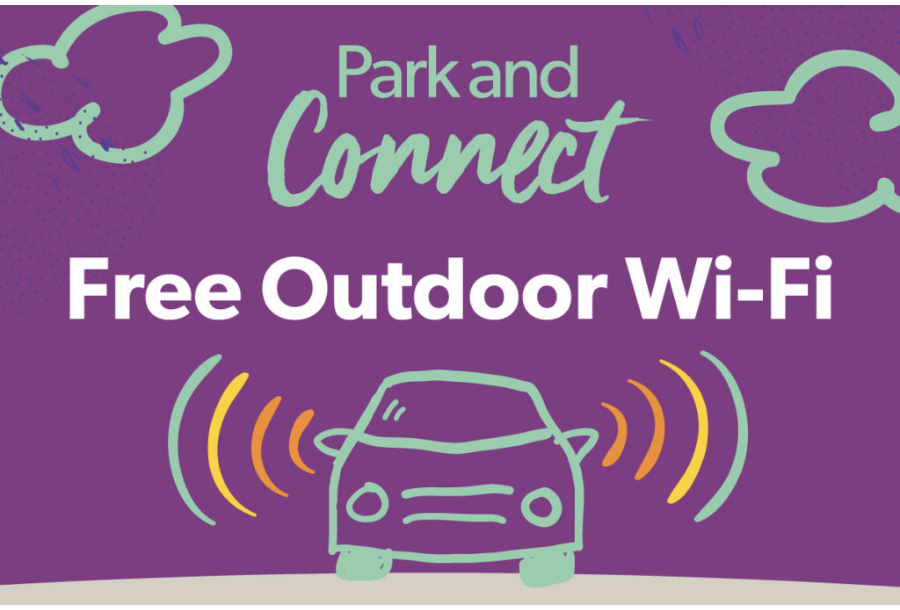
I feel like sometimes the patio areas and outside areas of libraries are detained to special events or rusty furniture. While I am all for the bubble parties and chalk zones of special event proportions, I think the introverted, more mobile patron would have a field day with a cozy and cared for outside reading/working area. Some ways to ensure the outside space is used are: 1) Make sure Wi-Fi is readily available! Nothing is more awkward than setting up shop, then debating whether or not to ask the librarian for help with the internet! 2) Make sure the outside furniture is clean and ready to use 3) Work with maintenance for an ample outlet situation!  4) Make this area available 24/7. This last one may take some convincing from the higher ups, but making outside spaces available at all times (Wi-Fi especially) gives patrons, especially introverted ones, more reason to use the library! The LA County Library boasts free unlimited access Wi-Fi, from their buildings to their parking lots! This initiative was created during COVID-19 lockdown, but stayed in order to support the community. This reddit thread is full of grateful users🙂

Purple background. "Park and connect. Free outdoor Wi-Fi" Signage for LA County's free outdoor Wi-Fi.
Signage for LA County Library’s free outdoor Wi-Fi. LA County.

Silent book clubs

The silent book clubs at my old library were a hit. We’d have a steady stream of regulars as well as newcomers just stopping by to read. Although the silent book club starts in the library, it doesn’t end there. I know that some folks have found friends via this program and take their reading (and friendship) elsewhere! A good reminder to anyone leading these is to reassure patrons that they aren’t obligated to share during post-read chat or even obligated to stay.

User-submitted displays and virtual passive programming 

Now I haven’t seen this in any libraries yet, but I’m thinking of something like highlighting a “weekly question” forum on the library website, then having the answers displayed on a digital signage at the library. I’ve seen similar ideas at museums (like this Wisdom Arc at San Francisco’s Exploratorium), where there’s a display of visitor-submitted art or quotes, but I haven’t seen any that were sent in virtually! I think this would be a great way for at-home patrons to participate in library programming without needing to come in physically!

Two kids looking at the Wisdom Arc Time Machine
Two kids looking at the Wisdom Arc Time Machine. Wisdom Arc Project. 2014.

What I find most important from my exploration of the Mobile Information Environments articles is this bit from David Weinberger’s “Let the Future Go.” Although it was written more than ten years ago, the sentiment that the future of libraries lies in its users, and not the library itself, still holds true (2014). This is why, with the very transient, nomadic nature of many library users, the library needs to provide the environment for them to thrive, wherever and whenever that may be.

Resources:

Weinberger, D. (2014). Let the Future Go. The Digital Shift. http://www.thedigitalshift.com/2014/09/digital-libraries/let-the-future-go/

Jenson, K. (2022). Using QR codes for RA: Helping patrons find new book recs in the stacks. https://teenlibrariantoolbox.com/2022/05/11/using-qr-codes-for-ra-helping-patrons-find-new-book-recs-in-the-stacks/

LA County Library. (n.a). Free Wi-Fi. https://lacountylibrary.org/wifi/

Reflection On Hyperlinked Communities

Beyond learning, exploration, and connection that kids, tweens, and teens often experience at the library, there are adult library regulars who use the space as ground for stability and sometimes sanity. I loved hearing about the innovative ways libraries connect with their patrons through specific, community-focused programs – sleepovers at the library, the healthy happy eaters club, etc – but what really struck me was the Tareq Nurul Hasan article on the library as a “sanctuary of health and wellness” (2022).

Inside Mill Valley Public Library -- two wooden chairs facing a floor-to-ceiling window. Tall trees overtake the view.
A patron enjoying the view from inside Mill Valley Public Library. 2022. @patriciamou_ on X.

Maybe this comes at a tender moment in my life, but Hasan’s emphasis on loneliness got me thinking about how dire public libraries are to those who are struggling mentally and emotionally, and for those who need solutions, but don’t know where to start. Although technology and social media connect us in ways we’ve never imagined, some people still feel disconnected from the world around them, and the judgement-free, accessible, welcoming environment of the library is one foothold that we can use to gain some stability.

I recently moved to a new state, and with it came a new library job. One of my coworkers asked me, “What do you want to do with your library degree?” I told her I wanted to focus on building up the community with fun, relevant programming and do outreach to get the (very new, very blossoming) city of Buckeye, Arizona excited about the library. But after reflecting on a particularly difficult season of my life, and recounting the stories from “Libraries Change Lives” from Public Libraries Victoria, I find that another part of my goal is making the library a place for sanctuary – a place where pondering and contemplation is not questioned, judged, or interrupted, but welcomed and fostered.

This little reflection brought me to search for looser, quieter, a little more pensive, library programs, like the meditation practices we talked about in the lecture, that I could potentially share with my new coworkers! One idea in particular was super interesting to me: meditation rooms at the library. I found that the Glendale Community College Library (just about 40 minutes from me) has a Quiet Meditation Space open for its students. According to the FAQ, “This space is intended for prayer, meditation or if someone needs a quiet space to collect themself,” and “Not intended to be used as a lounge, study room, or meeting room.”

I really love the distinction they make here – while private study rooms can most certainly serve as flex rooms for different programming, having a dedicated space for meditation/prayer/contemplation really emphasizes the importance of the practice. As Emily Mross (2018) of the Penn State-Harrisburg Library suggests, “By providing formal or informal, flexible and inclusive spaces for spiritual practices, we facilitate an environment of inclusion and affirm a sense of belonging.” While these kinds of private rooms are prevalent in academic libraries, I was able to locate Missouri libraries that offer Wellness Rooms. While their website emphasizes nursing as a use for the wellness room, I think it’s still significant that patrons are given the privacy and trust to use the room for any purpose, from nursing to meditating to just being alone for a little while.

Green paper sign in plastic sleeve for the prayer room at Penn State-Harrisburg Library
A paper sign indicating the prayer room at Penn State-Harrisburg Library. 2018. College & Research Libraries News.

Although community is about building relationships with others (the library is definitely the place for that), I think it’s also about including those who need extra space and time for their own personal practices. And giving people a safe, judgment-free place to do that is what the library should be doing.

Resources:

Hasan, T.N. (2022). ‘Free, non-judgemental, accessible’: How your local library is a sanctuary of health and wellness. Special Broadcasting Service. https://www.sbs.com.au/language/bangla/en/article/free-nonjudgmental-and-accessible-how-your-local-library-is-a-sanctuary-of-health-and-wellness/t15blzsi9

Libraries Change Lives. Public Libraries Victoria. https://www.plv.org.au/hear-stories/

Mross, E. (2018). A place to study, a place to pray. College & Research Libraries News. https://crln.acrl.org/index.php/crlnews/article/view/17010/18758