This question brought up a lot of interesting thoughts for me as I pondered it in the sphere of teaching a one-stop session on information literacy for a College Experience class. The article, “Sparking Curiosity-Librarians’ Role in Encouraging Exploration” by Ann-Marie Deitering and Hannah Gascho Rempel was very engaging as many librarians know all to well that students more often than not, don’t pay attention in information literacy sessions or other courses. Not all students, but we have all seen those students who even after they have been informed to not be on devices during class, are sneaking peaks at their social media, or “forget” to take out their earbuds and are listening to whatever else they are deeming important. The goal here in getting their attention back is by asking them the question, “How are you curious?” This question is not a simple yes or no answer, but a discussion on the complexities of what interests and motivates a student to learn. To open up about their curiosity and to use that to show them that even research projects on topics that they know nothing about can be an exciting adventure that has the student on a trajectory to learn in a way that stays with them.
This plays into the part where faculty and librarians collaborate to create conditions or an environment that students will feel motivated and safe to explore and learn. This may mean re-evaluating library spaces to include more than just books. Carl Straumsheim (2017) speaks to the reorganization of libraries as there has been an increase in the use and demand for electronic resources. This means that the physical collection, while still important, has less usage than prior years and students want more collaboration space that also includes places for creativity and relaxation. In my library we have a small makerspace, a coffee cart (coffee is free to students), and collaborative areas designated for students to gather and discuss projects, sports information, or just hang. We also have created a “stress-free” station where they can color, learn origami, or put together puzzles. This re-imagining of space within the library walls has had positive effects for our student population and we have even found that our faculty and staff have taken advantage of these spaces too. In addition, we actively check out bikes and disc golf sets to students while our student services have expanded to fishing poles and other recreational items to be available to students.
Linda Spice (2019) discussed the food-share program that developed after noticing a need within their own staff of college students who were skipping meals. This is an ongoing issue at many colleges and I think that it’s wonderful that they started a collection and distribution process that takes away the judgment and allows the students to access food when needed and even provides advice on what to stock more of as many of these students look for ready-to-eat meals rather than ones you have to put together. My college has a “food pantry” of sorts called the Spartan Corner and students can come and get what they need from the food available as well as hygiene products. It is housed in our student center outside the bookstore and from time to time the college sends out notices when it is time to “restock” the Corner. We have even had community members donate food to the cause and it has gone over very well since its inception four years ago. I make sure to donate to the Corner when I can, because I remember when I was in college and food was not always something I could afford while attending school and they didn’t have this type of thing available to students at my college back then.
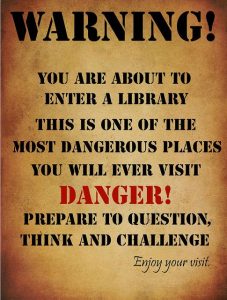
I also liked the article on library signage. Luca and Narayan (2016) really showed what the difference in signage could do to the overall aesthetics of the library while still being informative without all the wording. Many times we take for granted that our signs should be easy to comprehend, when in fact, they aren’t because they are written from a librarian’s point of view and not from a student’s point of view. While the article really engaged what larger colleges and universities could do in their much larger library spaces, it really did make me re-think about the signage that I have in my community college library and if it really was engaging and informative at the same time without making the users more confused or frustrated and walking right out the doors. I will have to take some time and see where I can improve and this is even a cross-over into display signage where sometimes I think we also need to re-evaluate what the signage says and how it may be interpreted.
Resources
Great post, Becca! I just wanted to touch on the need for creative and relaxing spaces. Especially in a time where we are so often connected to some device or screen, I agree wholeheartedly that we need more of these passive spaces that encourage students / patrons to unwind for a bit and just be in “a moment”. It’s interesting to observe that most if not all children’s spaces have toys, puzzles, and other non-book activities available to them, but some libraries “forget” about their tweens, teens, and even adults who may also enjoy having free and ready access to such materials.
It’s amazing how many students who come and seek out coloring pages in our library. We offer markers, crayons, and colored pencils for them to use in the library. However, we have had students take a page and some crayons or markers and take them back to class (I have seen this with nursing students and psychology students) because the instructor said that they could color while in class as a stress reduction activity or help them focus. The puzzles are hit and miss for some, but the origami really took off this last year, especially with one student who was just fascinated with it and made several different things and we displayed her creations on our counter for others to enjoy. We even have a chess/checker board that students can use in the library and I know the public library has a chess club for a while, but not sure if it is still going. This really speaks to the nature of humans to want to disconnect from technology and do other things that are creative. We make sure to change things out every month to keep things fresh. We even have talked about having Legos in the library or magna-tiles for students to build creations.
Becca – I enjoyed this exploration of academic libraries and your responses to some of the course resources. I also appreciate the comments here as well. I am all about making sure that students have food available and I would argue that the library might be a good place to house a community closet type situation. I also have been a long time advocate for positive and encouraging signage in all types of libraries.
Hey Beeca,
Your point about signage being written from a librarian’s point of view instead of a student’s made me think back to a middle school library I worked in. When I started there were barely any signs at all, and the few that existed were these long text explanations that read like a lecture. All correct info, but not written with the reader in mind.
With kids especially, they move fast and take things personally, so a sign has to get to the point immediately. Less flowery wording, more blunt and clear: tell them what to do and move on. The visual side matters just as much as the words, maybe more. It’s what stops a kid for two seconds. Little cartoon characters, emojis, that kind of thing signals “this is friendly, not a rule you’re in trouble for.” Memes too: that’s the visual language a lot of younger people are fluent in already, so leaning into that instead of fighting it makes signs land better.
@nhaynes287 I agree. Simple signs that are colorful and eye-catching not attracts teens, but adults as well. We also need to think about accessibility of signage for our colorblind population as well. Trying to achieve both can be tricky, but we don’t want anyone to feel left out.