Stories are powerful things. They have the ability to let our minds travel to the past, to the future, to countries we may never see in real life. We can live a lifetime through stories. We can live experiences through other people’s stories. Stories have the power to bring people together to share memories, to discuss important topics, and to facilitate perpetual learning. I strongly believe in the power of stories. @Michael really honed in on the power that stories have to be many things to many people and also act as a catalyst for change.
The great thing about stories is that they can be told in many different formats. From written words to human libraries. Podcasts and video blogs as well as the telling through emojis. Finding different paths upon which to share stories keeps alive the creative process and can reach more people in different ways. I like how @michael talked about in the video lecture about the fact that if you tell your story through emojis, you could cross language barriers! I found this neat website called Emojistory and had to try it out.
👧🧹😢✨🧚👗👠🏰💃🤴💍👸
Can you guess the fairy tale?
I loved the thought of writing love letters or breakup letters to books. Stephens’s example of Annie Spence’s book Dear Fahrenheit 451 (2017) had me looking for it almost immediately (Stephens, 2019). She has a way with words that make people think, good or bad, about the books in question and follows up with additional suggested reads. It’s almost as if she can help shape a “To Be Read” list for us and for us to take on our own sense of love or loss to create our own letters.
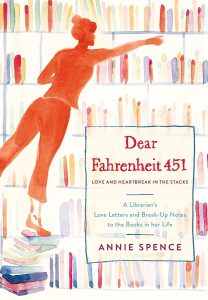 courtesy of: amazon.com
I have been trying to get into listening to podcasts. So far I have not found one that I have been able to stick to and listen for more than say a couple of minutes. But the sheer number of podcasts that are currently out in the world is astounding. According to a natural language search on Google, the AI assistant stated that there are 4.5 – 4.8 million podcasts currently in the world featuring around 190 million episodes! I was astonished at that general fact, but it alludes to the popularity that podcasts have. They are informational, more importantly mobile, and provide a way for people to learn information while multi-tasking. Currently Podcaststatistics.com states that in the United States alone, 55% of the population listen to 1 or more podcasts. Podcasts are generally real people telling real stories. Listeners can connect with the hosts or storytellers in a much different way that simply reading the same story in print or online. When @michael collaborated with Evans Groth, Kylie Carlson, and Felicity Macchion to present at a Next Library Conference in Denmark, they used the medium of podcasting to record the stories that were being told there to show how these stories strengthen the library in relevance, space, etc (Stephens, 2019). The use of Narrative Inquiry to gather valuable information typically in an interview format shows the varying ways people learn and their unique experiences that can contribute to better services (Stephens, 2020). Not only is narrative inquiry important when talking to patrons, but the librarians and library staff also have stories that are just as unique and worthy of inclusion into this process.
One other story telling idea that I would love to see come back to my college and more specifically my library is the Human Library organization. This thought provoking program seeks to challenge stereotypes, opens up dialog, and creates an atmosphere of learning maybe at least of what it is like to “walk a mile” in someone else’s shoes. Wentz (2013) states that Human libraries are patterned after public libraries and so these are perfect places to hold such events, but I feel like academic libraries can be just as fitting if not more so with the diverse nature of the student body. Most programs like these have people reflecting on their own biases and internalizing what it means to be more inclusive.
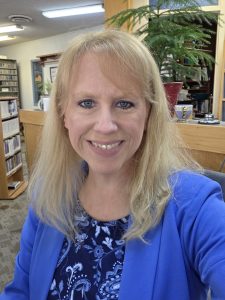
Here is my story:
I am a single mother of two teenage children. I earned my master of arts degree in History in 2011. I have worked in higher education the majority of my adult life and love every minute of it. Unfortunately, in March of 2014 my husband died unexpectedly, leaving me to raise two small children on my own. I was not prepared. I had two wonderful college friends who came to my rescue and have helped me co-parent my kids. They as well as my work family supported my decision to go back to school and get my MLIS which will be completed in December 2026. I have learned so much since starting this program and if it wasn’t for the “family” that I have, I don’t know that I would be where I am.
So, what is your story?
References
Stephens, M. (2019). Office Hours: With a Little Twist & Power of the Pod
Stephens, M. (2020). Office Hours: Narrative Inquiry