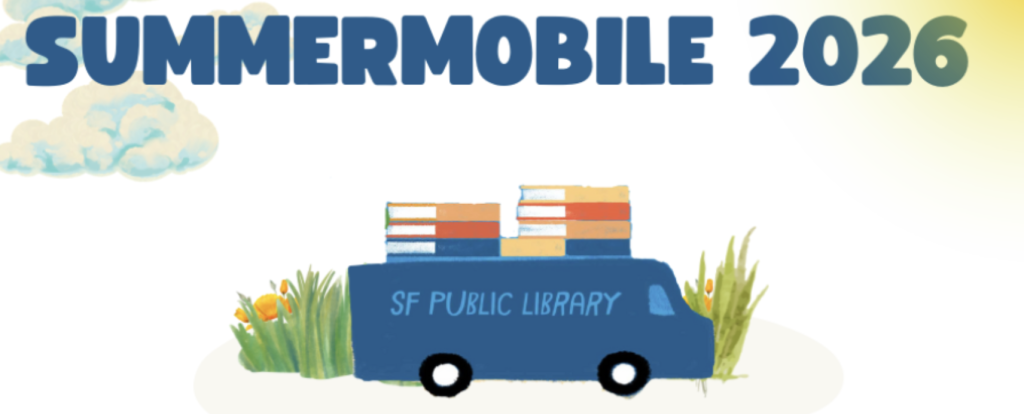
Lauersen’s blog post, The Necessary Nearness, An Ode to Bookmobiles, is a genuine plea asking people to read more for society’s sake. His concerns are valid: there has been a gradual but steady trend that indicates fewer Americans are reading for pleasure in spite of its benefits (Iyengar, 2024). Lauersen cites similar statistics in his native Denmark. A saving grace of the public library is the bookmobile, bringing accessibility to the community as well as a gathering place where there was just a vacant spot (Lauersen, 2025). I don’t know what it is, but people truly get excited when they spot a library bookmobile in the wild, and it’s not just kids. The Summer Stride reading program is in full swing at SFPL right now, and it’s always super popular and engaging (track twenty hours of reading and get an SFPL tote bag! And yes, I love this even though I have more tote bags than I can keep track of). I saw the bookmobile in the park while I was walking; it was a foggy and damp day, and yet there were so many people cheerfully hanging out with the library staff. And this brings me to Lauersen’s other point: it’s not just the bookmobile getting more people to read, but rather our connections to other people who are passionate about reading and discovering great books. Sure, the bookmobile might be there, and they might be handing out free books, too, but actually engaging with librarians and other community members makes a difference.
Lauersen’s assertion that a strong reading culture is a societal investment ties into West’s article on the digital divide and those individuals who intentionally opt out of online usage, including email. Although this piece was written over ten years ago, it’s still relevant in regards to a large aging population. As scary as it is to face change and uncertainty, shunning the basics of modern technology can be isolating and can make one’s world smaller. We live in a highly digital society, and I cannot envision a future during which we would go backwards. West posits an interesting perspective I had not previously considered: online literacy is a civic responsibility and an “interactive tool” even though many of us use it for passive entertainment (2014). Given how much of our immediate world exists online, being socially active (in any capacity) can be an empowering thing. To be fair, no one is suggesting giving up in-person interactions. There can be a balance; community can have many facets just as reading can open up new worlds, and curiosity and learning can still foster human connections. How one gets there might be via social media or other online forums, but collective experiences can be transformative when discovering people have more in common than they realized.
References
Iyengar, S. (2024, October 03). Federal data on reading for pleasure: All signs show a slump. National Endowment for the Arts Blog. Retrieved from https://www.arts.gov/stories/blog/2024/federal-data-reading-pleasure-all-signs-show-slump
Lauersen, C. (2025, February 05). The necessary nearness – An ode to bookmobiles. The Library Lab. Retrieved from https://christianlauersen.net/2025/02/05/the-necessary-nearness-and-ode-to-bookmobiles/
San Francisco Public Library. (2026) SummerMobile 2026 [Screenshot]. Retrieved from https://sfpl.org/locations/bookmobiles-mobile-outreach/summermobile-2026
Stephens, M. (2022, August 16). The Hyperlinked Library – Hyperlinked Communities. [Lecture]. Retrieved from https://sjsu-ischool.hosted.panopto.com/Panopto/Pages/Viewer.aspx?id=3eacdb23-84fd-49e5-9975-aef3014b3ed2
West, J. (2014). 21st century digital divide. Retrieved from https://www.librarian.net/talks/rlc14/
@yoli This: “We live in a highly digital society, and I cannot envision a future during which we would go backwards.” I agree with you. It will not happen. I also appreciate you pulling in West and her words immediately after this sentence. If anything, we should keep momentum going for making sure that everyone has access to the information rich resources available online. That said, we should also educate people as to how to be good digital citizens. It is amazing to me how divided things are right now.