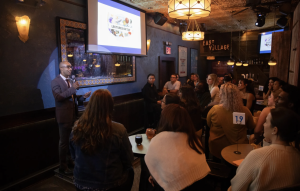
More often than not, library programs and services are aimed and highly geared towards children, adolescents, and senior citizens. Reaching the middle demographic – young adults in their late teens and twenties seems to be a mystery. The authors of Library 2.0 observe that “we created services for users when they were young kids, lost them as teens, got some of them back as parents bringing their own kids in, tried to involve them in services such as reading groups, lost many yet again as they worked hard in midlife to save for retirement, and finally brought them in one last time as senior citizens, with targeted reading materials and programs for that age group” (Casey & Savustinuk, 2007, p. 61). It’s matter-of-fact, yet accurate. I have to admit, this happened in my life as well. I graduated from college armed with my B.A. in English, and then…I was just aimless. I struggled to find my footing in various fields until I started focusing on a paralegal career (nope, this was a mistake), met my future husband, got married, started a family. Shortly after having a child is when I returned to the library, almost religiously. In hindsight, that period between college and marriage can best be described as a weird limbo, not so much an educational wasteland, per se, but more like an uncertainty of where one belongs anymore. I grew up in a family in which college was sort of like the holy grail, the end-all to schooling. Reading books voraciously was something that was always present in my life, but lifelong learning was a foreign concept, something that cost more money than I or my parents could afford.
I can understand how libraries can have some difficulties simultaneously drawing in and retaining all age demographics for their programs, particularly lifelong learning. While there are plenty of programs and services that encourage improving and investing in oneself, professionally and academically, these are for those patrons who are specifically seeking out this type of knowledge. Why not seek out knowledge for its own sake and find joy in this endeavor? Lectures on Tap and other similar gatherings (Profs and Pints, Big Brain, Nerd Nite) have been happening at local bars with much success. People still crave learning something new, and in a lecture-style format, no less! It seems like a fun event, but it made me think of this quote from the module: “We are born to learn, but somewhere along the way many of us pick up the idea that we must be taught in order to learn. We think that if someone doesn’t stand up in front of us and talk to us with either a chalkboard or PowerPoint slides, we cannot learn. We must regain our sense of wonder and our desire to learn” (Tennant, 2003, p.28). Perhaps this is a a nudge in the right direction, to seek out new knowledge within a community of peers. This is the type of event that involves fees and cover charges; I hope many libraries can adapt and make this their own while inspiring people to return as steady library patrons and involving local breweries and taprooms as community partners.
References
Casey, M.E. & Savastinuk, L.C. (2007). Chapter 5: Participatory service and the long tail. Library 2.0: A guide to participatory library service. Information Today, Inc.
Lectures on Tap (n.d.). About. [Screenshot]. Retrieved from https://lecturesontap.com/
Tennant, R. (2003, September 15). Strategies for keeping current. Library Journal, 128(15), 28.
Man, I can’t tell you how accurate of an article this is. I currently work at a public library and the hardest group of people to reach is the Young Adults. We have tried many different ways to reach this audience, but it seems almost impossible. I don’ t know if young adults are not reading anymore or they just are not interested in it as much as other things. My library creates programs geared towards children and teens but not young adults. We typically tend to put young adults on the back burner because it just seems as though we used so much of our time and resources and nothing ever works. I hope that someone has an idea that we could try or any advice! Great post! You have a really good writing style.
Hi Anthony, thank you for the kind words! I’m so glad my post resonated with you. I don’t work in a public library, but this was just an observational hunch I had just from looking around at my environments. I feel as if young adults are more interested in socializing, going out and being seen, do you know what I mean? It’s a hard thing to grasp and figure out how to apply library programs to this lifestyle. Hopefully something will stick!