
Reflection Blog: Hyperlinked Communities
In a fast-paced digital world focused on immediate services, sometimes we overlook how valuable connections to people can be. However, this week’s materials highlighted one of the library’s most important resources: the community. While libraries often focus on preserving and providing access to information resources, this week’s materials highlighted that one of the library’s most important resources is the community itself. As librarians, we also want to take care of our resources.
One topic I have been learning about outside of this course is the whole-person librarianship movement, which uses concepts from social work such as cultural humility and person-in-environment to help librarians connect to diverse patrons (Zettevall, n.d.). Rather than viewing people as just their behaviors, the whole-person perspective involves recognizing individuals as culminations of experiences within an environment (often within biased systems), personal connections to others, and various aspects of well-being. Many of these ideas have been echoed in this week’s readings. Particularly, during his presentation at the 2016 UX in Libraries conference, Lauersen (2018) mentioned Maslow’s hierarchy of needs in the context of inclusion. Humans have basic needs such as food, water, shelter, and safety. There is also a higher need to feel a sense of belonging that libraries try to meet, but it cannot be met until the basic necessities are taken care of.
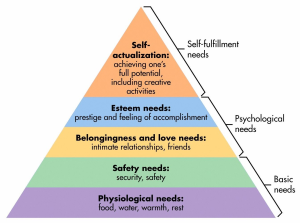
These concepts are not just theoretical. In my own library work, I have seen how addressing basic needs can support broader goals of inclusion and community engagement. The library branch I work at provides a limited number of daily snack packs and hygiene kits for adults upon request. This helps meet one of the basic physiological needs that, when unmet, serve as a barrier to realizing the higher-level needs libraries typically address. Anyone above the age of 18 can request a pack or kit at any time, whether they are unhoused, experiencing a medical issue, or are just hungry and do not feel like leaving the library to find food. We do have an additional partnership with a local food bank to run Kids Cafe, which is more regulated and operates within a specific time frame. We also provide water bottles during the summer in addition to a drinking fountain. As for rest, we no longer ask patrons to leave for sleeping. Rather, we leave them be as long as they’re breathing normally (though we may wake them up to ask them to move to a more comfortable spot if they are at a computer).
Making room in the library for these services has helped in so many ways. It has made it possible for individuals to stay longer at the library and engage in programming, or to simply keep returning to what they know is a safe place.
Note: I am not implying that libraries should take over the roles of shelters, food banks, and other social services, but that libraries can help bridge gaps between these services and the patrons who need them. Healthy boundaries between what the library provides and what other social services provide are important to ensure that libraries can still operate as libraries!
A library cannot be truly person-centered without an empathetic, whole-person approach. Communities are made up of people with rich and diverse lived experiences, but individuals cannot fully participate, create, or connect when their basic needs remain unmet. By helping bridge gaps between essential services and the people who need them, libraries can foster stronger, more engaged communities.
References
Lauersen, C. (2018, June 7). Do you want to dance? Inclusion and belonging in libraries and beyond. https://christianlauersen.net/2018/06/07/inclusion-and-belonging-in-libraries-and-beyond/
Zettervall, S. (n.d.). About. Whole Person Librarianship. Accessed June 28, 2026, from https://wholepersonlibrarianship.com/about-2/.




6 Comments
Raemetrice Harvey
Hello Ina,
I enjoyed reading your reflection on what the idea of a hyperlinked community looks like to you. I too, also share in your perspective and highlighting that true community involves being concerned about the whole-person. In this day and age, people come to the library for many things and for many reasons, aside from just checking out a book…as you said, the library doesn’t replace the specific orgs and social service sectors that exist to help the public, however, the library is also very much a social institution and can provide similar assistance, even if its in a minimal capacity. The library is designed not only to provide access to information, but to help the user and community feel seen and heard.
Thanks again for an insightful post! @inasamuel
Ina Samuel
Hi @raeharvey,
Thank you for your comment! People come to the library to become connected, whether that be to information resources, other individuals in the community, or just to the atmosphere of learning. It is so important to make sure everyone has a place in the library and, as you said, that they are seen and heard to meet the need for belonging.
Rachel Leverenz
Thank you for raising the point about needing boundaries between library services and support services offered by other organizations. I find myself struggling with this hand off as well. As a helper, I want to fix the problem that a patron comes to me with. However, I have come to see this hand off is crucial as the other organization or department is the expert and more helpful than I could have been. Like you said, we still need to function as a library. This is just another way of connecting patrons with resources. Thanks for sharing!
Ina Samuel
Hi @rachelll,
Thank you for your comment! Like you, I also see myself as a helper. I want to do all I can to support the people around me, including solving their problems. However, as I continue to work in a public library, I learn every single day that it is okay not to have the right answers right away. As libraries, we may not be able to solve the big social issues that our communities face. However, we can find little ways to offer relief and refuge.
Michael Stephens
@inasamuel This: “Note: I am not implying that libraries should take over the roles of shelters, food banks, and other social services, but that libraries can help bridge gaps between these services and the patrons who need them. Healthy boundaries between what the library provides and what other social services provide are important to ensure that libraries can still operate as libraries!”
I so appreciate the focus of this post and especially the quote that I pulled. This is exactly what I have been focused on so much in the last handful of years. It really is about balance: we can offer things like the community closet, and access in the library to food and referrals to organizations that can assist folks that need it. Your points in the first paragraph are very strong, especially regarding aspects of social work and cultural humility. It feels like there should be a class or two in LIS programs that focus on these ideas sort of like a mini social work aspect to the library degree.
Liz Grewal
Hello Rachel, I enjoyed reading your post, a lot of it resonnated with me and howMu libraries can support people through Maslow’s Hiearchy of Need. I am former teacher and my educational background is largely in science education. Working with teens and now working with kids and adults in a library setting, the adults I see regularly are really just trying to get their basic needs met and have sought out the library for support in that. I think the library has a role to play in supporting our community members from basic needs to self acutualization. Like you said, the library is not the only one with a role to play in our community in helping our community members not only exisit but hopfully thrive. Thank you!