
Module 11 Reflection: Infinite Learning-Learning Everywhere
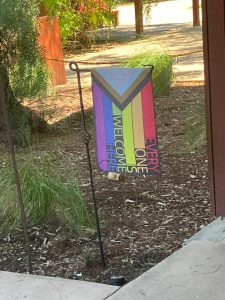
Personal Picture I took of the sign in the outdoor walkway of the Rancho Los Alamitos Welcome Center entrance
About a month ago, I visited a historical site in the Long Beach/Los Alamitos, Ca area called Rancho Los Alamitos, which is situated on Tongva-Gabrielino land known as Povuun’gna. The site originally belonged to the Bixby family, which consisted of their home and farm, and was later gifted to the City of Long Beach for the public to enjoy. This historical site has a welcome center, botanical garden, the original Bixby house, a black smith stable, and an area for the resident animals (chickens, goats and horses). During your visit, you are able to request a tour guide who walks you through these areas while providing historical background information and interesting facts about the site (you are allowed to self-tour the site as well); I opted for the guided tour. What makes this an even better outing is that Rancho Los Alamitos is a free offering. Upon my visit, I was immediately taken in by the scenic environment, the peaceful atmosphere, as well as the sign posted in the walkway leading into the welcome center (see picture above). Once in the welcome center, this sign came to life as the staff truly were welcoming and friendly; and eager for me to enjoy my visit since this was my 1st time there. Just within these initial minutes of being there, I was immersed into the experience; I learned alot of new things about the area and enjoyed my visit from beginning to end.
I decided to start my discussion by sharing this experience because it was the first thing I thought about while exploring this Infinite Learning module, and even moreso with selecting the Learning Everywhere sub-module as my CYOA. The idea of learning and obtaining information beyond library walls is a notion that can elicit and create endless possibilities for gaining knowledge and an awareness of new and innovative technology and trends. Since I was visiting a historical site, there was a blend of both older and newer concepts, but the most involved was the use of participatory service. This was evident throughout the guided tours, being able to ask questions, and interacting with the different areas to explore. As far as learning, I can see a user coming here to gather information for school, research, or personal reasons; which could pertain to the history of the area, past farming and agricultural practices, farm living, Indigenous history, botanical gardens, archival purposes, etc. Whatever reason it might be, visiting this historical site offers a unique experience of learning and being able to physically view information outside the pages of a book. To tie-in the library, local branches could suggest this place for users to visit if they’re interested in learning more about the topics I previously mentioned, or of similar focus. It might be that they already do this, but if not, this would be a great opportunity for librarians to extend their skills by knowing of other learning centers to recommend to users should the need arise. As Dr. Stephens implores in his Y Library? paper, “Librarians should seek every opportunity to be teachers in their communities. Library users should look to the library for opportunities to experience new things, new ideas, and new technologies” (2014). This sentiment holds several meanings, one being that librarians can offer their expertise by informing users of other learning spaces to explore that they may be unaware of, aside from the library space.
This module (and the previous ones) aptly implies that learning is and can be all encompassing-meaning that it effects all the senses: you can see it and hear it through audiovisual means, you can taste it and smell it through kitchen libraries, you can touch it through the makerspaces, and you can feel (honorary 6th sense) it through the power of stories. This and more are what drives the hyperlinked library…it is linked by people, technology and trends, that serve as gateways to information, connection and infinite learning for all who wish to participate. This module demonstrated to me how any space can be designed to showcase the act of learning, in all its forms, if done with directed intention and with the user in mind.
To conclude my post, I would like to share Rancho Los Alamitos mission, vision, and values as provided on the About Us page of their website. I highlighted the vision section and marked the values I felt was most relevant to this post. I believe this is a great example of what all informational institutions should strive for, reflect, and constantly practice.
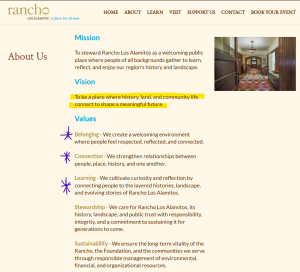
Source: Rancho Los Alamitos About Us
References:
Stephens, M. (2014). YLibrary? Making the case for the library as space for infinite learning. Drop Box. [PDF]. https://www.dropbox.com/scl/fi/4zt1yliwb2ffzr8euix2p/YLibraryInfiniteLearning.pdf?rlkey=m0v6lkd43ufilkp5aktawhlpr&e=1&dl=0
Rancho Los Alamitos. (n.d.). About Us. https://www.rancholosalamitos.org/about-us.html
Rancho Los Alamitos. (n.d.). Home Page. https://www.rancholosalamitos.org/
Hi Raematrice,
I was not logged in when I posted my earlier comment. I will repost the same comment so it can show up in my activity feed for participation. I hope that is ok. Thank you again.
I enjoyed reading your blog post, especially your focus on how a special location can be a place of learning encompassing all senses when done with intention. I also love that you tied it to the power of stories, especially with Rancho Los Alamitos being on Tongva- Gabrielino land before colonization. There is a lot to be said about learning in a location with all your senses that can inspire patrons in pursuit of lifelong learning via different places and ways. I think humans are built to learn this way – through all their senses in an immersive environment of knowledge. It reminds me of the Disneyland ride Rise of the Resistance – so realistic you feel you are on a real Star Destroyer hangar with real stormtroopers escaping capture with the help of rebel spies. When something is so tangible and real, it helps you learn as it engages all of your senses through the power of stories. Thank you for such a thoughtful post.
Hi @chicanasteamlibrarian
No worries! Thank you for your comment and glad you enjoyed my post. And I agree, learning is an overall sensory experience in many forms. That’s what makes the library and other institutions of learning so important and necessary, because they create unforgettable memories in some way or another. You will remember something from the experience, something you saw, heard, felt, touched or even tasted and smelled. That’s the joy of learning, you never know what you’re gonna get! (excuse the Forrest Gump line lol)…and thank you for sharing your Disneyland ride Rise of the Resistance connection-I love that!