Stories are not just about escapism; more often than not, they’re a means of connection. When we share and when we listen, we open ourselves up to those around us. Looking at human libraries and the rare, vulnerable conversations that they stimulate in the Power of Stories module drew my attention to how necessary these types of connections are: the ones that get us out of comfort zones and break down barriers. What better space to facilitate these moments than the library? As Erin Wentz (2013) described with regard to human libraries, “the library’s mission of providing a neutral, safe space for learning provides an open environment which invites readers to ask probing questions.” In a setting where people are comfortable, such as the library, they are more likely to feel inclined to experiment, whether that means learning a new skill or putting themselves in an unfamiliar social situation. In this way, libraries inhabit a unique intermediary position of witnessing, supporting, and preserving the stories of their community members. As we’ve seen through the strong partnerships forged between public libraries and StoryCorps, there is deep value in serving as a repository for local stories (Eberhart, 2018).
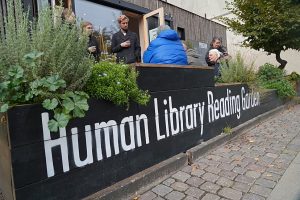
In the Human Library Organization’s video showcasing the Human Library Reading Garden in Copenhagen, what seemed to resonate with participants most was the ability to talk directly with people whose lives look very different from their own (Human Library Organization, 2023). Although the focus of this human library lies in understanding and sharing perspectives from those in stigmatized groups, I couldn’t help but also notice the variety of ages represented in the “books” and “readers” alike. It reminded me of a video linked a few modules back from Anythink Libraries where they hosted “Get to know your neighbor” sessions that paired strangers within the community together for spontaneous conversations (Anythink Libraries, 2016). What struck me in that video as well was the smooth communication between elders, adults, teens, and children. Generational divisions have in some ways been exacerbated by the exponential growth of technology, which can make intergenerational conversations daunting. When it comes down to it, though, we’re all people. Old or young, we have a favorite childhood toy, have watched one specific movie way too many times, or enjoy the feeling of the sun on our faces. Sometimes all it takes is a prompt to close the distance.
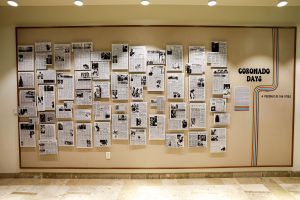
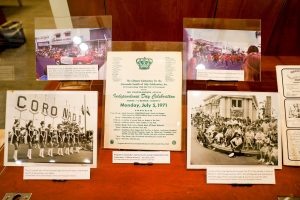
Recently, the library where I work held a special exhibition in the main hallway called “Coronado Days: A Portrait of the 1970s.” In celebration of the US bicentennial, this exhibit sought to paint a picture of what Coronado looked like in the 1970s through historic local ephemera, newspaper clippings, photos, and more (Clifford, 2026). My favorite part? The intergenerational video interview. On a television between the exhibit cases, patrons could watch a series of conversations between current students at Coronado High School (CHS) and adults who graduated from CHS in the 1970s. They talked animatedly about their high school experiences, their treasured Coronado traditions, and the best spots to hang out around town. During my shifts at the nearby reference desk, I watched this video reach people. They would stop in their tracks and watch all of the interviews to their conclusion. I was seeing the words of @michael play out directly before my eyes: “The dialogue that stories can create benefits all who participate” (Stephens, 2019, p. 93).
References:
Anythink Libraries. (2016, December 21). Get to know your neighbor [Video]. YouTube. https://www.youtube.com/watch?v=rzLI-aqFzDQ
Clifford, B. (2026, September 14). Exploring Coronado in the 1970s … at the Coronado Library’s featured exhibit. Coronado Eagle & Journal. https://www.coronadonewsca.com/news/coronado_city_news/exploring-coronado-in-the-1970s-at-the-coronado-library-s-featured-exhibit/article_86411c88-34f1-4ef2-98e8-e5c16c36b0c0.html
Eberhart, G.M. (2018, February 10). Sharing people’s stories: StoryCorps partners with public libraries. American Libraries. https://americanlibrariesmagazine.org/blogs/the-scoop/sharing-peoples-stories/
Human Library Organization. (2023, April 25). The human library reading garden in Copenhagen [Video]. YouTube. https://www.youtube.com/watch?v=rxukgiVqb5A&t=84s
Stephens, M. (2019). Whole-hearted librarianship: Finding hope, inspiration, and balance. American Library Association.
Wentz, E. (2013, April 26). The human library: Sharing the community with itself. Public Libraries Online. https://publiclibrariesonline.org/2013/04/human_librar/