When I wrote about circulation as part of the hyperlinked environment a few weeks ago, I ended on something that had been nagging at me ever since I read the ALA’s interpretation on economic barriers. Proof of address is a policy I uphold at my own library, and somehow I had never thought of it as a question of access. I even brought up my concerns with this policy to my branch manager recently, and we decided to look into how other libraries have adjusted their proof of address policies in recent years. Then this module introduced me to a library that already implemented some of the changes we’re considering.

On December 1, 2018, Berkeley Public Library started issuing Easy Access Cards at every one of its branches. Berkeley applicants must still show a photo ID, but they no longer have to provide proof of address to gain access to library resources . The card comes with three checkouts at a time, three holds that may be picked up at whichever Berkeley branch is most convenient, access to library computers, and a laptop to use while inside the building (Peet, 2018; Rees, 2018).
The story about one of their patrons, a woman named Peterson who is unhoused, really stuck with me. Before implementation of the Easy Access Cards, she had to walk back up to Berkeley’s reference desk every hour to get a new computer access code, because she had no home address she could list on Berkeley’s library card application (Rees, 2018). Nobody turned her away. She got her hour, every hour. She just had to ask for it again and again, in front of whoever else was in line, in a building that so many others could walk into and use freely without explaining themselves.
This relates to the continuum Stephens (2019) describes, where serving our most vulnerable patrons and offering technology are not competing priorities; they’re points along the same path of serving everyone in our community well. Berkeley’s Easy Access Card improves services to its vulnerable patrons and increases their access to technology like laptops.

Berkeley did, however, leave one barrier standing in the library card registration process. Photo ID is still required there. Their acting Director of Library Services deemed that requirement to be non-negotiable, though their circulation manager has been given the authority to use some discretion. In response, the director of a nearby Berkeley shelter pointed out that many people without a fixed address can’t get an ID, or they’re unwilling to hand one over because of privacy concerns. As of December 3, 2018, 579 Easy Access Cards were active in Berkeley, a city of roughly 120,000, including at least a thousand homeless residents (Peet, 2018). That means that proof of ID is a barrier to access for a large group of people – one that may benefit most from the library’s services.
I’d also like to circle back briefly to a barrier we discussed previously – overdue fines and fees. When Berkeley went fine-free in 2018, their analysis showed that “the zip codes where wealthy people tend to live showed very few blocked patrons, whereas the communities that are lower income showed much higher rates of patrons being suspended because their fines were over ten dollars” (Peet, 2018). This supports the ALA’s assertion that fines, particularly overdue fines, are an economic barrier (American Library Association, 2025). These fees unfairly and disproportionately affect vulnerable groups, and I’m glad that my local library system went fine-free a few years ago.
After reflecting on INFO 287’s modules thus far, I’m determined to find a way to dismantle the barrier upheld by the address verification requirement at my own library. As Assistant Branch Manager, I may not be able to rewrite our card policy alone, but I can pull our own data, bring it to the rest of the management team, and make sure the staff I train know what discretion they already have to serve all of our patrons equitably. No one should have to ask us again and again for what the rest of us receive from one request.
References
American Library Association. (2025). Economic barriers to library access: An interpretation of the Library Bill of Rights. https://www.ala.org/advocacy/intfreedom/librarybill/interpretations/economicbarriers
Peet, L. (2018). Berkeley PL launches cards for patrons without fixed address. Library Journal. https://libraryjournal.com/story/Berkeley-PL-Launches-Cards-for-Patrons-Without-Fixed-Address
Rees, M. (2018). No permanent address? No problem. Berkeley library makes it easier for those without homes to get library cards. Berkeleyside. https://www.berkeleyside.org/2018/12/03/no-permanent-address-no-problem-berkeley-library-makes-it-easier-for-those-without-homes-to-get-library-cards
Stephens, M. (2019). Wholehearted librarianship: Finding hope, inspiration, and balance. ALA Editions.
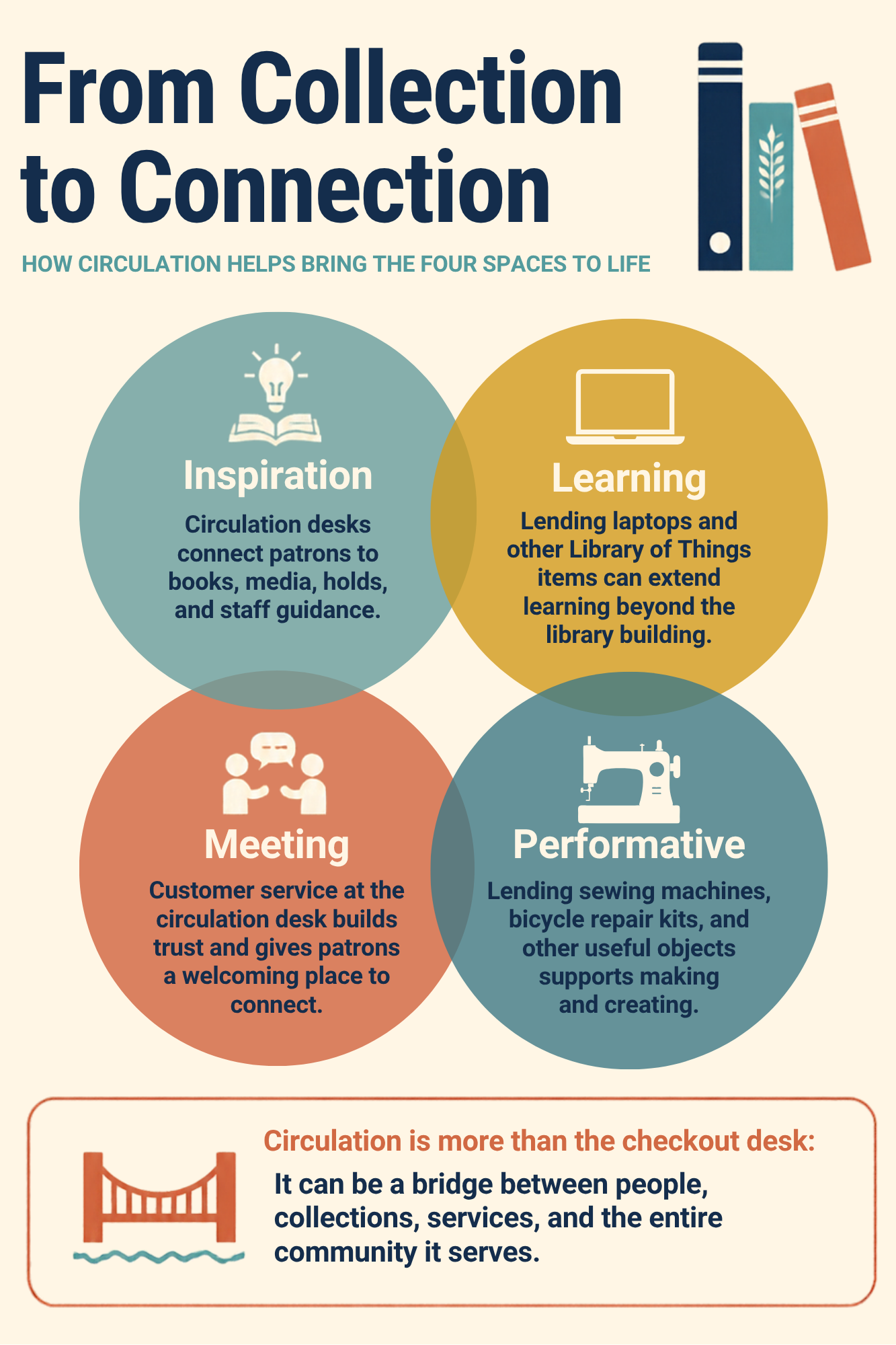
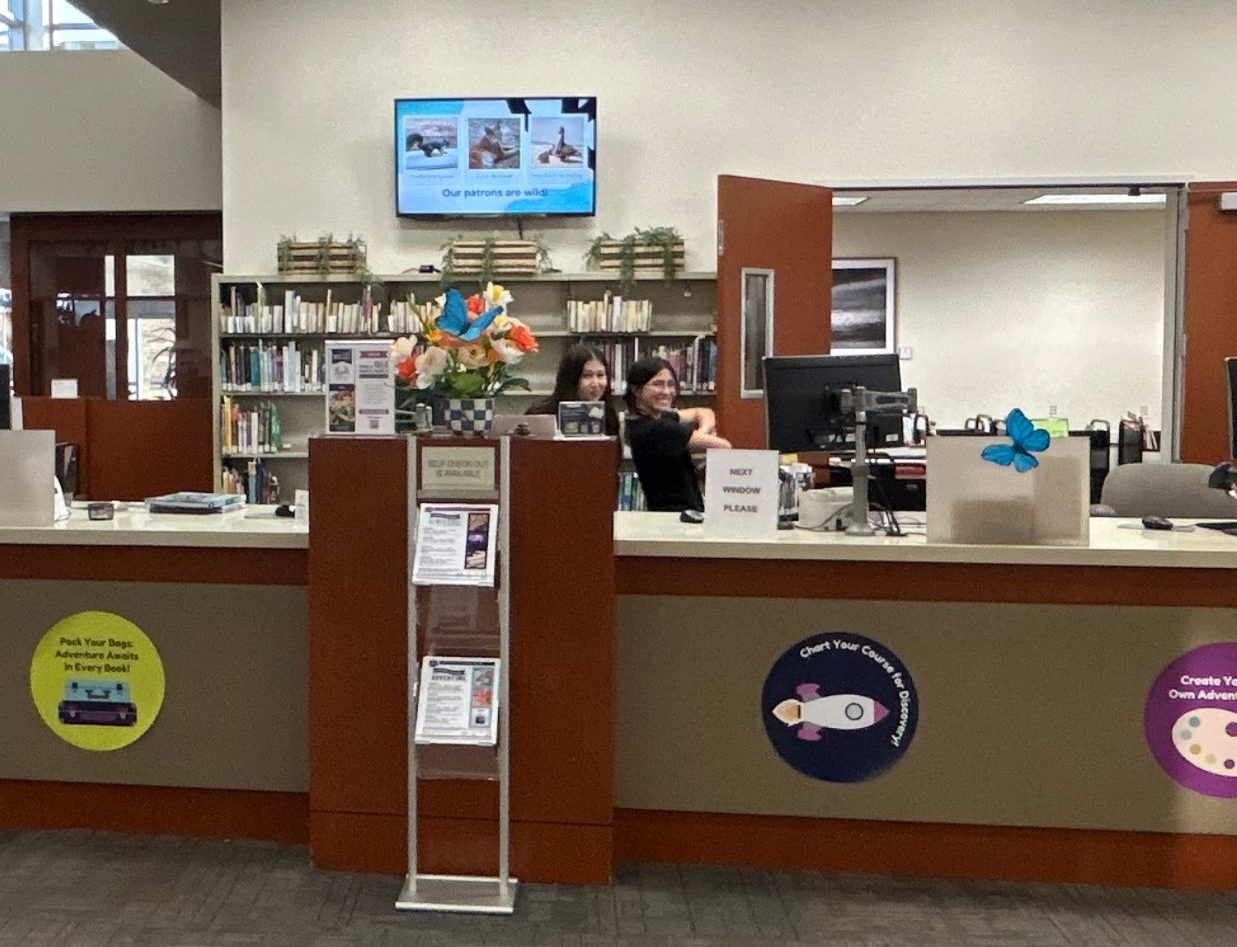
 As someone who supervises circulation in my local public library, I was particularly interested in the role circulation departments play within the Four Spaces. Skot-Hansen (2017) does not mention circulation directly, but her descriptions of the inspiration, learning, and meeting spaces all overlap in some way with the services provided at circulation desks. Thinking of circulation desks as “meeting spaces” may seem like a bit of a reach, but customer service and making connections with our patrons is very important to us at Temecula Public Library, and there are numerous patrons who visit our circulation desk not just to pick up holds but to chat with our staff. All areas of the library help to build trust with our patrons so that they feel comfortable to connect with each other and to create alongside others.