Reflection on Module 8 – New Models: Addressing Barriers to Access through Policy

When I wrote about circulation as part of the hyperlinked environment a few weeks ago, I ended on something that had been nagging at me ever since I read the ALA’s interpretation on economic barriers. Proof of address is a policy I uphold at my own library, and somehow I had never thought of it as a question of access. I even brought up my concerns with this policy to my branch manager recently, and we decided to look into how other libraries have adjusted their proof of address policies in recent years. Then this module introduced me to a library that already implemented some of the changes we’re considering.

Two hands exchanging a small white business card in a high-rise office

On December 1, 2018, Berkeley Public Library started issuing Easy Access Cards at every one of its branches. Berkeley applicants must still show a photo ID, but they no longer have to provide proof of address to gain access to library resources . The card comes with three checkouts at a time, three holds that may be picked up at whichever Berkeley branch is most convenient, access to library computers, and a laptop to use while inside the building (Peet, 2018; Rees, 2018).

The story about one of their patrons, a woman named Peterson who is unhoused, really stuck with me. Before implementation of the Easy Access Cards, she had to walk back up to Berkeley’s reference desk every hour to get a new computer access code, because she had no home address she could list on Berkeley’s library card application (Rees, 2018). Nobody turned her away. She got her hour, every hour. She just had to ask for it again and again, in front of whoever else was in line, in a building that so many others could walk into and use freely without explaining themselves.

This relates to the continuum Stephens (2019) describes, where serving our most vulnerable patrons and offering technology are not competing priorities; they’re points along the same path of serving everyone in our community well. Berkeley’s Easy Access Card improves services to its vulnerable patrons and increases their access to technology like laptops.

group stacking hands in colorful sweaters

Berkeley did, however, leave one barrier standing in the library card registration process. Photo ID is still required there. Their acting Director of Library Services deemed that requirement to be non-negotiable, though their circulation manager has been given the authority to use some discretion. In response, the director of a nearby Berkeley shelter pointed out that many people without a fixed address can’t get an ID, or they’re unwilling to hand one over because of privacy concerns. As of December 3, 2018, 579 Easy Access Cards were active in Berkeley, a city of roughly 120,000, including at least a thousand homeless residents (Peet, 2018). That means that proof of ID is a barrier to access for a large group of people – one that may benefit most from the library’s services.

I’d also like to circle back briefly to a barrier we discussed previously – overdue fines and fees. When Berkeley went fine-free in 2018, their analysis showed that “the zip codes where wealthy people tend to live showed very few blocked patrons, whereas the communities that are lower income showed much higher rates of patrons being suspended because their fines were over ten dollars” (Peet, 2018). This supports the ALA’s assertion that fines, particularly overdue fines, are an economic barrier (American Library Association, 2025). These fees unfairly and disproportionately affect vulnerable groups, and I’m glad that my local library system went fine-free a few years ago.

After reflecting on INFO 287’s modules thus far, I’m determined to find a way to dismantle the barrier upheld by the address verification requirement at my own library. As Assistant Branch Manager, I may not be able to rewrite our card policy alone, but I can pull our own data, bring it to the rest of the management team, and make sure the staff I train know what discretion they already have to serve all of our patrons equitably. No one should have to ask us again and again for what the rest of us receive from one request.

References

American Library Association. (2025). Economic barriers to library access: An interpretation of the Library Bill of Rights. https://www.ala.org/advocacy/intfreedom/librarybill/interpretations/economicbarriers

Peet, L. (2018). Berkeley PL launches cards for patrons without fixed address. Library Journal. https://libraryjournal.com/story/Berkeley-PL-Launches-Cards-for-Patrons-Without-Fixed-Address

Rees, M. (2018). No permanent address? No problem. Berkeley library makes it easier for those without homes to get library cards. Berkeleyside. https://www.berkeleyside.org/2018/12/03/no-permanent-address-no-problem-berkeley-library-makes-it-easier-for-those-without-homes-to-get-library-cards

Stephens, M. (2019). Wholehearted librarianship: Finding hope, inspiration, and balance. ALA Editions.

Hyperlinked Environments: From Collection to Connection – Starting at the Circulation Desk

The title of the Copenhagen case study on the Four Spaces model – “Library Development: From Collection to Connection” (Skot-Hansen, 2017) – piqued my curiosity immediately. The model maps four overlapping spaces – inspiration, learning, meeting, and performative – that together move a library from a passive collection of books and media into an active place where people connect and create.

As someone who supervises circulation in my local public library, I was particularly interested in the role circulation departments play within the Four Spaces. Skot-Hansen (2017) does not mention circulation directly, but her descriptions of the inspiration, learning, and meeting spaces all overlap in some way with the services provided at circulation desks. Thinking of circulation desks as “meeting spaces” may seem like a bit of a reach, but customer service and making connections with our patrons is very important to us at Temecula Public Library, and there are numerous patrons who visit our circulation desk not just to pick up holds but to chat with our staff. All areas of the library help to build trust with our patrons so that they feel comfortable to connect with each other and to create alongside others.
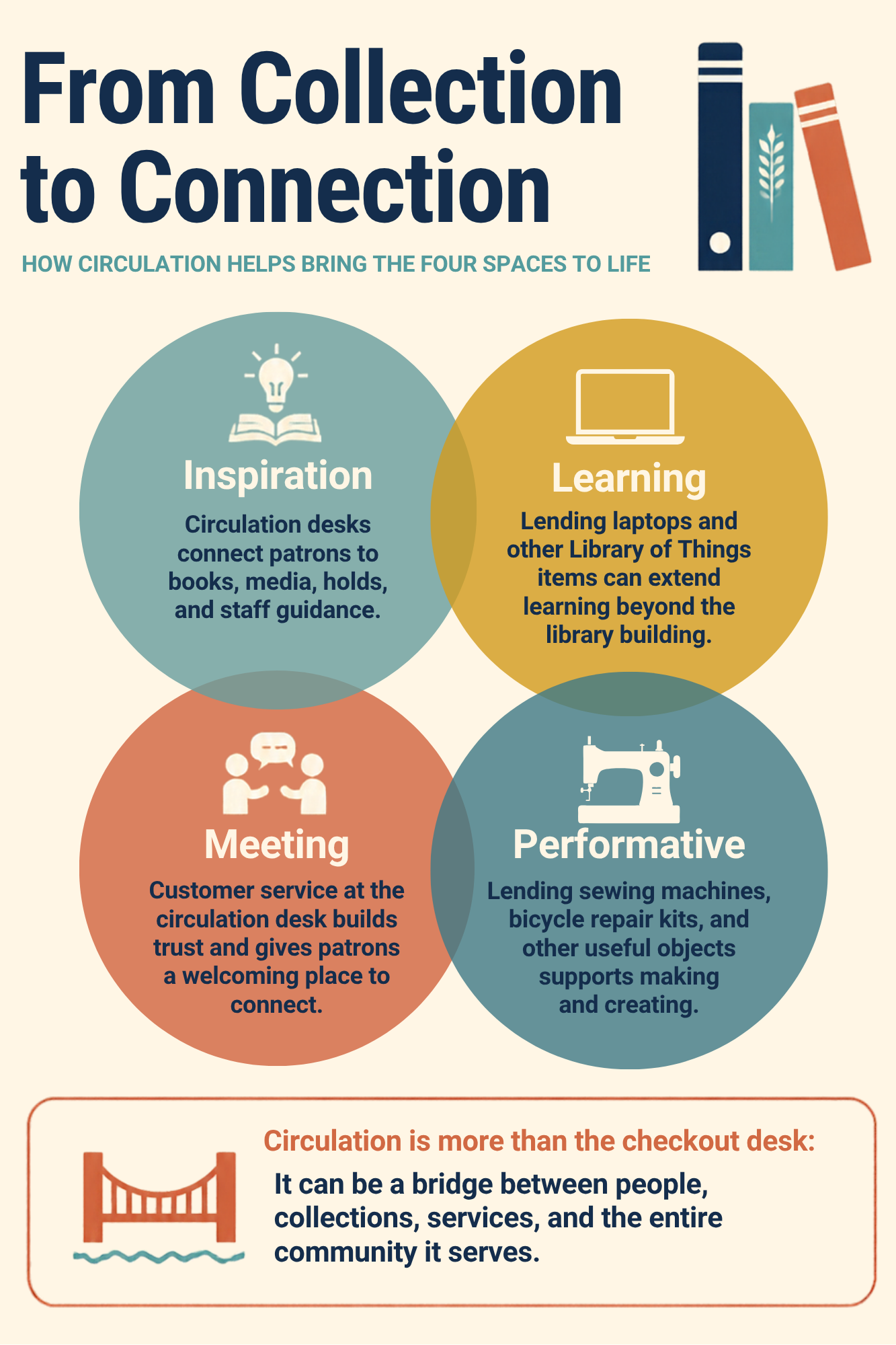
The Memphis Public Libraries have moved further into the Four Spaces than most other libraries, and much of this is done through circulation. They have abolished late fees, and now offer a Library of Things that includes items such as sewing machines, bicycle repair kits, and even laptops. In 2017, they also redesigned their library card to look more like a membership card, as part of the ‘Start Here’ campaign (Grant, 2021). These are ways that circulation can bring the performative space into the library (by lending out sewing machines), take the learning space out of the library (by lending out laptops), and make the library’s meeting space more welcoming to the community (by issuing a card that indicates ‘membership’ rather than ‘permission’).

The topic of removing fines can be a contentious one, and since fines can be one of the biggest barriers of access to library services, I decided to assess the validity of the arguments against removing this barrier. The two main arguments against it are related to  revenue and accountability. The revenue argument is that fines are a line item on many libraries’ operating budgets and are therefore necessary to fund the library. The accountability argument is that without a penalty for overdue items, people will not return what they borrow. Based on my personal experience working in a public library, these are valid concerns. To combat these issues, many fine-free libraries have switched to replacement billing, which means that a patron cannot check out items until they have returned their overdue items or brought in replacement copies. That is the model that my library uses, and it has been very effective at motivating patrons to return anything they check out.

The ALA’s Council asserted in 2019 and 2025 that fines are a barrier to library use, and it encouraged libraries to review such policies (American Library Association, 2025). Other barriers mentioned included policies on personal belongings, hygiene, and home address verification. All of these are policies that are enforced throughout the entire library, including the circulation desk. However, I had never considered the issue of verifying a patron’s address to be a barrier to access until I witnessed the difficulties it created for unhoused patrons looking to get a library card.

Stephens (2011) states that in a hyperlinked library, outdated rules and policies are stripped away to remove barriers to the library’s services and collections. My original reading of Stephens was that he was advocating for an attitude or mindset shift among library professionals, but I now see that he is also talking about the need for changes in policy.

The question I am now asking about my branch is simple: which of our circulation policies are good for our community, and which still exist simply because we have not reconsidered their effectiveness in the decades since the library was originally built?


References

American Library Association. (2025). Economic barriers to library access: An interpretation of the Library Bill of Rights. https://www.ala.org/advocacy/intfreedom/librarybill/interpretations/economicbarriers

Grant, R. (2021, November). How Memphis created the nation’s most innovative public library. Smithsonian Magazine. https://www.smithsonianmag.com/innovation/memphis-created-nations-innovative-public-library-180978844/

Skot-Hansen, D. (2017). Library development: From collection to connection. Impact of humanities research: 24 case studies. University of Copenhagen.

Stephens, M. (2011, February 21). The hyperlinked library: A TTW white paper. Tame the Web. https://tametheweb.com/2011/02/21/hyperlinkedlibrary2011

Reflection on Hyperlinked Communities – Module 5 – Bridging the Gap between 90% and 29%

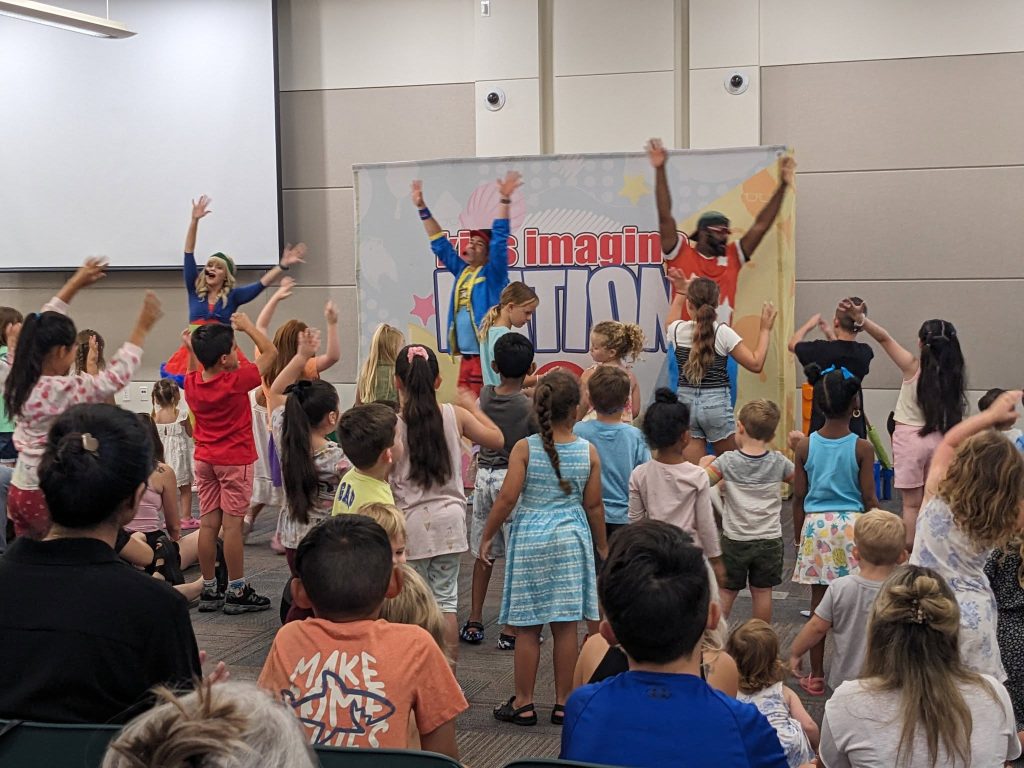
a group of performers in front of a crowd of families at the library
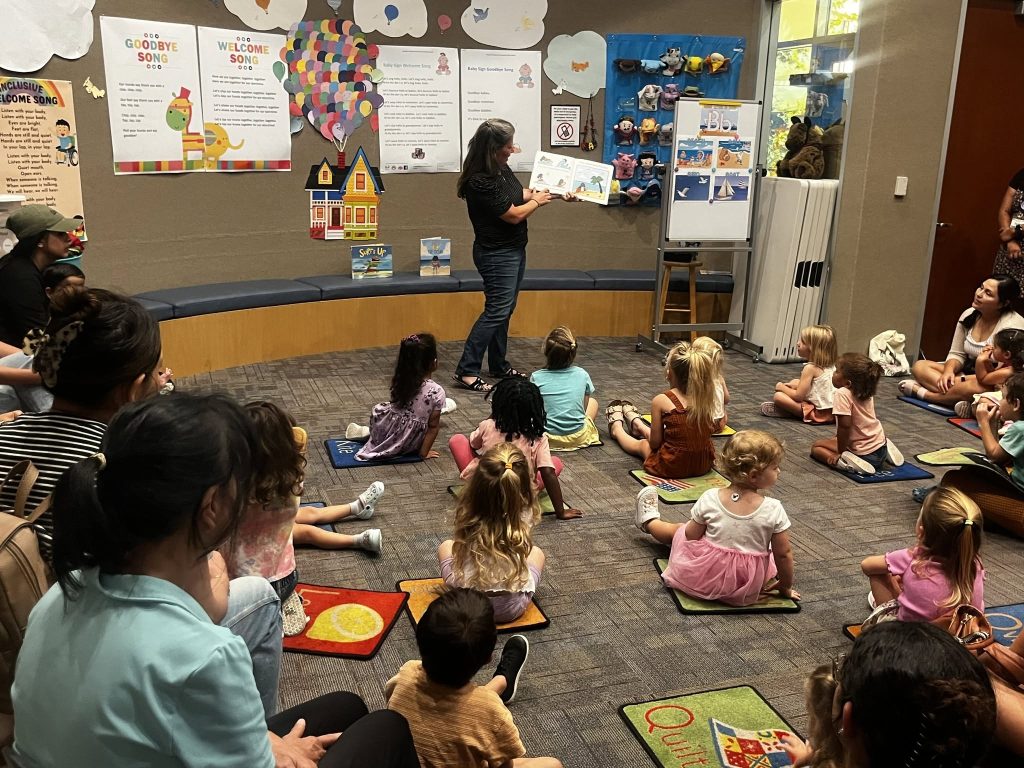
Turnout for our library programs is high, but what could we achieve by taking our programs outside our building?

While exploring the readings for Module 5, I encounterd a statistic in Stephens (2016) that surprised me greatly: According to a study conducted by the Pew Internet & American Life Project, 90% of Americans ages 16 and older said closing their local public library would affect their community. However, only 29% said that their own household would be impacted by such a closure. That made me wonder: if 90% of American adults believe libraries are so important, why are we only reaching a third of them? How can we have more of a positive impact on our communities?

Stephens (2016) asks a version of this himself when he wonders whether we are giving people a reason to depend upon us. His advice is to find the people who are not using the library and ask them what they need. He also emphasizes paying attention to what people are not saying, because that can indicate they do not believe we can give them the assistance they need.

As an Assistant Branch Manager at a public library in Temecula, California, I supervise circulation, our highest-volume point of contact with the public. We issue a card to almost anyone who requests one. But after reading Lauersen (2018), I reflected on his distinction between being invited to a party and being asked to dance at the party. Applying that analogy to the library, the library card is the invitation. The dance is what happens afterward, when we have an opportunity to connect with the patron one-on-one. Exclusion, Lauersen notes, is seldom intentional; it happens when inclusion is not built into our systems and habits – when we do not capitalize on these opportunities to connect with our community.

the mayor of a southern California city stands at the front of a room, reading a storybook to a group of kids at the library
Taking storytimes on the road more often could be a simple first step to increasing our outreach efforts.

So how do we close the gap between 90% and 29%? As suggested in Stephens (2016), library staff cannot keep waiting for people to come to us. We must reach them where they are, just as Stephens’ home library did through the launch of Books & Brewskis, a discussion group held in a local microbrewery. We must be willing to leave our building to connect with those who do not yet know how many valuable resources and connection opportunities await them at their local library.

My challenge to myself and my co-workers for the upcoming year will be to pick a place where our community already gathers and show up there with some regularity. It could be the farmers’ market, recreation center, or even the senior center. A folding table, a stack of library card applications, and one staff member to issue cards on the spot would put us in front of people who may never walk through our doors otherwise. I would also like to inquire about scheduling our county’s book mobiles to visit our community. Williams and Muller (2021) describe how book mobiles can be used to extend service past library walls, and no additional funds would be required to offer that service to our community if we can leverage our current partnerships.

If we want to reach more than 29% of American households, we cannot just extend an invitation to meet at the library. We must ask our communities to dance with us.

References

Lauersen, C. (2025, February 5). The necessary nearness—An ode to bookmobiles. The Library Lab. https://christianlauersen.net/2025/02/05/the-necessary-nearness-and-ode-to-bookmobiles/

Stephens, M. (2016). The heart of librarianship: Attentive, positive, and purposeful change. ALA Editions.

Williams, A., & Muller, C. (2021, March 17). Libraries are bridging the digital divide. Internet Society. https://www.internetsociety.org/blog/2021/03/libraries-are-bridging-the-digital-divide/internetsociety

Assignment X: Transactional vs. Partnership Models at the Circ Desk

The most common interaction in my library is a transaction. We scan the patron’s library card, check out their chosen books, read the due date, say thank you, and call the next person forward. It happens thousands of times a week at my branch, and as the person who supervises circulation, I am the one responsible for making sure it happens smoothly and in the warmest, most welcoming fashion.

That is why the idea of transactional vs. partnership models in libraries really stuck with me. Mathews et al. (2018) explains that, historically, the operational model for libraries has been transactional: staff provide access to resources and tools, and typically offer more extensive help when asked. But Matthews et al. (2018) argue that libraries are moving past this model toward what they call “partnership models,” in which library workers act as collaborators and consultants rather than suppliers. While reading their article “Empowerment, Experimentation, Engagement: Embracing Partnership Models in Libraries,” I realized how valuable implementing more aspects of a partnership model could be for my branch.

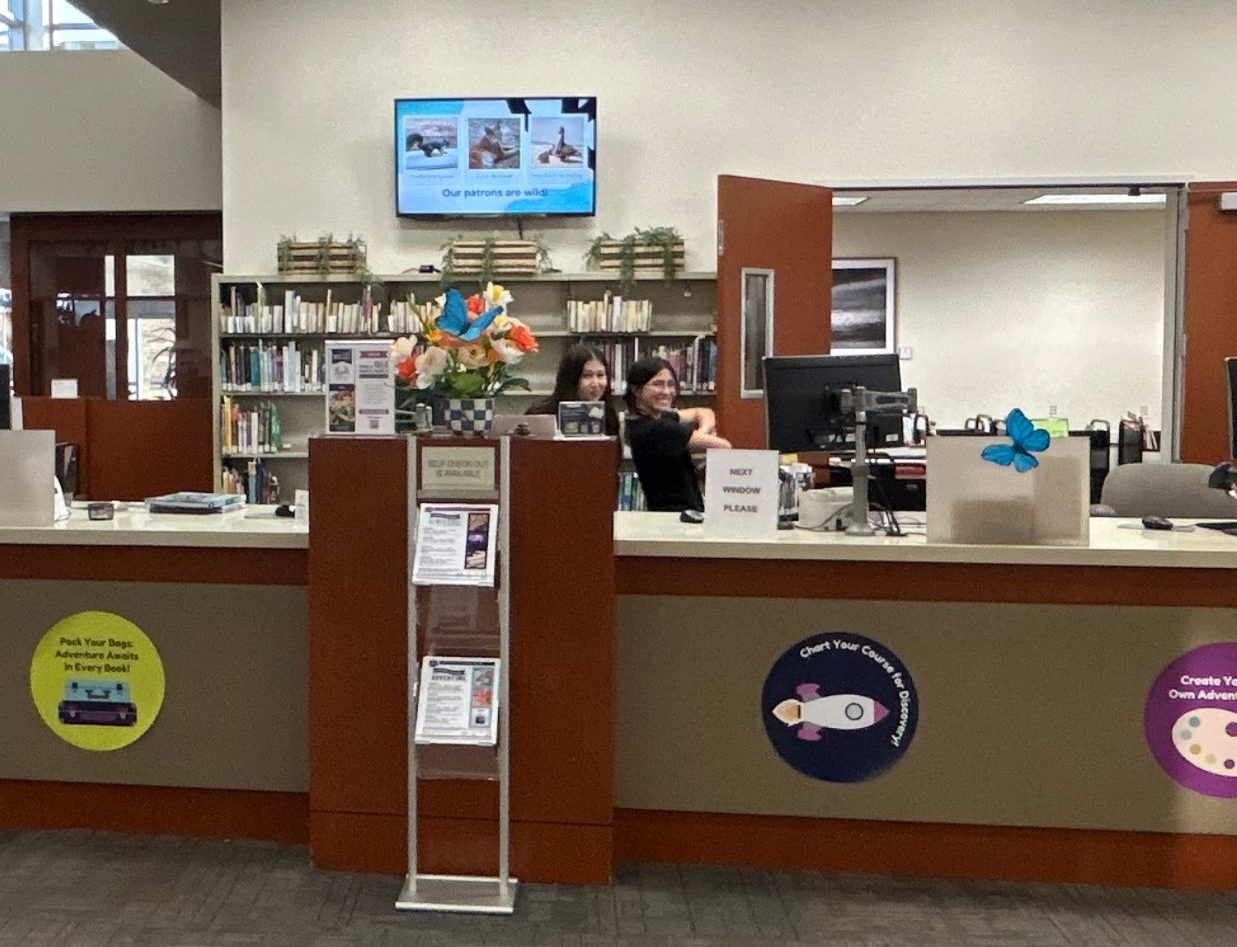
Circ staff at the Temecula Public Library. Blurry photo courtesy of yours truly!

At Creekview High School’s media center – dubbed “The Unquiet Library” – library media specialists Buffy Hamilton and Roxanne Johnson collaboratively planned 100 lessons with the school’s teachers in a single year (Mathews, 2010). This helped to position them as additional members of the teaching team rather than a simple service stop for the school’s students. Hamilton and Johnson taught 1,533 class sessions with a small but efficient three-person staff. This was just one example of how a partnership between library staff and teaching faculty can result in more effective library programming for patrons.

Libraries like Creekview High School’s Unquiet Library demonstrate the “hyperlinked library” philosophy described by Stephens (2011) as “an open, participatory institution that welcomes user input and creativity” – one where library collections and programming grow through user input and active engagement.


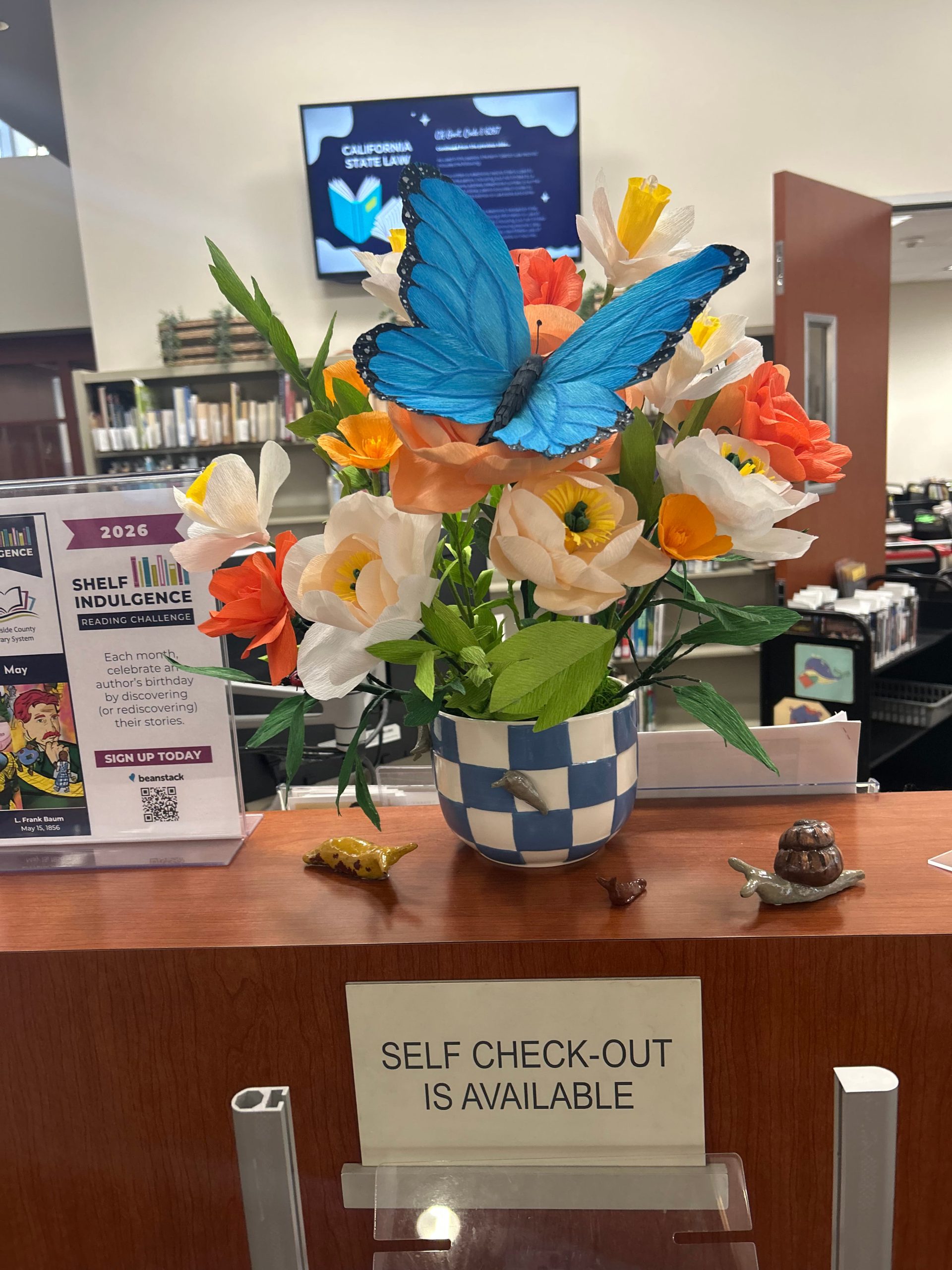
Handmade crepe paper flowers and butterflies, clay insects made by circ staff to brighten up the front desk for patrons during Summer Reading Adventure 2026.

A lot of the discourse around the benefits of the partnership model focuses on library programming. But can partnership also be implemented at the circulation desk? Co-working on lesson plans with teachers is a natural partnership. Handing someone a library book they placed on hold is not. But circulation is the highest-volume touchpoint we have, and if partnership only lives in programming and outreach, then the majority of our public interactions stay transactional by default.

Partnership work is slower and more relational than transactional work, and while some patrons love to linger and chat the circulation desk, others want a friendly but fast transaction and nothing more. So how can we implement the tenets of the participatory and hyperlinked library models to circulation? What would it take to treat a checkout as the beginning of a conversation instead of the end of one? I want to consider these questions in my studies this semester.

I would love to hear from others working in circulation. Has anyone found a way to make the circulation desk feel more participatory without slowing the line?


References

Mathews, B. (2010, June 21). Unquiet library has high-schoolers geeked. American Libraries. https://americanlibrariesmagazine.org/2010/06/21/unquiet-library-has-high-schoolers-geeked/

Mathews, B., Metko, S., & Tomlin, P. (2018). Empowerment, experimentation, engagement: Embracing partnership models in libraries. EDUCAUSE Review, 53(3). https://er.educause.edu/articles/2018/5/empowerment-experimentation-engagement-embracing-partnership-models-in-libraries

Stephens, M. (2011, February 21). The hyperlinked library: A TTW white paper. Tame the Web. https://tametheweb.com/2011/02/21/hyperlinkedlibrary2011/

Welcome to my blog! Here’s a little about me…

Hi, everyone! My name is Marlo and I’m a second-year MLIS student at San Jose State University. Currently, I work at a public library in Southern California as the Assistant Branch Manager. I have about four years of experience in public librarianship, first as a page and now in management, and those experiences have shaped many of my interests within the LIS field.

I chose this course because I’m interested in the future of libraries and how they can grow into digital spaces while still promoting analog materials and creating meaningful, face-to-face connections. I think one of the biggest challenges ahead will be finding the right balance between the things we value about analog materials and books, along with the convenience, accessibility, and reach of digital services. Rather than seeing print and digital resources as competing with one another, I’m interested in how libraries can use both to create more enjoyable experiences for patrons.

This semester, I’m most excited to learn more about how technology can help libraries expand access to services, particularly for underserved communities. Digital tools can help us reach a larger audience, but they can also introduce new barriers when people have restricted access to the internet or struggle to navigate online resources. Because of that, I’m interested in the role librarians can play in promoting both media literacy and digital literacy. As misinformation and AI continue to become a larger part of everyday life, I think libraries have a responsibility to help people utilize new technology in a safe, responsible, and ethical manner.

My primary area of interest in LIS is public librarianship, but I’m also becoming increasingly interested in data analysis. I believe data can help libraries better understand who they are serving, what they (the patrons) want, and how to best serve their needs. Whether someone works in a public, academic, or special collections library, understanding how to interpret and use data helps us make operational and managerial decisions that will have a positive impact on the communities we serve and the people we work with.

I’m excited to explore these topics further throughout the semester, and I look forward to having amazing conversations with classmates who are also passionate about building more welcoming, inclusive libraries.