The title of the Copenhagen case study on the Four Spaces model – “Library Development: From Collection to Connection” (Skot-Hansen, 2017) – piqued my curiosity immediately. The model maps four overlapping spaces – inspiration, learning, meeting, and performative – that together move a library from a passive collection of books and media into an active place where people connect and create.
 As someone who supervises circulation in my local public library, I was particularly interested in the role circulation departments play within the Four Spaces. Skot-Hansen (2017) does not mention circulation directly, but her descriptions of the inspiration, learning, and meeting spaces all overlap in some way with the services provided at circulation desks. Thinking of circulation desks as “meeting spaces” may seem like a bit of a reach, but customer service and making connections with our patrons is very important to us at Temecula Public Library, and there are numerous patrons who visit our circulation desk not just to pick up holds but to chat with our staff. All areas of the library help to build trust with our patrons so that they feel comfortable to connect with each other and to create alongside others.
The Memphis Public Libraries have moved further into the Four Spaces than most other libraries, and much of this is done through circulation. They have abolished late fees, and now offer a Library of Things that includes items such as sewing machines, bicycle repair kits, and even laptops. In 2017, they also redesigned their library card to look more like a membership card, as part of the ‘Start Here’ campaign (Grant, 2021). These are ways that circulation can bring the performative space into the library (by lending out sewing machines), take the learning space out of the library (by lending out laptops), and make the library’s meeting space more welcoming to the community (by issuing a card that indicates ‘membership’ rather than ‘permission’).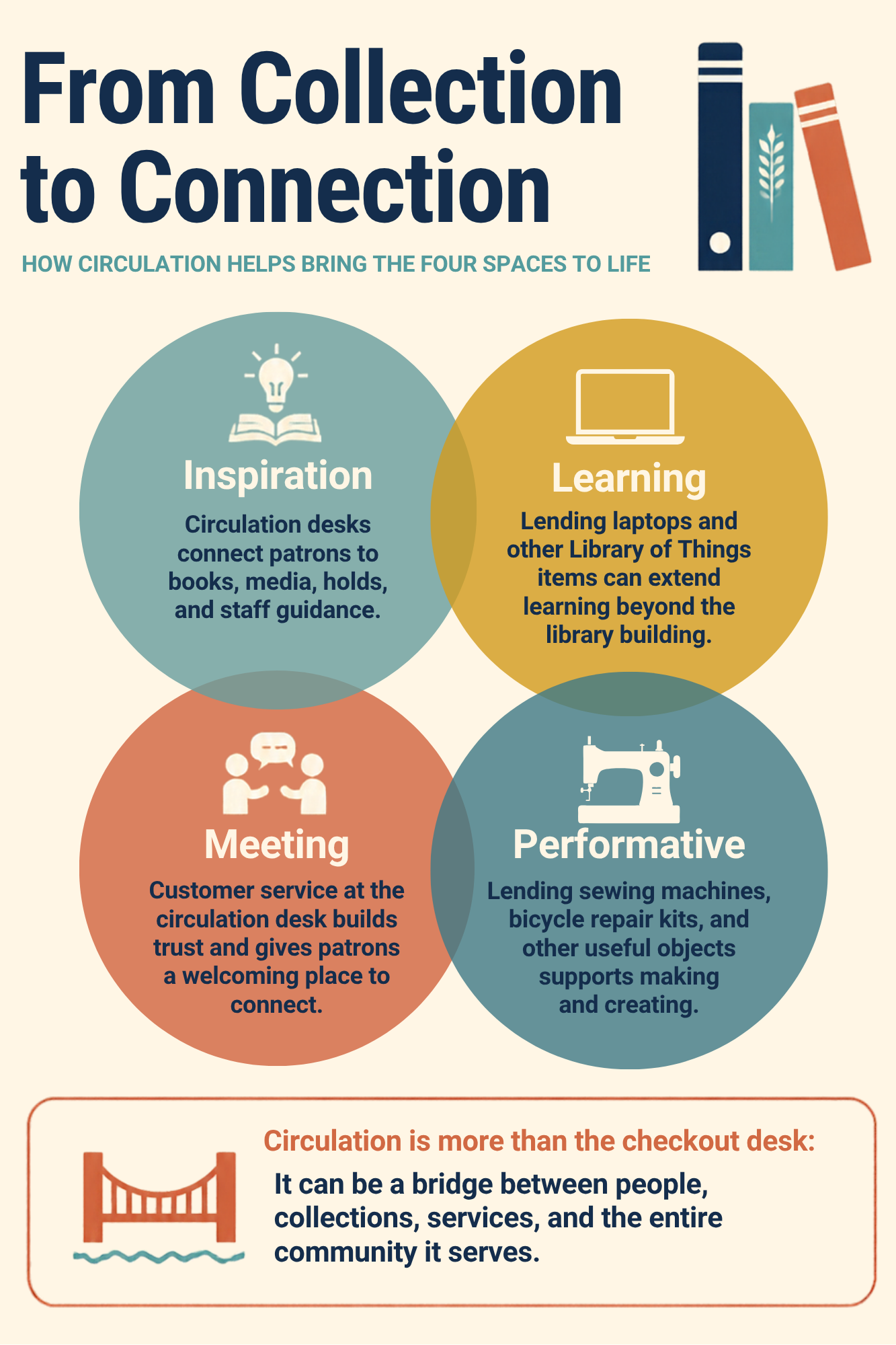
The topic of removing fines can be a contentious one, and since fines can be one of the biggest barriers of access to library services, I decided to assess the validity of the arguments against removing this barrier. The two main arguments against it are related to revenue and accountability. The revenue argument is that fines are a line item on many libraries’ operating budgets and are therefore necessary to fund the library. The accountability argument is that without a penalty for overdue items, people will not return what they borrow. Based on my personal experience working in a public library, these are valid concerns. To combat these issues, many fine-free libraries have switched to replacement billing, which means that a patron cannot check out items until they have returned their overdue items or brought in replacement copies. That is the model that my library uses, and it has been very effective at motivating patrons to return anything they check out.
The ALA’s Council asserted in 2019 and 2025 that fines are a barrier to library use, and it encouraged libraries to review such policies (American Library Association, 2025). Other barriers mentioned included policies on personal belongings, hygiene, and home address verification. All of these are policies that are enforced throughout the entire library, including the circulation desk. However, I had never considered the issue of verifying a patron’s address to be a barrier to access until I witnessed the difficulties it created for unhoused patrons looking to get a library card.
Stephens (2011) states that in a hyperlinked library, outdated rules and policies are stripped away to remove barriers to the library’s services and collections. My original reading of Stephens was that he was advocating for an attitude or mindset shift among library professionals, but I now see that he is also talking about the need for changes in policy.
The question I am now asking about my branch is simple: which of our circulation policies are good for our community, and which still exist simply because we have not reconsidered their effectiveness in the decades since the library was originally built?
References
American Library Association. (2025). Economic barriers to library access: An interpretation of the Library Bill of Rights. https://www.ala.org/advocacy/intfreedom/librarybill/interpretations/economicbarriers
Grant, R. (2021, November). How Memphis created the nation’s most innovative public library. Smithsonian Magazine. https://www.smithsonianmag.com/innovation/memphis-created-nations-innovative-public-library-180978844/
Skot-Hansen, D. (2017). Library development: From collection to connection. Impact of humanities research: 24 case studies. University of Copenhagen.
Stephens, M. (2011, February 21). The hyperlinked library: A TTW white paper. Tame the Web. https://tametheweb.com/2011/02/21/hyperlinkedlibrary2011