The message behind the “Power of Stories” is simple: everyone has a story. As library and information professionals, we are poised to gather and hear the stories of our patrons to strengthen connections and better serve the greater community. But we also have our own stories to share, particularly during this trying time where libraries have been a target of challenges, book bans, and other destructive actions. Though there are groups that seek to undermine the core foundations of libraries, we have the power—through our stories and experience—to counter those institutional assaults and add our voices to library advocacy efforts.
"Your story matters. Not just because you curate collections or answer reference questions, but because you build bridges between people and knowledge. You have witnessed quiet triumphs: a child learning to read, a student discovering their passion, a senior reconnecting with history. These moments are part of our collective story, and they deserve to be shared." — Helmick, 2026
Challenges to libraries
The past 5-10 years have been especially tough for American libraries due to the rise in social and political conservatism. With the intention to shutter the IMLS, funding across the entire country for libraries and museums was cut in March of 2025 (ultimately restored) only to be slated to be cut again in 2027 (American Library Association, 2026b). Book challenges shot up again with 4,235 unique titles reported in 2025 (vs. 2,452 in 2024 and 4,240 in 2023); compare this to the average number of challenges between 2001 and 2020: only 273 (American Library Association, n.d., 2026a). A total of 91% of 2025’s challenged book titles were initiated by pressure groups and government organizations. In May 2025, President Trump fired Dr. Carla Hayden, our fourteenth Librarian of Congress—originally nominated by President Obama—and moved to end the Digital Equity Act, which was blocked but continues to be tied up in legal battles (American Library Association, 2026a). More generalized challenges include mistrust in the government, lack of faith in objective information, the vanishing middle class, declining literacy rates, general erosion of civility, and ongoing systemic issues such as lack of diversity (see Smith, 2019).
However, through all of these struggles, libraries have prevailed through continued support from individuals and organizations who believe in their mission and core values. The American Library Association (2026a) noted that Congress and the courts have demonstrated that library funding and the continuation of libraries with the U.S. is desired and a priority.
While this gives us hope, it is the power of advocacy that keeps the fight alive.
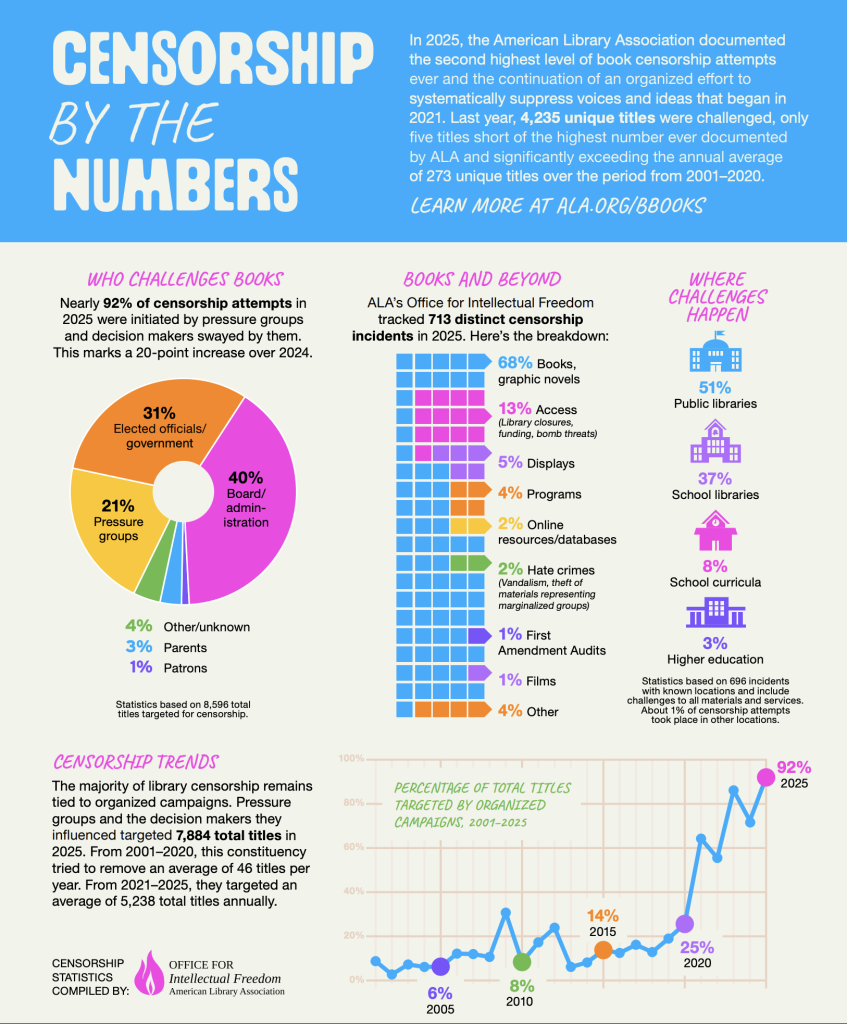
Censorship by the Numbers: American Library Association, 2026a
Data storytelling augments library advocacy
Data storytelling combines a narrative structure (story or experience) with actual and meaningful data. An example might be sharing with the community how their donations made an impact: not only how finances were allocated, but identifying how they met community needs. Through a series of surveys and focus groups of librarians, data storytelling expert Kate McDowell discovered library staff wanted to tell three kinds of stories: 1) achievements; 2) sharing benchmarking data; and 3) justifications for funding, donations, and other investments (UI News Bureau, 2024; see also McDowell, 2023, 2026a). I find this approach to be incredibly impactful: data on its own can be helpful but also uninspiring without context. Incorporating “workplace” stories and experiences along with the data gives the community a better insight into the organization’s impact, which further aids in building connections. However, we must also understand who our audience is in order to effectively communicate our stories and reach our community (see UI News Bureau, 2024). The audience’s role is also critical in data storytelling via the ways they react to the information (e.g. comments, feedback, questions) and through retelling to keep the story alive (McDowell, 2023).
"Storytelling involves trust between the teller and the audience. Data storytelling is a way of mobilizing factual evidence to build trust as truthful storytellers in and for our communities."
— McDowell, 2026b
Sharing our experiences with our community, our Board of Trustees, our friends and family, and beyond are all ways to deepen connections to libraries. Combining the authenticity of data with the subjectivity of emotion through data storytelling, we have the unique stance and knowledge to demonstrate how important, relevant, and impactful libraries truly are. Through transparency and integrity, we can make our voices heard while advocating not for libraries alone but ultimately for the very people they serve.
Inspiring voices
Here are some resources to help us use the power of our stories to make a difference.
- American Library Association: Show Up For Our Libraries
- American Library Association: National Library Legislative Day (February 24-25, 2027)
- Empire State Library Network: Data Storytelling with Kate McDowell (Video)
- Illinois Library Association: Library Advocacy Toolkit
- Maine State Library: Storytelling for Library Advocacy (Video)
- National Endowment for the Humanities: The Complicated Role of the Modern Public Library
- Unite Against Book Bans
References
American Library Association. (n.d.). Censorship by the numbers: Banned book data. https://www.ala.org/bbooks/book-ban-data
American Library Association. (2026a). The state of America’s libraries: A snapshot of 2025 [Report]. https://www.ala.org/sites/default/files/2026-04/state-of-americas-libraries-report-2026-WEB-acc-4.pdf
American Library Association. (2026b, April 3). White House FY27 budget proposal repeats threats to eliminate IMLS. https://www.ala.org/news/2026/04/white-house-fy27-budget-proposal-repeats-threats-eliminate-imls
Helmick, S. (2026, January 2). Your library story. American Libraries. https://americanlibrariesmagazine.org/2026/01/02/your-library-story/
McDowell, K. (2023, June 29). Data storytelling for libraries: Peer to peer review. Library Journal. https://www.libraryjournal.com/story/data-storytelling-for-libraries-peer-to-peer-review
McDowell, K. (2026a, February 4). The need for storytelling in librarianship: Data storytelling as a means for advocacy, social justice, and inclusion in libraries. Choice (ALA). https://www.choice360.org/libtech-insight/the-need-for-storytelling-in-librarianship/
McDowell, K. (2026b, July 20). Critical data storytelling. Library Journal. https://www.libraryjournal.com/story/critical-data-storytelling
Smith, M. (2019, April 26). Top ten challenges facing public libraries. Public Library Quarterly, 38(3), 241-247. https://doi.org/10.1080/01616846.2019.1608617
UI News Bureau. (2024, July 11). Project helps librarians use data storytelling to advocate for public libraries. University of Illinois Urbana-Champaign. https://ischool.illinois.edu/news-events/news/2024/07/project-helps-librarians-use-data-storytelling-advocate-public-libraries
Featured image attribution: Guardian Nurses
Hi Liz, thank you for sharing this piece on data storytelling. I’m reminded of participating in engaging meetings where facilitators used Slido or Mentimeter as survey tools, polling us and collecting data in real time. Have you seen it in use before? (https://www.slido.com/features-live-polling or https://www.mentimeter.com/features/live-polling)
The quick data visualization makes feedback and advocacy fun, interactive, and truly participatory and impactful.