For this module, I watched the lecture and had a lot of thoughts spark (see page of notes pictured below).
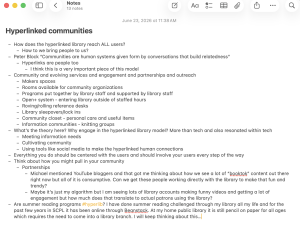
For this reflection blog I wanted to expand on some of the things I took notes about. Specifically as they relate to these 2 questions: How do these ideas connect with real-world library service? What assumptions are challenged, and what possibilities are sparked?
- Hyperlinks are people too
This lecture covered many of the ways that the Hyperlinked Library model is not just about integrating emerging tech and new online trends. It was focused on the ways that hyperlinks and people too. This is statement that I have already heard and read before in the course but each time it continues to stand out. This is such an important piece of the hyperlinked puzzle that I feel sometimes gets overlooked in this world of trying to keep up with trends in tech. It’s so easy to look at all the new tools emerging and see the trends in internet and tech use and focus on the statistics and clever features and how it can be beneficial for the system/organization but I find that these conversations can get lofty pretty quick and forget the why of it all. Why do we have to keep up with the new tech? Not just because it’s new, right? Shouldn’t we be keeping up with it because it will help library users and staff engage more with the services and supports the library offers? Shouldn’t it be that if a new trend is not fitting the needs of the community we recognize that and move on to something that will? I know this sounds very broad but that’s the headspace I’ve been in recently, thinking very big.
How does this connect to real life library service? In the lecture Michael mentioned YouTube vloggers and that got me thinking about how we see a lot of “booktok” content out there right now but most if not all of it is consumptive (i.e. promoting buying all the books you read instead of borrowing from friends or the library). In the spirit of the hyperlinked library and partnerships and outreach, can we get these booktok influencers working directly with the library to make borrowing books more fun and trendy? Maybe it’s just my algorithm but I am seeing lots of library accounts making funny videos and getting a lot of engagement but how much does that translate to actual patrons using the library? Could connecting the influencers to the libraries help?
- Summer Reading Challenges
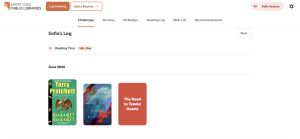
Are summer reading programs #hyperlib? I have done summer reading challenges through my library all my life and for the past few years through the Santa Cruz Public Library it has been online through Beanstack. At my home public library (Multnomah County in Oregon) it is still on paper for all ages which requires the need to come into a library branch. My initial assumption was that the Beastack system is more hyperlinked due to the online aspect of it, but after reflecting on the materials of this module I think both are engaging in the model equally as I know that the choices to stay on paper for Multnomah County and to move the challenge online for SCPL came from feedback from the library patrons. They are both user centered in the end, and both pull in partnerships from the community to make it happen every year.
As I continue working through the summer reading challenge this year I’m going to keep thinking about how it falls under participatory service and community engagement. I’ll leave you with some of my challenge progress so far.
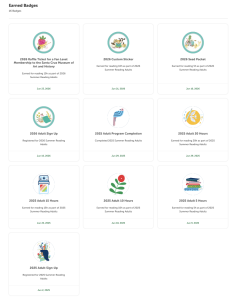
Thanks for your post, Sofia! I liked your reflections on these two topics. Summer reading resonated with me because, as many of us are, we are currently full steam ahead in our summer reading programs and events. Our program is largely “paper” as well, in that information such as books read are not recorded digitally. I’d love for us to incorporate some digital aspects like a badge system (like we see on all sorts of apps for usage) and digital recording of books for statistics to share with patrons and the community.
Moving away from strictly digital, I believe summer reading is definitely part of #hyperlib in the sense of connecting people and community. Yesterday was our kick-off, and the library was slammed with families signing up for summer reading, registering for library cards, socializing, and seeing friends from school. It was one of those moments of really seeing a large part of the community all coming together at the same time for the purpose of promoting and encouraging reading, with the library as a hub to facilitate it.
I’m looking forward to hearing more of how your summer reading challenge goes! Thanks again.
@ssolares I really appreciated your question “are summer reading programs #hyperlib? As both a teacher librarian and a very PT library assistant at my local library (Vallejo, CA), I find the reading challenge to be an intesting scenario. At my schools we “push” it before the end of the school year with the deepest hopes that our students will read over the summer. When I was working at my local public library branch, I had at least 4 different interactions with summer reading. It was fascinating to hear parents ask if they could join. Granted the images are somewhat young in nature, we want EVERYONE to read! We use Beanstack as well, but most patrons come into the library with their papers so their children can get their badge. It is very fun to see people embracing one of the best joys of summer, which is fun reading.
@ssolares This:
“It’s so easy to look at all the new tools emerging and see the trends in internet and tech use and focus on the statistics and clever features and how it can be beneficial for the system/organization but I find that these conversations can get lofty pretty quick and forget the why of it all.”
I appreciate this! You owned in on one of the themes of our class, which is technology in the library should be used to advance the human goals of the library. The WHY is so important here and I so agree with you that it sometimes gets lost.
Your notes while watching the lecture remind me of the thoughts running through my head, too! So many ideas and so many questions. There’s a lot to think about and I, too, wonder about how we can harness the power of social media to make an actual difference in our libraries. I see the videos and wonder if it would help my library if we had a greater social media presence. Or if we incorporated social media trends into our libraries somehow. I would love to see the statistics on libraries that do both.
I love summer reading challenges. To me, it is definitely another aspect of the hyperlinked library because it involves so many different parts of library services and, at least where I live, every patron can be involved. It’s a great way to bring new people to the library and engage with those who use the library regularly.