“The medium is the message” – Marshall McLuhan
I was talking to my friend about the board game he’s designing when this quote came up. I had never heard it before, but after doing some digging I realized I’d been behind and this is a pretty famous quote in the world of communication and media studies. Basically, what I have interpreted the quote to mean is that when information is delivered, the creator of that information has intention behind how it was delivered and that medium should be considered with equal importance to the information itself.
The reason I bring it up here is because my friend mentioned it in the context of learning and teaching in non-traditional ways, such as in board games. I also found a great article from Scholarly Kitchen that talks about this quote and the medium of the web/internet/Web 2.0/the participatory web and how abundance of access is the message of that medium (Anderson, 2010). Reflecting on this quote in relation to the infinite learning module materials, I really like the idea of the medium as an intentional message to the receiver of information. In libraries, there are many mediums at our disposal to help serve our communities and provide moments of learning. Some work better than others, and the work is to find what medium will work best for you. This concept of an intentional and functional medium was discussed in the Digital Promise blog post about the Chicago Public Library’s (CPL) CyberNavigators and Digital Learn programs. In the post, the authors head a section with “If You Can’t Find the Right Technology, Help Develop It” (Promise, 2016). To me, this is an instant connection to the idea of the medium is the message. CPL piloted a number of programs for teaching adults digital literacy skills, but ultimately decided that none of them were what their libraries needed. So they worked with developers of existing technology and programs to create a custom system that worked for them (Promise, 2016). They created a medium that shared a message of care for the community and an understanding of the importance of the opportunity of learning skills like digital literacy.
And truly, the library itself is a medium with a message. The library is an alternative to other learning mediums such as YouTube University or traditional tuition and fees based academic learning, because it’s not individual/isolated or behind a paywall, it’s an accessible-to-all medium that delivers the message that we can be connected through learning, teaching, and resource providing. When the library is a classroom, when learning is prioritized for patrons and library staff alike through professional learning experiences, the medium of the library screams the message that infinite learning is possible and can be prioritized within a community.
References
I really love this module and that it is included in this course. I personally am a big sharer and contextualizer because I am a big believer that sharing stories will lead to more empathy and understanding and that will lead to stronger communities. I see this both in my personal and professional worlds and am very grateful for the opportunity to continue the exploration of this topic right here.
Like mentioned above, I have a lot of professional experience with stories. One of my most honored experiences was working as a transcript editor for a Spanish language oral history project that produced the first Spanish material to be collected and housed in my college’s archives. The project, called The Listeners Project: Queremos Escucharte (TLP) began with the Colectivo de Arte Social (Socially Engaged Art Collective) which is a “group of creative immigrants and immigrant advocates from the Walla Walla Immigrant Rights Coalition” and is produced in partnership with the Walla Walla Public Library and the Whitman College and Northwest Archives (TLPWW, n.d.). The project collects oral histories of the Latine and immigrant community members that have been left out of the region’s history. The history of the region I was getting from my education was mostly focused on the westward expansion/settler colonialism/indigenous displacement side of things. TLP aims to collect a more recent history of the influx of Mexican and Central American immigrants to the area to work in agriculture and affirm that story among the context of the broader history that includes the aforementioned well recorded history.
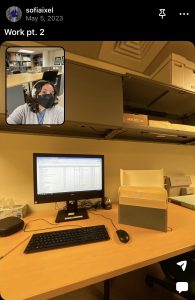
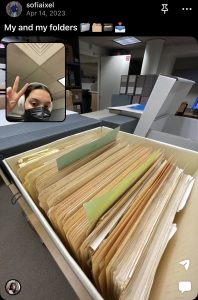
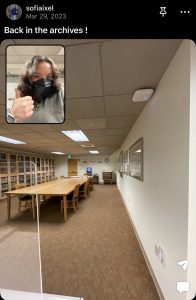
As the transcript editor, I was some of the first people to hear these stories (outside of the interviewer of course). Part of the job too was organizing the notes from the interview and helping the archivists condense them into both Spanish and English finding aids for each of the audio recordings and written transcripts. I am semi-fluent in Spanish so this was an awesome opportunity to keep flexing that language muscle and making sure that these stories would eventually be accessible and findable to all in the community. I know that this project means a lot to the Walla Walla community and has fostered a really great partnership between the community, the public library, and the college. I’m grateful to have had a small part in making it happen.
Separate thought:
Has anyone heard about Book from the Ground: From Point to Point by Bing Xu? In the lecture, Micheal mentioned how Emojis are great story telling mechanisms and I immediately thought of this book! It’s a story about the day in the life of an office worker told completely using emojis, symbols, logos and emoticons. It has no words just symbols and is paired with another art piece by the same artist/author called “A Book from the Sky” that is made up of entirely made up glyphs that looks like traditional Chinese characters. Both are worth looking up they are very cool and thought provoking.
References
Here I am, back again with a screenshot of my notes app! So you know what that means, it’s Reflection Blog Time!
Expanding on these thoughts…
Trend Reports:
Not sure if it’s just me but I love a data report. In my school library I LOVE looking at our circulation statistics and comparing data month to month. Part of this I learned from my teacher librarian who used to work in retail and has a, in her words, “sales growth mindset” that is driven by stats. But the other part comes from me and my enjoyment of seeing important information organized in a pleasing way, it makes my brain feel warm in a good way! Which is why I love re-visiting the IFLA Trend Report (2024) and reading through the EDUCAUSE Horizon Report and the Horizon Report Library Edition (2017). I found it interesting that each report organized their trends in different ways. For example, EDUCAUSE has their report and trends organized by topic, then has a separate section discussing the signals of change. And the Horizon Report Library Edition was mainly organized by time, but also by “difficulty” which by some definition can also be seen as time related.
I find these different types of organization important for those who are making trend spotting and change signal watching a part of their regular professional practice because it highlights different aspects of some of the same trends. If you’re reading the Horizon Report Library Edition and getting a lot out of the section that divides trends and changes into the solvable, difficult, and wicked challenges, you might take that system of organization into what you’re seeing being reported from the topic-sorted EDUCAUSE or IFLA Trend Reports. Many of these reports overlap because they are seeing the same things coming through, I find this interesting especially because I am comparing trend reports that were published almost 10 years apart from each other, but I am still seeing some of the same things (I ctrl+f’ed Artifical Intelligence in the 2017 Horizon report to see what was there and it included a technology development timeline that looking back now quite accurate!) being mentioned and being flagged as important to keep an eye on or include in your work right now.
The other reason I like these trend reports is because I feel like they are not just important to the now, but will be important for the future as historical record of the way we in this field have thought and worked and persevered before. Like i said before, from 2017 to now many of the same trends still exist and yet are so different, how will it be in another 10 years and will the pattern of change be something worth paying attention to? I have also been seeing these trend reports as a motivational factor. If libraries survived huge change that impacted society for good, like the introduction of the internet, then we can make it through whatever changes are coming next, and record of how signals of change were charted and understood and then acted on are helpful tools that we should be attuned to.
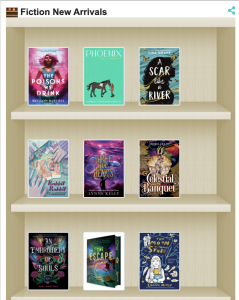
What is the idea? Integrating monitors or tablets as digital aspects of the already existing book displays in a public middle school library.
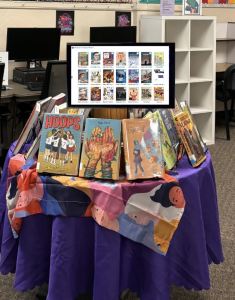
Image above is a crude digital rendering of what a possible digital display could look like with a monitor displaying the Women’s History Month topic wall on the digital display along side the physical books. Credit: Sofia Solares
This innovation is hyperlib because it expands the user centered OPALS project into the physical library. It also brings the user into the final stages of the OPALS project by getting patrons involved in using all the features the ILS has to offer. The end goal is that the digital poster displays will inspire new types of connections between library staff and patrons. Also ultimately getting more OPALS engagement and links between patrons and the ILS in new ways
Mission & Institutional Context
Mission Statement: “The MHMS Library is a welcoming, inclusive space where students of all abilities can explore, learn, and grow. We foster a love of reading, support media literacy, and provide resources that enhance learning. Through collaboration with students, educators, and the community, we offer dynamic programming that encourages creativity, communication, and lifelong learning.”
The library has been undergoing a large change in the form of de-emphasising dewey for the non-fiction collection and is working on genrefying the whole library to make browsing and discovery more accessible for students. Part of the motivation for this innovation would be to help patrons learn about the new sections in the library. For example, during Non-Fiction November, there could be a display of new arrival non-fic books where the digital posters display a map of the library and in what section a book can be found. Eventually, there might be digital displays in each section of non-fiction that can help patrons find their way around, highlight a low-circulating book or new arrival, or locate a specific book in that section with some prompting.
The main idea is to get patrons more involved with OPALS, our integrated library system and online catalog. Part of the genrefying project has been a lot of data clean up of the MARC records of circulation items, book lists, pathfinders, and topic walls all found in OPALS. Now that they are a lot “prettier” and have been aligned with our accessibility and findability goals, it would be a shame not to show them off in a new way through the digital displays.
The next step of the OPALS overhaul would be to begin using the features available on it again, specifically the book reviews. If we incentivize leaving book reviews on OPALS with the chance to be shown on a digital display (and also maybe a sticker or jolly rancher or something as well) there would be more engagement with that feature.
The library has also been looking for more ways to collaborate with classroom teachers, and having a review writing “assignment” would be a win-win collaboration for all.
Action Brief Statement
For target audience: Convince middle school students that by leaving reviews in OPALS they will learn more about how their library catalog works (and also win prizes) which will create more engaged readers because the library is more than just a room full of books but also an additional learning space in the school.
For staff: Convince middle school teachers that by motivating students to leave reviews in OPALS they will practice their writing and reading comprehension skills which will create more engaged readers and help meet ELA standards because the library is a partner with teachers and can be a fresh alternative to “traditional” methods of ELA skills teaching and practicing.
For library staff: Convince the library team that by integrating digital posters in displays they will get more flexibility and opportunities to be creative with display designs which will create more engaged patrons and lead to higher food traffic because the library is mission driven to “offer dynamic programming that encourages creativity [and] communication”
Where did you find inspiration?
Guidelines & Policies
Timeline for Implementation
Marketing & Promotion
Staff Training & Readiness
Evaluation & Future Expansion
Bookmobiles are Hyperlinked Environments.
I have been thinking a lot about how social media engagement has become such a central part of many people’s lives, mine included. I scroll on Instagram daily, and because I engage with it so much the algorithm knows about all the things I am interested, including libraries. So, since starting this MLIS program, I have come up on A LOT of library related content on social media. Some of the content I get most frequently comes from the Santa Clara City Library instagram account. As part of a marketing strategy, they post mostly comedy Instagram Reels and TikToks that follow current video trends and using trending audio, but make it library specific. They have a “cast of characters” that show up consistently in their videos, and one of them is the bookmobile librarian. Before I started seeing this content, I of course knew that bookmobiles existed and understood it as a “non-traditional” library settings, but it was the combination of the mobile library environment and the features on social media that really got me thinking about how all this very much falls under the Hyperlinked Library model.
I wanted to find out the history of the Santa Clara City Bookmobile specifically since it was their online content that really started the ball rolling for me. Unfortunately, the city library didn’t have much information online about their bookmobile other than it’s stop schedule, BUT the Santa Clara County library system which has their own bookmobile had an awesome webpage dedicated to their bookmobile that gave me a better idea about the historical and modern function of mobile libraries in the area. At the bottom of the page there was a timeline of the history of the county bookmobile, showing its start in 1953 and the immediate success and popularity it had among patrons. It goes on to discuss the expansion of the program, then the discontinuation of some services due to budget constraints. Further reductions happen at the same time that the program itself shifts to try and emulate the different services provided at library branches, such as access to technology and different forms of media other than books. Today, it is a full program with over 50 stops serving rural areas, isolated communities such as retirement homes and other care facilities, and preschools (About the Bookmobile Services, n.d.).
The bookmobile timeline is a great example of showing how in Santa Clara their bookmobile is a hyperlinked environment. They are engaging in constant and purposeful change, some of which was being forced due to budget changes, but some of it was in listening to patrons and wanting to fill gaps in materials and information access. You can sign up for a library card, check out DVDs and CDs and video games, request materials, and use technology like laptops all from a bookmobile like you could from a branch library, all because there was a need for it from the community and the library was creative enough with their resources to make it happen (About the Bookmobile Services, n.d.;Bookmobile| Santa Clara City Library, n.d.). The bookmobiles of the 1950s wouldn’t serve the community well today, but the program has continued because it has evolved and embraced the changes in the environment and community to remain relevant and useful.
References
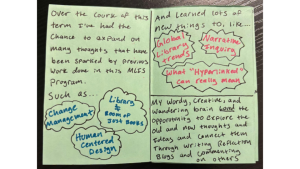
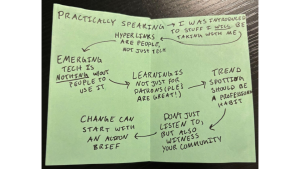
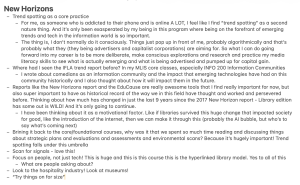
For this module, I watched the lecture and had a lot of thoughts spark (see page of notes pictured below).
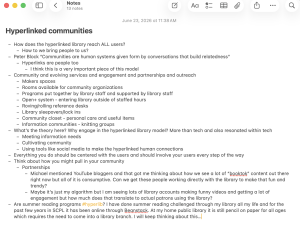
For this reflection blog I wanted to expand on some of the things I took notes about. Specifically as they relate to these 2 questions: How do these ideas connect with real-world library service? What assumptions are challenged, and what possibilities are sparked?
This lecture covered many of the ways that the Hyperlinked Library model is not just about integrating emerging tech and new online trends. It was focused on the ways that hyperlinks and people too. This is statement that I have already heard and read before in the course but each time it continues to stand out. This is such an important piece of the hyperlinked puzzle that I feel sometimes gets overlooked in this world of trying to keep up with trends in tech. It’s so easy to look at all the new tools emerging and see the trends in internet and tech use and focus on the statistics and clever features and how it can be beneficial for the system/organization but I find that these conversations can get lofty pretty quick and forget the why of it all. Why do we have to keep up with the new tech? Not just because it’s new, right? Shouldn’t we be keeping up with it because it will help library users and staff engage more with the services and supports the library offers? Shouldn’t it be that if a new trend is not fitting the needs of the community we recognize that and move on to something that will? I know this sounds very broad but that’s the headspace I’ve been in recently, thinking very big.
How does this connect to real life library service? In the lecture Michael mentioned YouTube vloggers and that got me thinking about how we see a lot of “booktok” content out there right now but most if not all of it is consumptive (i.e. promoting buying all the books you read instead of borrowing from friends or the library). In the spirit of the hyperlinked library and partnerships and outreach, can we get these booktok influencers working directly with the library to make borrowing books more fun and trendy? Maybe it’s just my algorithm but I am seeing lots of library accounts making funny videos and getting a lot of engagement but how much does that translate to actual patrons using the library? Could connecting the influencers to the libraries help?
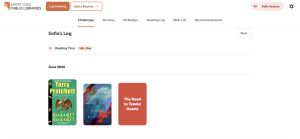
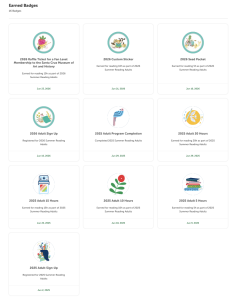
Are summer reading programs #hyperlib? I have done summer reading challenges through my library all my life and for the past few years through the Santa Cruz Public Library it has been online through Beanstack. At my home public library (Multnomah County in Oregon) it is still on paper for all ages which requires the need to come into a library branch. My initial assumption was that the Beastack system is more hyperlinked due to the online aspect of it, but after reflecting on the materials of this module I think both are engaging in the model equally as I know that the choices to stay on paper for Multnomah County and to move the challenge online for SCPL came from feedback from the library patrons. They are both user centered in the end, and both pull in partnerships from the community to make it happen every year.
As I continue working through the summer reading challenge this year I’m going to keep thinking about how it falls under participatory service and community engagement. I’ll leave you with some of my challenge progress so far.
“Change has been constant for libraries. But why does this change feel so much faster, so much deeper? This change feels faster because in many ways it is faster. Technology has played a key role in this perception of change, but it is by no means the only factor. Shifting population centers, changing demographics, and the cyclical ups and downs of the economic roller coaster all contribute to the change with which libraries must deal.” (Casey & Savastinuk, 2007, p.2)
📚📖📚
Theme: “Constant and Purposeful Change”
This theme has stuck out to me a lot so far in this course because to me it is not a new concept. I know that’s a bit ironic or maybe oxymoronic to say, but I really mean that this is a theme that I have seen come through every single one of my classes in this MLIS program so far (at least a little but) and that I have seen in my work in libraries and archives before I started this program. Change is a central theme in the world of libraries and information organizations.
What has motivated me to write about it here, is the way it is being discussed. The quote that opened this blog post, as well as the title for the assignment and theme comes from Michael Casey and Laura Savastinuk’s book Library 2.0: A Guide to Participatory Library Service (2007). This book discusses the “essential ingredients” of the Library 2.0 model, one of them being “Constant and Purposeful Change” (Casey & Savastinuk, 2007, p.12). These foundational concepts were created with the idea that libraries have a goal to meet the needs of their patrons and do so in a sustainable fashion that is good for the patrons and the library staff as well. It also stems from the understanding that technology is evolving and becoming ever-so interconnected with every aspect of our lives. So that means that patrons are going to have technology related needs, and they are going to expect their libraries to help them.
While the truth of technological evolution is certainly a factor of both the creation of the Library 2.0 and The Hyperlinked library model, what I really appreciate is how both models refuse to let tech be the biggest and/or only motivator for change. As it says in the quote above, population changes, political influence and events, cultural shifts, and more non-tech related things have influence over why things in the world of libraries is changing.
Now a counter to this thought could be that everything today has been influenced by tech. The participatory web, social-internet, etc. has permeated everything in modern society, including how populations are changing and culture is shifting. Michael himself even said so in some of the lectures from these first few modules so far. I understand this and see it myself. And yet, I believe there is influencing going the other way too. There is no participatory web without people to participate, right? So that’s all to say that while the web/tech is important to take into consideration, changes that are made in libraries can’t and shouldn’t be completely based on technology changes. This is reflected in the Library 2.0 and The Hyperlinked library through their concentration on people and access being the main goals of the models.
Another reason I’ve chosen to write about the theme of change here and now is that I’ve already done a lot of thinking and writing about change in libraries before. When I took INFO 204: Information Professions, there were at least 3 (and probably more) modules that discussed change, change management, strategic planning, and evaluation of changes. If the idea of constant and purposeful change wasn’t so important for libraries, then why was so much time spent on discussing and understanding it in a foundational class of this program? From that class I took away that being able to make change, be comfortable with change, and being able to effectively communicate about changes makes for a very strong information professional. It’s these lessons that I see again here in the sources from this class so far.
Finally, I write about change here because I know that this is something that will continue to come up so I should be familiar with why and how to handle it. I see through the study of the Library 2.0 and The Hyperlinked library models that change is necessary and important. I see in my workplace in a public middle school library that change is not always chosen it is often inherited. These are the reasons to think about change.
More thoughts I have but am running out of space so I will open up to the comments:
References
Hi all!
My Name is Sofia, this summer is my 3rd term/semester of classes at the iSchool working toward my MLIS and I am so excited to me taking this course!
During the school year I work as a Middle School Library Media Assistant at 2 different schools in my district. I have worked in school libraries for 3 years now and while I love my job and working with middle schoolers, I have come to realize that long term, school libraries are not for me. I started this program with the intention of becoming an academic librarian, but through all the courses I’ve taken so far in this program, I feel have found my self being drawn to public libraries and adult education.
I am very much looking forward to this class and getting “up to speed” so to speak with all the current and emerging trends of the library world. I feel like this is going to be a very valuable learning experience for me and I am excited to get started.