For my symposium I did a bit of a digital mind map. I think it fits with the theme of as much chaos as you can handle. It has been a joy and I am feeling deeply grateful for the process. 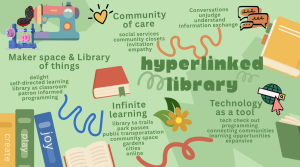
Author: Liz Grewal
As I was researching for my inspiration report, I was reflecting on the Library as Classroom chapter by Stephens (2016) and really thinking about how the library can work towards supporting patrons in lifelong learning and building community. The idea of everywhere as classroom is something that has been a throughline in my education and I am grateful to be coming back to this idea towards my MLIS program. My background is as an environmental educator, taking kids out in the North Cascades National Park during the school year and doing garden and literacy summer camp education in the summer. While I loved the elements of self-directed learning, curiosity and wonder, I also needed stability in my life and health insurance. I pivoted to classroom teaching and taught 150 15-year-olds. After burning out in the classroom, I am pivoting to the library. Library as classroom feels so deeply right in my bones, and I am excited to explore education in this capacity.
Block’s article on messy learning (2014), made me smile as I thought about project-based learning in my science classroom and providing students with multiple ways to show their knowledge. Reflecting, I was thinking about how I miss messy learning in the library Teachers bring their classes in for an informative, polished lesson generally about how to research. Then I realized that is exactly what research is, it is deeply messy for these students. Students generally have choice in the topics they are researching, they unfortunately haven’t done a ton of academic research, and it can feel vast and overwhelming. I resonated a lot with Block’s reflection, particularly around the comment of “projects are filled with random ideas, questions, changing minds, and students who feel lost”. One thing Block does to structure the messiness and support students is to have clear learning tasks to complete. Reflecting on my own practice, I think I could do a better job of supporting student in the mess of research, but part of this has been not fully what knowing what my role is as a teacher librarian, and not feeling like as the librarian I can provide students with learning tasks.
As I prepare for the new school year, I have been thinking about ways to provide offerings of delight and incorporate more whimsy and play in my capacity as a teacher librarian. When reading an article about Anythink’s Library of Things, Keely Smith’s words suck with me, ““At that time we wanted to create moments of surprise and delight when you walk into the library” (Diamond, 2026). My guiding question for the year, how can I create moments of delight for my patrons. Reading Stephens’ (2014), article, I was struck by the duality for formal vs informal. It is so obvious where formal learning fits in but building a high school library program from scratch with no funding, I struggle with the informal. Now that I have increased our ratio of books to students from 0.36 to 3 (still very small) I feel that my focus can shift my focus toward programming for joy and play. This course has given me some ideas, and I look forward to trying, failing and succeeding along the way.
When thinking about moments of delight these past two years I was reflecting on the following:
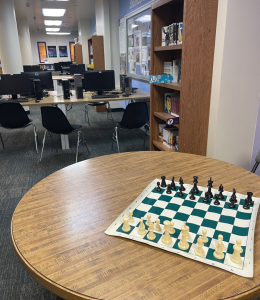
The chess table has been a moment for delight during lunch and has been a space for lively chess games.
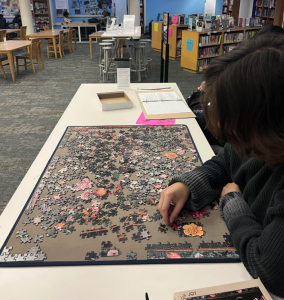
We have abandoned more community puzzles than we completed, but they have been a nice community builder and place where students introduce themselves.
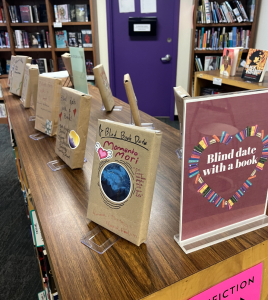
When making the Blind Date with a Book display, the students had more fun helping me decorate the covers then they did checking out a mystery book.
References:
Block, J. (2014, January 7). Embracing messy learning. Edutopia. https://www.edutopia.org/blog/embracing-messy-learning-joshua-block
Diamond, S. (2026, June 27). Come for the books, stay for the power tools. The New York Times. https://www.nytimes.com/2026/06/27/arts/library-of-things.html
Stephens, M. (2014). Making The Case for the Library as a Space for Infinite learning [PDF].
Stephens, M. (2016). The Heart of Librarianship. In The Heart of Librarianship. American Library Association.
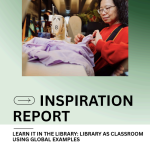
For my inspiration report I wanted to explore how libraries are pairing their Library of Things collections to programming to empower patrons.
Click here to view my report.
Everyone has a story and a perspective to share, however, because of power structures our society has deemed some people’s stories more important than others. Human libraries, whose motto is “Unjudged Someone”, allows people, “human books”, who have been stereotyped in some way to volunteer to share their life experience to members of the community, “readers” (The Human Library Organization, n.d.; Wentz, 2013). Readers can browse a catalogue of books to gain some background on the life experience or perspective of the book. When selected, the readers meet with the books for a one-on-one conversation where they can ask questions, learn about different perspectives, and seek common ground.
Learning more about the Human Library, I began to think of “othering”, the categorization of people according to perceived difference or viewing people as inferior to alienate others (Curle, 2020). This focus on differences dismantles our ability to find similarities or identify connections. Without this sense of shared empathy for one another, “othering” can lead to discrimination, and in extreme cases the denial of someone’s humanity. When doing additional research on “othering”, fear came up; fear of the unknown, and fear of what is different. This fear is what can lead people to dehumanize others. Stephens discussed fear in an interview about his program at Dokk1’s Next Library (2019). With a fear and division palpable in U.S. politics and communities, Stephens says that libraries can push back against fear through the power of free information and welcoming everyone (2019). The first impact study was done for the Human Library, people who participated as Readers reflected on their own biases and were excited about their experience. When discussing the power of podcasts, Jason Evans Groth, digital media librarian at North Carolina State University Libraries, “If we help our patrons and our colleagues to share our library stories, we build and fortify a culture of accessibility and inclusion by making accessible the many stories that come out of our libraries” (Stephens, 2019). Inviting patrons to share their stories can take many forms, from Human Libraries to podcasts. The power in storytelling lies in bringing people together, helping us recognize one another’s humanity, and moving beyond assumptions.
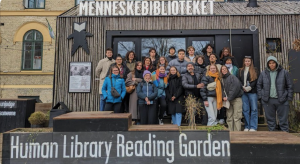
Participants in the Human Library program in Copenhagen.
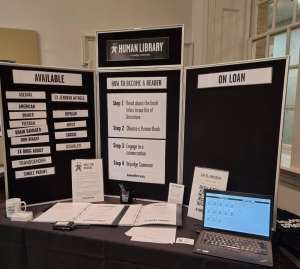
Available “books” for check out during a Human Library Program.
References:
Clint Curle. (2020, January 24). Us vs. Them: The process of othering. Canadian Museum for Human Rights. https://humanrights.ca/story/us-vs-them-process-othering
The Human Library Organization. (n.d.). About The Human Library. https://humanlibrary.org/about/
Stephens, M. (2019). Challenged but not dying, the public libraries are more relevant than ever.
Wentz, E. (2013). The human library: Sharing the community with itself. Public Libraries Online. https://publicl ibrariesonline.org/2013/04/human_librar/
I have been inspired by the large and small ways that libraries have continued to meet community needs and engage the public. As Pam Sandlian said, “the library is a space to encourage people to connect and be curious” (2013), and there have been many examples of ways that libraries are facilitating these opportunities for connection and curiosity. In Colorado, the Anythink Nature Library is a way to connect people to a place. The library can offer outdoor programming and hands-on learning, a one mile loop trail around the library, and a 140 acre trail system (Anythink Libraries, 2025). This reminds me of the model South San Francisco Public Library (SSFPL) did in collaboration with their Parks Department to create community spaces for movement, classes, and gathering. The building now holds a discovery room with a wide variety of tools to try and learn how to use, and also fitness rooms for Parks and Recreation programming (City of South San Francisco, n.d.). These examples of collaboration with other resources allows the library and other programs, like the parks department, to be a bridge to connect people to their community and other resources.
Dementia friendly space, as someone with a family member who is in memory care, can be incredibly isolating. I have spent a lot of time in the memory care unit, it can be a hard place to be. Patients can often feel scared because they don’t know where they are or yell for help. Having a space for caregivers to connect and build community is vital to their mental health and wellbeing. Brittany Noesworthy said in a Rogers TV segment, “It’s a space for everyone” (Rogers tv, 2025). People with dementia can obviously go to the library, but by creating this specific space for this population group, it is also actively inviting and welcoming people in.
A word that came to mind as a throughline in the resources shared for new models was “invitation”, the libraries are inviting their patrons to explore, play, and connect. Learning about Reading about Nicole Campolucci, a licensed clinical social worker at the Salt Lake City Public Library (SLCPL) (Harkins, 2023). At SLCPL they are creating a space where unhoused and patrons with psychosocial needs are being invited to connect to local resources not just by having literature out but by someone who can support people navigating these services. In a news segment about offerings at Massachusetts public libraries, noted that libraries are “thriving multi-service community centers” (Chronicle 5 WCVB, 2024). Libraries are meeting patrons where they are at, and addressing community needs.
A fun side note:
When Anythink Library reopened the library after Covid-19, they wanted to have offerings that delighted and surprised patrons (Diamond, 2026). They have EMF Readers in a ghost hunting kit, which has grown to 30 kits and have been very popular.
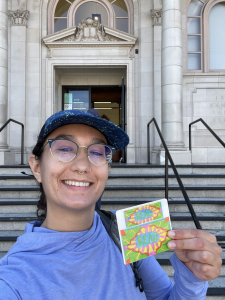
Liz Grewal with their new San Francisco Library card, while completing the San Francisco Crosstown Trail across the city.
References:
Anythink Libraries. (2025, May 1). Finding our place in nature: The vision behind Anythink’s Nature Library. https://www.anythinklibraries.org/news/finding-our-place-in-nature-the-vision-behind-anythinks-nature-library/
Chronicle 5 WCVB. (2024, June 18). Libraries are evolving into community centers with multi-services [Video]. YouTube. https://www.youtube.com/watch?v=tCvR7P42MKA
City of South San Francisco. (n.d.). Library | Parks and Recreation Center. https://www.ssfca.gov/Departments/Parks-Recreation/Library-Parks-and-Recreation-Center
Diamond, S. (2026, June 27). Come for the books, stay for the power tools. The New York Times. https://www.nytimes.com/2026/06/27/arts/library-of-things.html
Harkins, P. (2023, June 20). Salt Lake City downtown library’s new social worker has already helped thousands. The Salt Lake Tribune. https://www.sltrib.com/news/2023/06/20/salt-lake-city-downtown-librarys/
Rogers tv. (2025, November 11). Corner Brook Public Library creates dementia friendly space [Video]. YouTube. https://www.youtube.com/watch?v=r0T4H0uKwME
TEDx Talks. (2013, December 16). What to expect from libraries in the 21st century: Pam Sandlian Smith at TEDxMileHigh [Video]. YouTube. https://www.youtube.com/watch?v=fa6ERdxyYdo
Culturally Safe Libraries
As I reviewed readings about Queensland, Australia, I was struck by the collaboration between First Nations communities and libraries, especially in creating hyperlinked environments and culturally safe spaces for First Nations peoples.
In the video, “What is a culturally safe library? (NSLA, 2019) Marika Duczynski described it as a place with visual signifiers which show her culture well represented that make her feel comfortable and at home. Ronald Briggs, said it is an Aboriginal space as well as a space for the wider community, and where the Indigenous collection is developed. The National and State Libraries Australasia (NSLA) published competencies (2023), which include celebrating and recognizing diversity, engaging in respectful partnerships, demonstrating culturally competent work practices, and culturally responsive library services.
At the Indigenous Knowledge Center (IKC) is helping bridge the digital divide by providing programming using creative digital tools for art and storytelling. After identifying barriers to digital access among First Nations Peoples with 49% of people high excluded from technology (Reynolds, 2026), the IKC project gives people the opportunity to try and gain experience with new technologies, working to bridge the digital divide (mreynolds, 2025). Other projects by IKC include information sessions about online safety and the use of AI in scams (Reynolds, 2026b), and eSports tournaments (Reynolds, 2026a).
While exploring other resources through State Library of Queensland I found a 2024 truth-telling and treaty workshop for public librarians to support the initiation of truth-telling process at public libraries and IKCs (State Library Queensland, 2024). The First Nations Peoples, Aboriginal and Torres Strait Islander peoples, have been working on a path towards treaty, and came to an understanding that a path to treaty was would be challenging without a truth-telling and reconciliation process (State Library Queensland, 2024). As First Nations Peoples organized across Queensland to become treaty ready the Truth and Treaty Body called on the support of Queensland librarians to support their efforts in having a shared understanding of local history. Truth-telling must lead by Frist Nations peoples, in their terms and in their time. The library is a partner as an information hub, providing access to research materials, accessibility of collection and resources. During the workshop, keynote speaker Katie Kriss noted that relevant information for the truth-telling process is often fragmented across institutions, such as the Queensland State Archives and the State Museum, making it harder to piece together a complete narrative. Thinking about the hyperlinked library in this context, I think of how the library could partner with these institutions and Frist Nations peoples to reduce friction. The State Library of Queensland does have some collection resources under their truth-telling blogs, with a range of scanned primary sources documents like diaries, maps, and letters. Thinking back to what makes a culturally safe library, Queensland has many resources, blogs, collections, interviews, which provide historical context to support truth-telling. Later in 2024 the Queensland government abandoned the path to treaty for First Nations People (Australian Human Rights Commission,2024). Without support of the state, the efforts of knowledge and memory institutions are probably even more important to move Queensland towards a shared understanding of their history.
A personal reflection:
When I was pursuing my M.Ed. in Washington state, I was struck by the John McCoy (lulilaš) Since Time Immemorial: Tribal Sovereignty in Washington state, a pre-k – 12 tribally developed curriculum to be taught in all schools (Washington Office of Superintend of Public Instruction, n.d.), the incorporation of Indigenous Knowledge and into the science curriculum (Government of British Colombia, n.d.), how visually represented First Nations Peoples of Canada are on the UBC campus and around the city. This was noteworthy to me, because in California, there is an absence of Indigenous representation. History plays a role here, and that is a much longer story, Canada and the US had Indigenous boarding schools which sought to erode Indigenous language, culture and relationships (The National Native American Boarding School Healing Coalition). California is home to the highest Native American population in the US and most Indigenous nations without federal recognition (Prado 2022). Spanish colonization and development of missions led to the death of 37,000 California Indigenous peoples at the missions (Clarke, 2016). Encouraging the land grabs during the time of the Gold Rush, California government put bounties on the heads on the California Indigenous peoples (Helvarg, 2024). With this long history of explicit erasure of Indigenous culture, one that I was raised in and taught in, I am deeply interested in how California can move forward in a path of truth and reconciliation. I was disheartened to learn that Queensland abandoned these efforts, claiming that truth-telling divides people rather than unites them (Simpson, 2024), we have seen similar tactics in the US with the erasure of removal of exhibits on slavery (Zaru, 2026) or the erasure of our Trans community (Kim, 2025). I believe it is the job of libraries to be memory institutions and stand up to fascism, because the truth matters and is necessary in a truth and reconciliation process.
References:
Australia Human Rights Commission. (2024, December 4). Queensland bills a major step backwards for the rights of First Nations people. https://humanrights.gov.au/about-us/media-centre/media-releases/queensland-bills-major-step-backwards-rights-first-nations-people
Government of British Columbia. (2020, October 5). Indigenous Knowledge and perspectives in K-12 curriculum. BC’s Curriculum. https://curriculum.gov.bc.ca/sites/curriculum.gov.bc.ca/files/curriculum/indigenous-knowledge-and-perspectives/science-K-12-indigenous-knowledge-and-perspectives.pdf
Helvarg, D. (2024). The dark history of California’s gold rush. American Indian. 25(3). https://www.americanindianmagazine.org/story/California-gold-rush
Kim, J. (2025, February 14). Park service erases ‘transgender’ on Stonewall website, uses the term ‘LGB’ movement. NPR. https://www.npr.org/2025/02/14/g-s1-48923/stonewall-monument-transgender-park-service
mreynolds. (2025, March 25). Digital skills spark new creative ideas in Arkai (Kubin) on Mua Island. State Library Queensland. https://www.slq.qld.gov.au/blog/digital-skills-spark-new-creative-ideas-arkai-kubin-mua-island
National and State Libraries of Australasia. (2023, May 13). Indigenous cultural competency principles. https://www.nsla.org.au/resources/indigenous-cultural-competency-principles/
Prado, Y. (2022, August 11). California Indian tribes denied resources for decades as federal acknowledgement lags. San Francisco Public Press. https://www.sfpublicpress.org/california-indian-tribes-denied-resources-for-decades-as-federal-acknowledgement-lags/
Reynolds, M. (2026, January 13a). IKC eSports tournament creates digital pathways for remote First Nations communities. State Library Queensland. https://www.slq.qld.gov.au/blog/ikc-esports-tournament-creates-digital-pathways-remote-first-nations-communities
Reynolds, M. (2026, February 6b). Safer Internet Day 2026: Building safer and more confident digital communities across Queensland. State Library Queensland. https://www.slq.qld.gov.au/blog/safer-internet-day-2026-building-safer-and-more-confident-digital-communities-across
Simpson, F. (2024, November 28). A fresh start for Queensland: Path to Treaty Act repealed as Indigenous communities receive direct funding boost. Queensland Government. https://statements.qld.gov.au/statements/101654
State Library Queensland. (2024, February 28). Truth-telling and Treaty through public libraries [Video]. https://plconnect.slq.qld.gov.au/professional-development/events/truth-telling-and-treaty-through-public-libraries
Washington Office of Superintendent of Public Instruction. (n.d.). John McCoy (lulilaš) Since Time Immemorial: Tribal sovereignty in Washington state. https://ospi.k12.wa.us/student-success/resources-subject-area/john-mccoy-lulilas-time-immemorial-tribal-sovereignty-washington-state
Zaru, D. (2026, July 3). Court clears way for Trump admin to ‘immediately’ replace slavery exhibit in Philadelphia ahead of July 4. ABC News. https://abcnews.com/Politics/court-clears-trump-admin-immediately-replace-slavery-exhibit/story?id=134443527
The Idea:
Oakland Technical High School will be initiating a Library Advisory group, co-led by teacher librarian Mx. Grewal, and an elected OTHS student. This idea is not novel, however, up until this point students have not had much of a say with how their library functions, what programs are offered, or what technology is available. With this advisory group we are seeking to engage the students we serve. We will be building on the successful work of teen advisories at public libraries and other school libraries to build our advisory program.
With this work, we aim to give OTHS students a voice in what this space looks like, how it functions, policy, and what we offer. The goal is to make this space reflect a space where young people want to be, are safe, and feel welcome. We want the library collection and programs to reflect and celebrate the diversity of our school. What could the library be if more voices were in the conversation?
Context:
The Oakland Tech Library Mission:
The Oakland Technical High School Library exists to serve as an educational center for our students and staff while providing access to books, technology and other information needs to promote a lifelong love of reading, proficient research skills, and curiosity.
Oakland Tech Library Vision:
The Oakland Tech Library is where students and staff have access to a library which has books on diverse topics, with diverse main characters and authors. Students and staff use literacy to support their curiosity about the world around them. Students and staff have access to the latest technology and software to support their interests and passions. The Oakland Tech Library strives to remove barriers to access information.
In 2022 a group of motivate parents were permitted to transform our library into a “Student Center”. The vision of the “Student Center” did not come to life without a dedicated staff member to supervise and was largely a meeting space for teachers. The library was reinstated after funding was secured for a teacher librarian.
The priory has been 150-person staff meetings must be held here, but not much thought has been given to how students and staff use this space outside of being a meeting location, but as a library. The library is really thought of on campus as a space and not as an organism. The furniture is not modular, and the space before the library was added was sterile and reflected the community in a stagnate way. I personally called it a hospital for books, bright white light and bland walls.
When the library first opened, the collection was at 686 titles for a school of 1,800 students. In two years, the collection has grown to over 6,000 titles, while there is more work to be done with collection development, there is more capacity for the teacher librarian to meaningfully and formally engage the students. We also have good data that show the students are engaging in their library, circulation numbers are up, visitation numbers are up. Staff on campus can see how students utilize the space.
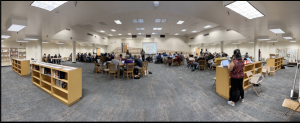
The remolded “Student Center” opened in 2022. Note the “mini library” to the left (2022).
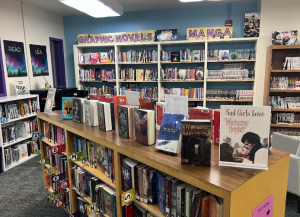
This is the current edition of the library (2026). Unfortunately I do not have a photo of the same angle.
Action Brief:
| Convince: | OTHS students | That by: | Participating in the Library Advisory group |
| They will: | Help design library programs, brainstorm new offerings, and contribute to collection development | Which will: | Increase student and staff engagement across the school |
| Because: | We want to challenge our community’s assumptions about libraries and reimagine what is possible. |
Although OTHS library users provide informal feedback, most of that input comes from students and staff who already use the library. Based on rough estimates, the library currently reaches a little less than one-third of the school community. A core group of students uses the library regularly, but most new users discover it through class visits. By increasing student engagement and input, the goal is to encourage students to use the library beyond scheduled class visits.
Guidelines & Policies
For fundraising purposes, the Library Advisory group must operate as a student-run club, with the teacher librarian serving as advisor. Because it will function as a student-led club, students will help determine its policies while following school guidelines:
-
-
- Clubs must be open to all students.
- Club meetings must take place on campus.
- Students cannot be required to pay membership dues.
- Clubs may become inactive if financial and documentation procedures are not completed.
- An advisor must be present at all meetings. (Oakland Technical High School, 2025)
-
Students may request voluntary membership contributions, but this approach conflicts with library values and would not be permitted by the advisor. Any funds raised by students should be spent only on priorities approved by the advisory group. To launch the club, one student will need to serve as president, and two additional students will need to serve as secretary and treasurer. The club must also be approved by the ASB leadership group.
Timeline for Implementation
In past years, club applications have typically been due sometime in September. To support consistent progress on programming and space revisioning, the advisory group should meet weekly or biweekly for planning. One proposal is for students to host or develop a monthly lunchtime program. Mx. Grewal can support the group by submitting a DonorsChoose proposal for needed materials and tapping into other avenues for funding or donations.
Marketing and Promotion
The OTHS Library does not currently have an Instagram account, so creating one could help connect with students. Many student clubs and academies already use Instagram to share information. The Library Advisory group could use the account to promote meetings, programs, and updates, as well as gather feedback through polls. The library also has a hallway display case where programs can be advertised. In addition, Mx. Grewal has access to the TV across from the main entrance, which can be used to promote events and reading incentives.
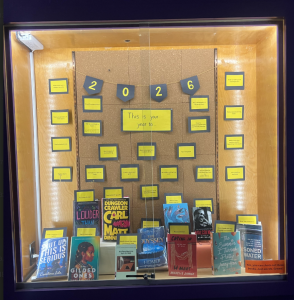
The hallway display case the library can use (2026).
The Library Advisory group could also collaborate with other campus clubs. For example, the library has previously hosted screenings from the Arab Film and Media Institute and could partner with the Muslim Student Union for similar events or displays related to cultural and religious holidays. The Sustainability Club is interested in starting a seed library hosted by the library; the Library Advisory group and Sustainability Club could co-host events in the garden or library focused on growing plants or saving seeds. The fact of the matter is, there is funding, it does not go to the library beside for my salary. So, we need to get creative about how to tap into other people’s funding. Can we can get money from VAPA (visual and performing arts) to get supplies for monthly art programming or books which highlight different kinds of visual and performing art? The different academies on campus have access to college and career funding, is there a way that the library could host an activity, speaker, or event that is open to the whole school and allows all students to experience a program from the Engineering or Computer Academy? The students in Library Advisory would ideally be from different grade levels and different academies across campus to help brainstorm a specific event.
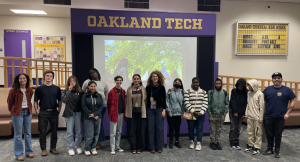
Arab Film and Media Institute film screening of Don’t Be Long, Little Bird (2025).
Staff Training & Readiness
Site visits to schools such as the Athenian School (Athenian School, 2025) and Berkeley High School (Berkeley Public Schools, 2026) where they have active student library advisory committees. It would be ideal if the student president was enrolled as a library IWE, independent work experience, as a class period. Part of their IWE period could be planning and prepping for the meeting to keep student engagement up.
Evaluation & Future Expansion
As a teacher I would get feedback from students every marking period asking them what was working, what wasn’t working, and what they wanted to see more of in the class. I adjusted my teaching based off their feedback.
Asking students in library advisory similar questions as an exit ticket for the meetings would be good for the president and the advisor to go over the feedback to adjust how the meetings are going and what we can offer to support the students in Library Advisory. 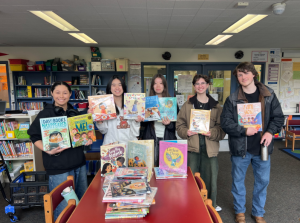
Library IWEs applied mylar to picture books for the local elementary school helping our OUSD library staff (2025).References:
The Athenian School. [@athenianschool]. (2025, April 10). Our Library Advisory Board—an Upper School student club for those with a passion for libraries and reading—took a field trip to the MLK Jr. Library in San Jose where they met with the directors of the acquisition, outreach… [Photograph]. Instagram. https://www.instagram.com/p/DISGtWesE_h/
Berkeley Unified School District Library Services. (2026, April). BUSD Library Advisory Committee. BUSD Libraries. https://library.berkeley.net/busd-library-advisory-committee
Oakland Technical High School. (2025, March 24). Oakland Technical High School: 2026-27 club application. [Google Docs]. https://docs.google.com/document/d/16f0X09oLVTcVCj2XUkg7ODak-aAuNVW97rpBg_if08Q/edit?tab=t.0
I think about library services from my lens as an educator and supporting students at a high school library. If we refer to Maslow’s Hierarchy of Needs, a community closet or collaborating with the food bank (Stephens, 2025), can support people in meeting their psychological needs (Aanstoos, 2024). In the reading, “Libraries in Balance” (2019), Stephens identifies that access to technology offerings are necessary for people to function in society and meet their basic needs and can provide an opportunity for skill building. With skill development, especially with technology, people can work towards being competitive in the job market. By supporting people in building skills, the library can support people with employment and help them meet their safety needs. The library also meets safety needs by offering space to protect people from environmental hazards, heat and cold, and a safe space to exist. I would also say ensuring people have access to the information they seek would fall under security. By providing a community closet or a care closet people can access materials that can help them get basic goods like toothpaste and a toothbrush, menstruation products, deodorant, etc. Approaching library services from a pedagogy of care (Yazdani, 2024), we see our patrons and show up for them in the best ways that we can.
From the lecture, the readings, and the research I did, a thorough line that I thought of was joy and bring joy to the community. The library can be a dynamic space that allows for joy, play, and exploration. I think there is always a need for joy and connectedness. The hyperlinked model of library services encourages us to identify available community resources and collaborate with partners. These partnerships can help patrons meet their physical and safety needs while also supporting moving up the Hierarchy of Needs for social connection, belonging, community, and inclusion (Aanstoos, 2024). Madison Public Library offers the community to submit a proposal their programming ideas happen in the library with the goal of “reflecting all of Madison” (Madison Public Library, n.d.). My fellow teacher librarian colleague, Sam Soloman, hosted Learn it in the Library, a monthly program where she hosts teachers and students to share skills, like origami and crochet. This allows students to connect with one another across grade level and connect with their teachers in a different way. Hyperlinked libraries and organizations are incorporating ways to see their patrons and communities and then responding to what they see in ways that allow for connection, joy, and support.
I am also reminded of a hyperlinked community I did my work study for in graduate school at Western Washington University. I supported logistics and programming for the Center for Community Learning, located in the WWU library. Community Engagement Fellows brought together community members in facilitated conversations with one another across the city of Bellingham, Whatcom and Skagit Couty, and internationally. Through conversations, brainstorming, and reflections, community members could solve problems together and work towards to solutions to co-create an community they longed for.
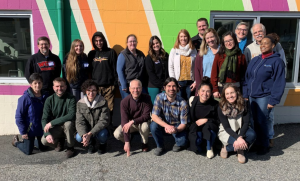
A Community Engagement Fellows meeting in Bellingham, WA (2020)
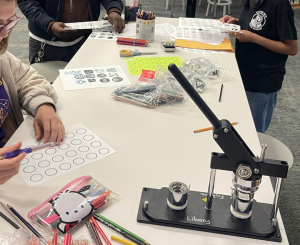
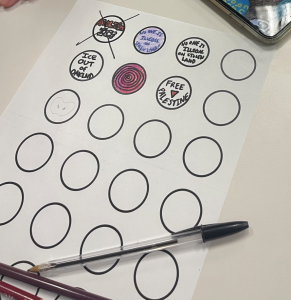
Students participating in pin back button making as a form of protest and expression after ICE terrorized a family in Oakland (2025).
References
Aanstoos, C. (2024). Maslow’s hierarchy of needs. EBSCO Research Starters. https://www.ebsco.com/research-starters/psychology/maslows-hierarchy-needs
Community Engagement Fellows. (n.d.). Community engagement fellows:
2026 winter cohort. https://www.cefellows.org/cohorts
Madison Public Library. (n.d.). Library takeover. https://www.madisonpubliclibrary.org/engagement/library-takeover
Stephens, M. (2019). Wholehearted librarianship: Finding hope, inspiration, and balance. ALA Editions.
Stephens, M. (2025). Hyperlinked communities [Lecture recording]. Canvas. https://sjsu-ischool.hosted.panopto.com/Panopto/Pages/Viewer.aspx?id=3eacdb23-84fd-49e5-9975-aef3014b3ed2
Yazdani, N. (2024). A pedagogy of care in academic libraries: A framework to increase underrepresented communities’ sense of belonging and engagement. Journal of the Australian Library and Information Association, 73(4), 505–528. https://doi.org/10.1080/24750158.2024.2391224
For my Assignment X, I was curious about the ways in which libraries globally are pushing forward the idea of what a library can be. What are some ways communities are shifting and changing to meet this moment of information overload and slop, and continuing to provide access to information, media, and tools. I am interested in how libraries support creatives and encouraging people to connect and create in a time where algorithms are companions and critical thinking can be farmed out.
The first time I saw a library as a “technological-intellectual infrastructure” (Mattern, 2014), was visiting the Central Branch of the Vancouver Public Library in 2018. I was visiting my aunt and walked around in awe after their Phase One redesign (Vancouver Public Library Foundation, n.d.) I remember a hum of activity on the first floor, and it was clear that the library was offering a third space right in the heart of downtown as a space for people to meet and collaborate. From our reading we have the Danish example of Library as a Universe through the Mindspot program out of the Aarhus Public Libraries (transformationlab, 2009). Aarhus continues to bring people together through creative library programming. Its Next Library program gathers librarians to exchange ideas about the future of libraries (Aarhus Public Libraries, n.d.). In collaboration with the Chicago Public Library, Aarhus also helped create a Design Thinking toolkit that supports patron engagement. Aarhus remains committed to expanding the possibilities of what a library can be.
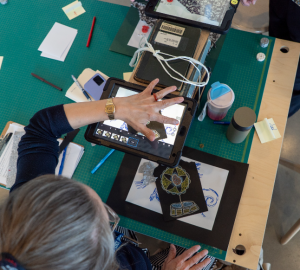
Image from Next Library website (Next Library, 2026)
In Helsinki, the Oodi library has been a place for collaboration and a third space. After books, the most borrowed items are spaces (Benke, 2026). The Oodi library and libraries in Finland are thriving, with high usage – over half the population (55%) uses the library at least once a month (Benke, 2026). Finnish libraries and librarians are supporting patrons with digital services. In 2019 all government programs can be accessed digitally, and librarians have taken on becoming digital tutors to support patrons (Ojaranta & Litmanen-Peitsala, 2019). Other services include maker-space materials like sewing machines, laser cutters, 3D printers and heat presses for use in the library.
Different regions of China have adopted varied approaches to meet the needs of their patrons. For example, last year the Ningbo Library broadcast the 700th episode of Tianyi Night Reading, a nightly two-minute video series featuring book recommendations from different people in Ningbo (Ningbo Library, 2025). Recommendations have come from cultural celebrities, truck drivers, craftspeople, and foreigners, reflecting a wide range of community voices (Ningbo Library, 2025). The Ningbo Library has also reported an increase in borrowing rates since Tianyi Night Reading (Ningbo Library, 2025). Ningbo Library has the Tianyi Book Reservation program for patrons to request books by mail for 6 yuan or use the digital library services for patrons unable to make it to the library (Ningbo, 2023). In Foshan, residents can apply to host a Neighborhood Library, commonly known as “N-Library,” a small public library located in people’s homes; this program makes library resources more accessible to community members. N-Library hosts can check out 200 items at a time, while the public library provides literature resources, service support, and assistance in establishing a reading space (International Federation of Library Associations and Institutions, 2021). The N-Libraries have been credited with increasing neighborhood communication and strengthening community ties (International Federation of Library Associations and Institutions, 2021). Beijing has designed a multiuse space that serves the needs of the community, offering a museum space, music venue, and a metaverse experience hall (International Federation of Library Associations and Institutions, 2024). In addition to these services, they also have a 24-hour reading room with self-service check-in and check-outs (International Federation of Library Associations and Institutions, 2024).
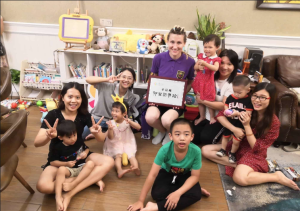
Children and their parents at home of the Xiaochenxi Neighborhood Library by Foshan Library under CC BY 4.0 (Foshan Library, 2021).
From this very small sampling of how libraries are incorporating hyperlinked library practices (Stephens, 2016), to adapt to meet the needs of the users where they are at. These examples can encourage us to think in ways that are more creative and dream of spaces that better serve our communities. If we think about libraries in a world of possibilities, what can we achieve?
References:
Aarhus Public Libraries. (n.d.). Next library. https://www.nextlibrary.net/
Benke, E. (2026, June 18). Not just books – how renting a sewing machine from the library can improve democracy. BBC Future. https://www.bbc.com/future/article/20260618-the-weird-and-wonderful-libraries-of-finland
International Federation of Library Associations and Institutions. (2021, February 3). Neighbourhood libraries in people’s homes promotes reading and community integration. Library Map of the World. https://librarymap.ifla.org/stories/neighbourhood-libraries-in-peoples-homes-promotes-reading-and-community-integration
International Federation of Library Associations and Institutions. (2024, November 30). From books to digital worlds: The Beijing Library’s role in shaping a community-centered future. https://www.ifla.org/news/from-books-to-digital-worlds-the-beijing-librarys-role-in-shaping-a-community-centered-future/
Mattern, S. (June 2014). Library as infrastructure. Places Journal. https://doi.org/10.22269/140609
Next Library. (n.d.). Frontpage. https://www.nextlibrary.net/
Ningbo Library. (2023, January 5). The AI services of Ningbo Library. https://en.nblib.cn/information/2723
Ningbo Library. (2025, November 30). “Tianyi Night Reading” has reached its 700th issue, a bookish promise cherished by the people of Ningbo. https://en.nblib.cn/information/2803
Ojaranta, A., Litmanen-Peitsala, P. (2019). Digital skills in Finnish public libraries to engage in the national operating model for digital support for citizens. IFLA WLIC. https://repository.ifla.org/rest/api/core/bitstreams/eb8e82cc-e0dc-47d8-9c2e-b07a613b5fa9/content
Stephens, M. (2016). The heart of librarianship: Attentive, positive, and purposeful change. ALA Editions.
transformationlab. (2009, April 20). Mindspot the movie: The library as a universe [Video]. YouTube. https://www.youtube.com/watch?v=ixsOLvLSARg
Vancouver Public Library Foundation. (n.d.). Central library renewal campaign. Vancouver Public Library Foundation. https://vplf.ca/capital-campaign/
My name is Liz Grewal (they/them), and I am a teacher librarian at a public high school in Oakland. I have been working in this role for 2 years now, and I love working with teens. I have two more semesters left for my MLIS. In addition to this class I am also interning at my local public library with the children’s librarian, and I am excited to gain a new perspective on librarianship. There has been a lot of joy in the library with the launch of the summer reading program, and it has been fun interacting with a different age group of youth.
I don’t have a strong tech background, and I am excited to try new things and learn new skills to take back to the high school library. My goal for next school year is to build out a website with resources for staff and students. I also support staff with research and assignments, and I am excited to hopefully bring in some ideas for assignments or checks for learning that use technology in a meaningful way. With LLMs improving and students plagiarizing AI work as their own, there has been a real shift away from technology in school (in some ways I am supportive of this), but to a point where a teacher had students do research projects without using the internet. I hope to provide teachers and students opportunities to incorporate technology into education which are meaningful and productive.
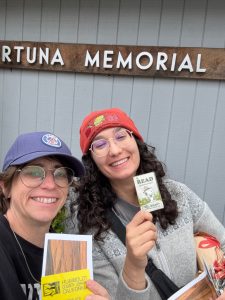
My friend and I (on the right) with our newest library card from Humboldt County, CA from a road trip up to Redwoods National and State Park.