Everyone has a story and a perspective to share, however, because of power structures our society has deemed some people’s stories more important than others. Human libraries, whose motto is “Unjudged Someone”, allows people, “human books”, who have been stereotyped in some way to volunteer to share their life experience to members of the community, “readers” (The Human Library Organization, n.d.; Wentz, 2013). Readers can browse a catalogue of books to gain some background on the life experience or perspective of the book. When selected, the readers meet with the books for a one-on-one conversation where they can ask questions, learn about different perspectives, and seek common ground.
Learning more about the Human Library, I began to think of “othering”, the categorization of people according to perceived difference or viewing people as inferior to alienate others (Curle, 2020). This focus on differences dismantles our ability to find similarities or identify connections. Without this sense of shared empathy for one another, “othering” can lead to discrimination, and in extreme cases the denial of someone’s humanity. When doing additional research on “othering”, fear came up; fear of the unknown, and fear of what is different. This fear is what can lead people to dehumanize others. Stephens discussed fear in an interview about his program at Dokk1’s Next Library (2019). With a fear and division palpable in U.S. politics and communities, Stephens says that libraries can push back against fear through the power of free information and welcoming everyone (2019). The first impact study was done for the Human Library, people who participated as Readers reflected on their own biases and were excited about their experience. When discussing the power of podcasts, Jason Evans Groth, digital media librarian at North Carolina State University Libraries, “If we help our patrons and our colleagues to share our library stories, we build and fortify a culture of accessibility and inclusion by making accessible the many stories that come out of our libraries” (Stephens, 2019). Inviting patrons to share their stories can take many forms, from Human Libraries to podcasts. The power in storytelling lies in bringing people together, helping us recognize one another’s humanity, and moving beyond assumptions.
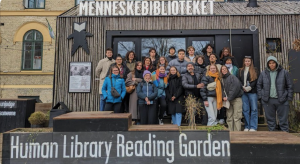
Participants in the Human Library program in Copenhagen.
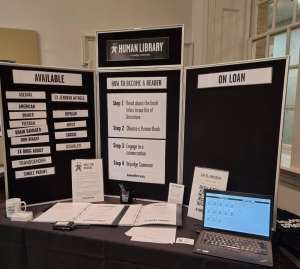
Available “books” for check out during a Human Library Program.
References:
Clint Curle. (2020, January 24). Us vs. Them: The process of othering. Canadian Museum for Human Rights. https://humanrights.ca/story/us-vs-them-process-othering
The Human Library Organization. (n.d.). About The Human Library. https://humanlibrary.org/about/
Stephens, M. (2019). Challenged but not dying, the public libraries are more relevant than ever.
Wentz, E. (2013). The human library: Sharing the community with itself. Public Libraries Online. https://publicl ibrariesonline.org/2013/04/human_librar/
Your blog post was quite thoughtful. I appreciated how you connected the Human Library concept to “othering” and fear, as it demonstrates that these programs do much more than simply encourage conversation. They can also help break down barriers that people may not even be aware of. Your post reminds me that libraries are uniquely positioned to build empathy and understanding, especially during times when communities feel divided.