I think about library services from my lens as an educator and supporting students at a high school library. If we refer to Maslow’s Hierarchy of Needs, a community closet or collaborating with the food bank (Stephens, 2025), can support people in meeting their psychological needs (Aanstoos, 2024). In the reading, “Libraries in Balance” (2019), Stephens identifies that access to technology offerings are necessary for people to function in society and meet their basic needs and can provide an opportunity for skill building. With skill development, especially with technology, people can work towards being competitive in the job market. By supporting people in building skills, the library can support people with employment and help them meet their safety needs. The library also meets safety needs by offering space to protect people from environmental hazards, heat and cold, and a safe space to exist. I would also say ensuring people have access to the information they seek would fall under security. By providing a community closet or a care closet people can access materials that can help them get basic goods like toothpaste and a toothbrush, menstruation products, deodorant, etc. Approaching library services from a pedagogy of care (Yazdani, 2024), we see our patrons and show up for them in the best ways that we can.
From the lecture, the readings, and the research I did, a thorough line that I thought of was joy and bring joy to the community. The library can be a dynamic space that allows for joy, play, and exploration. I think there is always a need for joy and connectedness. The hyperlinked model of library services encourages us to identify available community resources and collaborate with partners. These partnerships can help patrons meet their physical and safety needs while also supporting moving up the Hierarchy of Needs for social connection, belonging, community, and inclusion (Aanstoos, 2024). Madison Public Library offers the community to submit a proposal their programming ideas happen in the library with the goal of “reflecting all of Madison” (Madison Public Library, n.d.). My fellow teacher librarian colleague, Sam Soloman, hosted Learn it in the Library, a monthly program where she hosts teachers and students to share skills, like origami and crochet. This allows students to connect with one another across grade level and connect with their teachers in a different way. Hyperlinked libraries and organizations are incorporating ways to see their patrons and communities and then responding to what they see in ways that allow for connection, joy, and support.
I am also reminded of a hyperlinked community I did my work study for in graduate school at Western Washington University. I supported logistics and programming for the Center for Community Learning, located in the WWU library. Community Engagement Fellows brought together community members in facilitated conversations with one another across the city of Bellingham, Whatcom and Skagit Couty, and internationally. Through conversations, brainstorming, and reflections, community members could solve problems together and work towards to solutions to co-create an community they longed for.
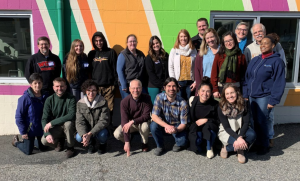
A Community Engagement Fellows meeting in Bellingham, WA (2020)
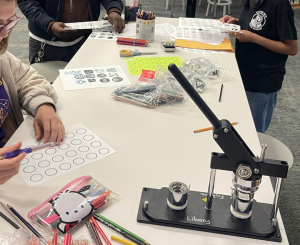
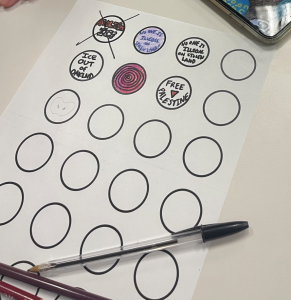
Students participating in pin back button making as a form of protest and expression after ICE terrorized a family in Oakland (2025).
References
Aanstoos, C. (2024). Maslow’s hierarchy of needs. EBSCO Research Starters. https://www.ebsco.com/research-starters/psychology/maslows-hierarchy-needs
Community Engagement Fellows. (n.d.). Community engagement fellows:
2026 winter cohort. https://www.cefellows.org/cohorts
Madison Public Library. (n.d.). Library takeover. https://www.madisonpubliclibrary.org/engagement/library-takeover
Stephens, M. (2019). Wholehearted librarianship: Finding hope, inspiration, and balance. ALA Editions.
Stephens, M. (2025). Hyperlinked communities [Lecture recording]. Canvas. https://sjsu-ischool.hosted.panopto.com/Panopto/Pages/Viewer.aspx?id=3eacdb23-84fd-49e5-9975-aef3014b3ed2
Yazdani, N. (2024). A pedagogy of care in academic libraries: A framework to increase underrepresented communities’ sense of belonging and engagement. Journal of the Australian Library and Information Association, 73(4), 505–528. https://doi.org/10.1080/24750158.2024.2391224
I really enjoyed reading your post and how you mentioned that libraries can meet several tiers of Maslow’s hierarchy of needs. In my local public library, we have a community fridge managed by the Boys and Girls Club, and residents can put extra food in there for the community to have. Moreover, we have Stargazing Kits for check out at the circulation desk; this would kickstart any child’s interest in astronomy!
Ruby, Thank you so much for sharing! Wow, I love the idea of a community fridge. I work at a school and I and many other teachers would use our own money to buy kids snacks. Kids should not be hungry at school, kids should not be hungry anywhere, people should not be hungry. I really think something like that should be available to kids at school, we have free lunch for kids only, and if you’re really nice they’ll give teachers a piece of fruit, but they are hungry at so many other points throughout the day. Why don’t we just have food around the school for kids to eat??
@lizgrewal I really like the idea around the program Learn It at the Library. This works on so many levels for getting Students together, especially across grade levels.
Hello Professor Stephens, Thank you! It is a program I am hoping to implement at my site next year, and expanding it for students to teach something as well.