Category: Uncategorized (Page 1 of 2)
Inspiration Report: Community Storytelling (Canva Slideshow)
This inspiration report (PDF) focuses on one approach for libraries to harness The Power of Stories. Drawing from the literature on participatory storytelling and its role in public libraries as well as from interactive storytelling installations at art and literature museums, this three-part, multi-modal program offers patrons several ways to share their stories with their community. First, a highly visible story wall allows patrons to easily add a story at their leisure and gets them accustomed to the idea of sharing publicly. Next, a more in-depth storytelling workshop and live performance will bring interested parties together and build networks in the community, contributing to a stronger social infrastructure and sense of camaraderie. Finally, a dedicated patron story page on the library website with an accompanying submission form will allow patrons to share their story virtually with the community.
Thanks for taking a look!
Our INFO 287 “Infinite Learning” modules contained many insightful takeaways about how and why libraries and librarians need to prioritize engaging, participatory learning opportunities—for themselves and their patrons. As Michael Stephens (2016) wrote in The Heart of Librarianship, librarians are no longer (and perhaps never really were) just peddlers of books: they are now “facilitators of learning” (p. 120) and “community learning connectors” (p. 122). I don’t know about you, but I find this framing exhilarating and inspiring. I created an infographic, displayed below, to try to capture some of the characteristics of infinite learning that Stephens presents in his writing.
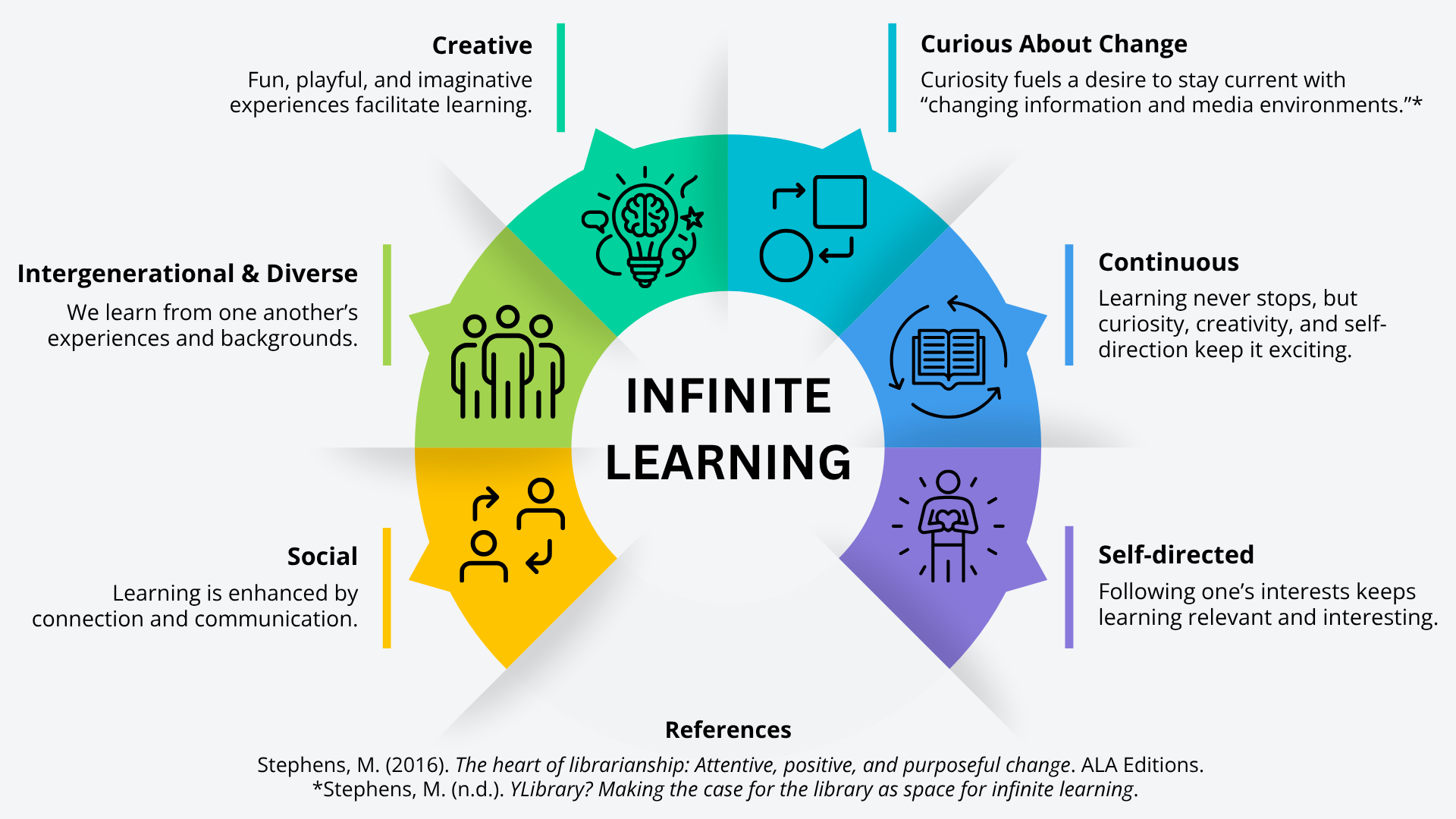
Libraries have become “collaborative spaces that facilitate lifelong learning and help our communities develop literacies that are necessary for successful functioning in today’s society” (Stephens, 2016, p. 119). Modern libraries can facilitate this learning by adopting what Henry Jenkins (2012) identifies as “a learning ecology within which learning occurs everywhere” and by eliminating “some of the obstacles which block the flow of information, knowledge, skills, and wisdom between different sectors.” I love this idea of breaking down the barriers that exist between different groups of people and the knowledge they possess: What could children learn from community elders? Could an artist and a historian collaborate to create a visual representation of a town’s history? What if a local scientist could explain to residents why a particular ecological phenomenon is occurring in their neighborhood? This kind of approach requires that librarians stay curious and informed about how to shape this learning ecology—as Stephens (2016) notes, this type of facilitation “requires well-trained, user-focused staff who understand how people of all ages can learn socially” (p. 128).
At the heart of this module is the simple fact that change is inevitable, and being a thoughtful and engaged citizen in this world requires that we maintain curiosity about those changes and apply what we learn to our lives (and those of others). I would argue that, in addition to keeping us professionally relevant, adopting a mindset of infinite learning will equip us to deal with many of the major challenges of our time. From the climate crisis to political instability to breakneck technological shifts related to AI, staying curious and keeping ourselves educated about the facts allows us to participate in creating solutions. As Jenkins (2012) noted about a learning ecology, “I especially value the focus here on participation—in the learning process, in the governance of society—since the struggle to achieve a more participatory culture remains one of the central battles of our times.”
Prioritizing self-directed, continuous learning for ourselves and our patrons gives us all a role in constructing the kinds of communities we want to live in. My favorite author, Rebecca Solnit, recently said this about her writing: “I want people to read it, I want them to maybe enjoy the writing, but I also wanted to give them tools to go out into the world and participate in how we change the world because that it’s changing is inevitable. How it changes depends on how we show up” (Defebaugh, 2026). Encouraging and facilitating infinite learning in our libraries is a way that we, too, can help our patrons access the tools they need to participate in changing the world.
References
Defebaugh, W. (Host). 2026, June 23). Rebecca Sonit: Why cynicism feels smart—and isn’t (No. 27) [Audio podcast episode]. In The Nature Of. Atmos. https://atmos.earth/podcast/rebecca-solnit-why-cynicism-feels-smart-and-isnt/
Jenkins, H. (2012, March 1). Connected learning: Reimagining the experience of education in the Information Age. Pop Junctions. https://henryjenkins.org/blog/2012/03/connected_learning_a_new_parad.html?rq=Connected%20Learning
Stephens, M. (2016). The heart of librarianship: Attentive, positive, and purposeful change. ALA Editions.
Stephens, M. (n.d.). YLibrary? Making the case for the library as space for infinite learning. https://www.dropbox.com/scl/fi/4zt1yliwb2ffzr8euix2p/YLibraryInfiniteLearning.pdf?rlkey=m0v6lkd43ufilkp5aktawhlpr&e=2&dl=0
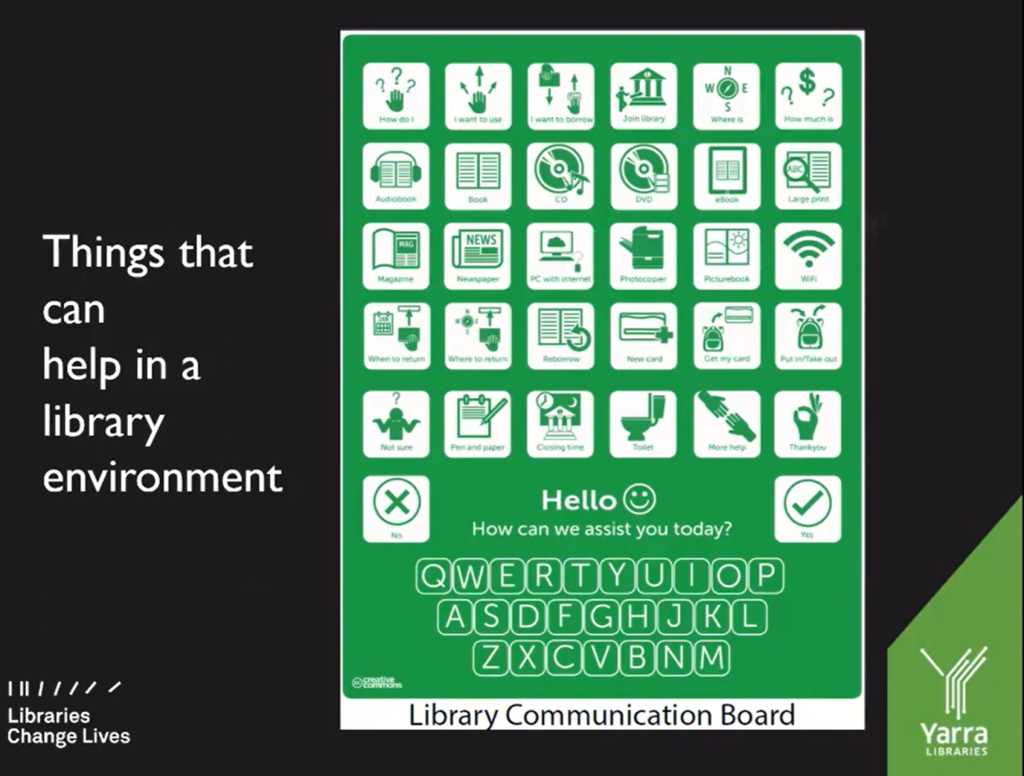
At the end of April, my family and I had the pleasure of exploring a few places in Ireland, including the city of Limerick, which we adored. On a beautiful sunny day, we walked around People’s Park, and naturally my kids were drawn to the playground. In addition to the in-ground trampoline, something stood out to me—a board at children’s height covered in little pictures that could be used to indicate emotions, activities, and directions. I was intrigued and pointed it out to my family, but in the bustle of international travel, I quickly forgot about it. Then came our INFO 287 module on The Power of Stories and Kylie Carlson’s story about her sons’ autism and the ways in which the Yarra libraries are serving people like them (Library 2.0, 2020). Carlson showed a picture of a library communication board that they use for patrons who do not have speech or require more visual methods of communication.
It turns out the communication board I saw in Limerick was one way that the People’s Park playground was designed to be inclusive and accessible to all children. Opened in 2023, it also features the aforementioned trampoline as well as a “fully accessible roundabout… and sand digger, while other equipment is thoughtfully designed for accessibility through transfers” (Lynch, 2023). The playground was designed “to provide children of all abilities and ages with an environment that fosters inclusive play, accessibility, and boundless imagination” (Lynch, 2023). These are all goals that this course has been emphasizing for our libraries, and I love visual communication boards as a symbol of how these ideals have been instituted in some libraries.
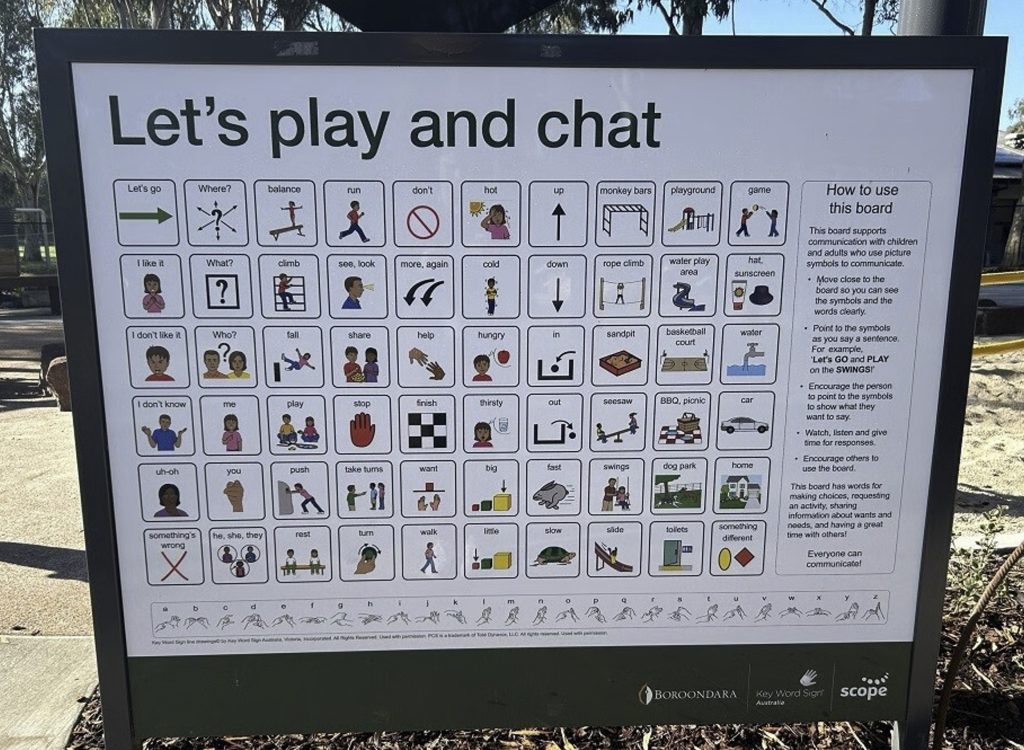
Communication board created by Scope Disability Services for Hays Paddock Playground in Boroondara, Australia, that includes instructions for how people can use the board. https://www.scopeaust.org.au/business-solutions/park-and-playground-communication-boards
As one Missouri Parks and Recreation department put it, the presence of these boards “ensures that every child has an opportunity to communicate and engage with their surroundings” while also promoting public awareness of communication barriers and encouraging learning for everyone (JC Parks, n.d.). I appreciate this approach because storytelling and story keeping are our superpowers as library professionals, but making sure that everyone is able to tell their story in their own manner is a challenge that we must continually address.
In this video, teachers from the Sumner-Bonney Lake School District in Washington talk about the communication boards and how they facilitate students’ expression of their needs on the playground. Larisa Sanchez, a speech and language pathologist, puts it this way: “everybody needs a little bit of help—you and I can get frustrated and have trouble finding our words, which I do very often, and if I had a visual of it, it’d be really helpful.” These board are such a simple way to make storytelling more accessible, and it makes me wonder—what are some other ways we can make it as easy as possible in our libraries to help our patrons tell their stories?
References
Emerald Hills Elementary School. (2025, March 30). Playground communication boards help students find a voice. https://ehe.sumnersd.org/our-school/our-school/ehe-news-details/~board/sblsd-stories/post/playground-communication-boards-help-students-find-a-voice
JC Parks. (n.d.) Enhancing play through communication boards. City of Jefferson (Missouri) Department of Parks & Recreation & Forestry. https://www.jcparks.com/inclusive-play-communication-boards/
Library 2.0. (2020, March 11). The power of stories [Video]. YouTube. https://www.youtube.com/watch?v=dvZlTRTVX10&t=617s
Lynch, Richard. (2023, September 5). Limerick City’s first fully-inclusive playground has been unveiled at the People’s Park. ILoveLimerick.com. https://www.ilovelimerick.ie/peoples-park-fully-inclusive-playground/
Sumner-Bonney Lake School Distict. (2025, March 19). Playground boards help students find a voice [Video]. YouTube. https://www.youtube.com/watch?v=DFlR-sTthak&t=66s
One of our course materials for this module that stood out to me was Tom Scott’s video about robots performing library tasks in Helsinki. Among their roles is sorting and shelving books. Of this work, he comments, “don’t waste a librarian’s time with tasks that a computer can now do.” But this made me wonder—could the robots potentially be taking away that work from a library tech or paraprofessional who may enjoy the work or wants to work at a library but doesn’t have an MLIS? How much do the robots cost versus the hourly wage of a human, and is that even the best way to determine which jobs should be replaced or automated? These questions seem especially relevant today when so many people are worried (rightly so, in my opinion) about how their job prospects will be affected by the newest AI applications (Wasik, 2026).
In the video, Scott ends with the statement “most libraries don’t have robots, but every library does have librarians—and they’re what’s important.” In the comment section under the video, Scott reiterates this point that people are integral to the functioning of a library—robots not so much.

In this moment, when it can feel like there is a rush to integrate new technology into our institutions to stay current, I think it’s especially important to recenter humans in the conversation. Whose livelihood might be impacted by turning to AI agents to serve our patrons? Will patrons enjoy interacting with new technology at every turn, or will they miss some of the human touches that staff traditionally brings to their experience?
The most touching—and arguably, meaningful—new horizon featured in this module was the trend of libraries employing social workers to uplift and assist members of their community that have the greatest needs (State Library of Iowa Continuing Education, 2023; Wright, 2023). Pam Sandlian Smith’s (TEDx Talks, 2013) account about the unhoused boy who put on a puppet show in her library for 30 patrons also highlights how the smallest interaction can make the biggest difference.
I appreciate that this class encourages us to approach technology from a humanist perspective, and this seems like the approach that most people in our communities are rallying for. In addition to highlighting AI, the 2024 IFLA Trend Report pointed to people seeking connection as a major trend. I believe it is our job going forward to honor and prioritize this need for connection as we make decisions about technology (and spending) in our institutions.
Resources
International Federation of Library Associations (IFLA). (2024). IFLA Trend Report 2024: Facing the future of information with confidence. https://repository.ifla.org/items/ae4dfcc0-8def-4318-8c4c-7f0507d15609
Scott, T. (2019, October 14). Why Helsinki’s library robots aren’t important. [Video]. YouTube. https://www.youtube.com/watch?v=dPb9o3uDF_Q&t=217s
State Library of Iowa Continuing Education. (2023, February 14). The Outreach Project: A library-social work partnership. [Video]. YouTube. https://www.youtube.com/watch?v=7iquPzVICfI&t=2808s
TEDx Talks. (2013, December 16). What to expect from libraries in the 21st century: Pam Sandlian Smith at TEDxMileHigh. [Video]. YouTube. https://www.youtube.com/watch?v=fa6ERdxyYdo&t=148s
Wasik, B. (Moderator). (2026, June 14). The A.I. Work Force Is Here. The New York Times Magazine, 26. https://link-gale-com.libaccess.sjlibrary.org/apps/doc/A892167974/STND?u=csusj&sid=bookmark-STND&xid=9a6536d1
Wright, G. (2023, April 10). Des Moines Public Library adding social worker position. WHO 13 Des Moines. https://who13.com/news/metro-news/heres-what-services-the-des-moines-public-librarys-social-worker-position-will-provide/
Community dialogues are “places for community members to come together, create new social ties (or reinvigorate old ones), discuss difficult topics and to better understand each other and their changing worlds” (Knology, 2023). For my Innovation Roadmap project, I’ve examined how a local library like my own might implement a community conversation program.
Here is a PDF of the slideshow with clickable links to resources. Enjoy!
One of the things that stands out to me in our readings about hyperlinked environments is that while the physical space of a library is important, being intentional—and expansive—about creating a welcoming environment is paramount. DOKK1 in Aarhus is an example of cutting-edge library architecture, but its beauty lies not just in its stunning views or sleek shelving but also in the way the space was designed to fully serve the people who use it.
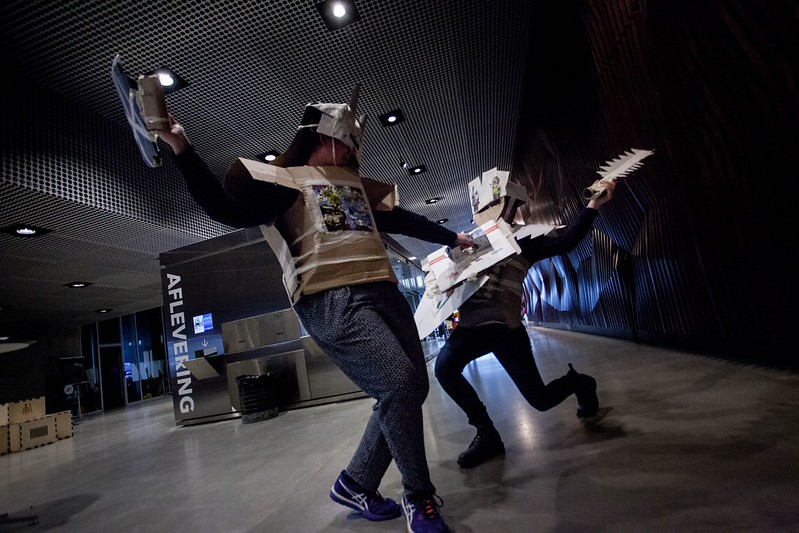
Cardboard Knights at DOKK1: https://www.flickr.com/photos/aakb/28134774212/in/album-72157668074145883
DOKK1 “is based on a vision that is strongly inspired by the [four-space] model,” which describes “four different spaces, or universes, that the library can include” and examines “how the library can be developed from a passive collection of books and other media into an active meeting place to create connections between people, experiences, learning and inspiration” (Skot-Hansen, 2017).
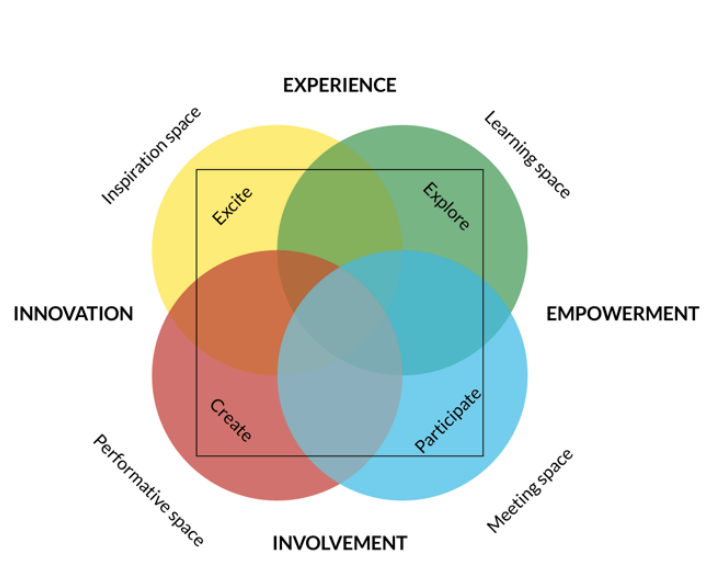
Diagram depicting the four-space model (Skot-Hansen, 2017).
This thoughtful approach to creating hyperlinked, community-focused environments is just as applicable to my neighborhood library as it is to an award-winning feat of design. Smaller public libraries may be working with less money and smaller spaces, but they can still prioritize using the space they have in ways that will best work for their patrons. Given my interest in the intersection of libraries and democracy, I was thrilled to find a recent discussion by Rasmussen and Larsen (2026) about “the democratic role of libraries” (p. 127) based on the four-space model. In their version of the diagram, “Rights, Citizenship, Public Sphere, and Influence … represent the key dimensions of democracy,” while “Access, Education, Dialog, and Participation … broadly illustrate how public libraries can support these chosen dimensions of democracy” (p. 127).
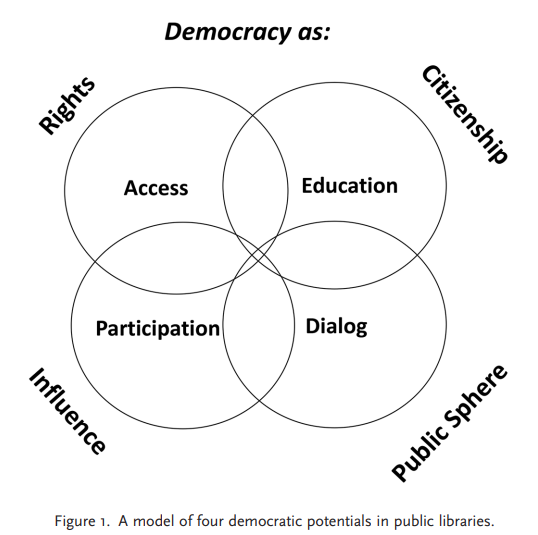
I love the idea that by fostering environments in which folks can learn and have important conversations, libraries are helping to cultivate a healthy democracy. Participatory service is a big part of this, as “participation represents a shift from providing services to their communities to working with them. From a democratic perspective, this approach can be seen as a revitalization of ancient direct democracy, where citizen participation was the foundation of democratic governance” (Rasmussen & Larsen, 2026, p. 127). Maybe this looks like community conversations about local events or issues, or maybe it could look like people learning from each other in more informal environments.
I’ve been amazed at the connections people have made in my monthly book club at the library—connections to each other, but also connections between their own lives and the books we read. A few months ago, we read The Briar Club by Kate Quinn. It’s a novel that takes place in McCarthy-era D.C., and one of the characters ends up working for Margaret Chase Smith—the first woman to serve as both a congressperson and a senator. In the book, the senator from Maine is preparing to deliver her “Declaration of Conscience” in opposition to McCarthyism.
One of my regulars appeared at that book club with handouts. She told us all that “Maggie” Chase Smith was a dear friend of her family’s growing up, and one year as a birthday present Maggie had given her a handwritten copy of the Declaration of Conscience. As a child, she was unimpressed with the gift, but now she was sharing with us how special it was. She then handed out copies of the speech to all of us to reflect upon later. When I think about this story, I see how libraries are perfect places for forging connections, having deep conversations, and cultivating “democratic potentials” (Rasmussen & Larsen, 2026).
References
Grant, R. (November 2021). How Memphis created the nation’s most innovative public library. Smithsonian Magazine.
Rasmussen, C. H., & Larsen, H. (2026). Four democratic potentials in public libraries: A model. The Library Quarterly, 96(2), 123–139. https://www.proquest.com/docview/1154264155/fulltextPDF/BF8F14C994044258PQ/1?accountid=10361&sourcetype=Scholarly%20Journals
Richardson, H. C. (2026, June 1). Margaret Chase Smith’s “Declaration of Conscience,” Narrated by Governor Janet Mills [Video]. YouTube. https://www.youtube.com/watch?v=F13vuHGf44U&list=PL2dS6uX1RkUzLppeUrqtvApwnR6whO7I_&index=46
Skot-Hansen, D. (2017) Library development: From collection to connection. Impact of Humanities Research: 24 Case Studies. University of Copenhagen Faculty of Humanities. https://287.hyperlib.sjsu.edu/wp-content/uploads/2025/02/4-Spaces-Model-from-Univ-Copoenhagen.pdf
There was a lot of meaty material in our Hyperlinked Communities module about building connections through conversation and engagement. I’ve found myself very interested in the role that libraries play in upholding democracies—a fitting subject as we approach the 4th of July and the 250th anniversary of the United States Declaration of Independence. The resources in this module drove home for me one of the ways that libraries do this: by facilitating discourse among people in a community. In her 2001 book Libraries and democracy: The cornerstones of liberty, Nancy Kranich wrote that
An informed public constitutes the very foundation of a democracy; after all, democracies are about discourse—discourse among the people. If a free society is to survive, … It must allow unfettered dialogue and guarantee freedom of expression. Libraries deepen the foundation of democracy in our communities. (p. v)
This kind of “unfettered dialogue” is also promoted by Casey and Savastinuk (2007) in their Library 2.0 approach to participatory library services:
As librarians, we know that a give-and-take conversation is critical to being understood. We work with the reference interview every day; the give and take of a dialogue can make conversations clearer and more easily understood. (p. 84)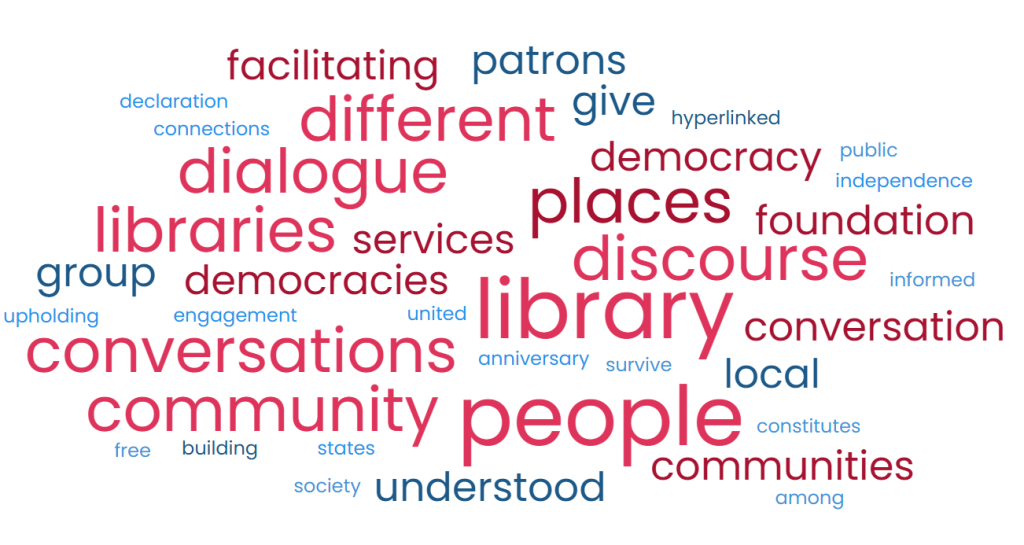
In 2025, my library hosted a book club in conjunction with the local police department that was facilitated by a library staff member and the relatively new chief of police. The book club, which included a discussion of the novel Widows of Malabar Hill featuring a character based on the first woman to become a lawyer in India in the 1920s, was an effort to strengthen ties between the community and the police after a tumultuous few years. It was attended by about 60 people and brought a diverse group together to have a dialogue about relevant, and somewhat controversial, issues but through the lens of historical fiction. It was a wild success, in my opinion. I would love to see more events like this at my library.
So I was thrilled to read Dixon’s “Convening community conversations” article about different ways that libraries are facilitating these conversations, sometimes around shared local history or by way of a film screening. Patrons participate in these dialogues with each other, but they also steer future library services. As Dixon notes, “group discussions can flourish when the patrons develop programs with local staff and feel empowered, coming up with ideas that matter to them” (p. 44).
This is democracy in action. As Ciara Eastell put it in her 2019 TEDx talk,
it’s the combination of the different activities and different people that give the library its life, its energy, its vitality…. libraries are the very definition of heterotopias, places of transformation, places of multiplicitous possibility, places that are inherently inclusive.
References
Casey, M. E., & Savastinuk, L. C. (2007). Library 2.0: A guide to participatory library service. Information Today. Inc. https://287.hyperlib.sjsu.edu/wp-content/uploads/2019/07/Library2.0Text.pdf
Dixon, J. A. (2017, October 15). Convening community conversations. Library Journal, 41–44. https://287.hyperlib.sjsu.edu/wp-content/uploads/2023/02/CONVENING_COMMUNITY_CONVERSATI.pdf
TEDx Talks. (2019, June 13). Ciara Eastell: How libraries change lives [Video]. YouTube. https://www.youtube.com/watch?v=Tvt-lHZBUwU&t=3s
Kranich, N. C, ed. (2001). Libraries and democracy: The cornerstones of liberty. American Library Association. https://ebookcentral.proquest.com/lib/sjsu/detail.action?docID=3001592
Participatory service is vital because so many elements of library design and service depend upon the patrons being served. It’s a good thing that librarians are committed to lifelong learning so they can approach their work with the “constant and purposeful change” discussed by Casey and Savastinuk in Library 2.0 (2007). Every community (and therefore its library patrons) has different needs! These needs are met in large and small ways—from creating breathtaking architecture that reflects a city’s design aesthetic to deciding where certain collections go so patrons can best find them. I am interested in how librarians can best leverage participatory service to foster social ties and nurture libraries as a vibrant third places in their particular communities.
The “Preferred Third Place”
How can a community’s library become “the preferred Third Place,” as Leferink (2018) put it, “where people let down their guard, relax, be themselves, develop new friendships, and deepen existing ones”? From our readings, it appears clear that one way is via participatory service. In “Age of Participation” from Wholehearted Librarianship, Professor Stephens says that “the era of participatory culture demands that cultural and information professionals play an active, visible role in our communities” (Stephens, 2016, p. 80). This was clear in the videos we watched in Module 4: from the “social librarian” at Dokk1 in Aarhus, Denmark, who engages the marginalized people served by Værestedet through the Dokk1 Writing program, to the gorgeous Oodi library in Helsinki that offers dedicated spaces for video gaming and cooking, to the YOUmedia labs at Chicago Public Library where youth get to be with their friends AND learn something.
While not all of our libraries will look like the Helsinki Central Library Oodi, we can tailor our offerings to the needs of our patrons. Abrams (2025) discusses the University of Amsterdam Library, which opened in September, 2025, and
shows what is possible when an institution takes this mission seriously. The building embodies a careful balance of past and future. … Crucially, the library’s planners sought input from students. They wanted not just a gleaming architectural statement but a place that worked for their daily lives: quiet study nooks, group work areas, and, importantly, stacks of actual books. Their preferences shaped the final design. The result is a building that feels human-scaled and welcoming rather than sterile or intimidating.
Abrams claims that this input from students contributed to its success as a third place and argues that “in an age of polarization and digital isolation, [third places] are more important than ever.”
Personal Connection and Empathy
Libraries already provide so many wonderful resources that people want and need, but analyzing how patrons use these resources and the ways that we can improve our offerings is a continual job. Additionally, fostering the role of libraries as third places means leaning into the personal connections people form there. As Leferink (2018) says, third places are “about sociability, not isolation.” I was reminded of this last week at the meeting of my monthly book club. I usually have about eight regulars, plus an occasional newbie. Several last-minute cancellations and two no-shows meant that I had two people attend that night. TWO! I lamented to other staff and hoped for a fruitful conversation anyway. I had some time beforehand to chat with my most faithful regular, a recent widow who explained to me that she saw a particularly isolating summer ahead as other groups were taking breaks and her friends were traveling with their families. I assured her that book club was still on for the summer months—no matter how many people showed up.
I was struck by Professor Stephens’s statement that “across our communities and across cultures, understanding, empathy, and kindness matter in everything we do. Technology extends human reach but participation requires engaged participants who feel welcome, comfortable, and valued” (Stephens, 2016, p. 81). I look forward to further exploring how to make my library patrons feel this way—now and into the future.
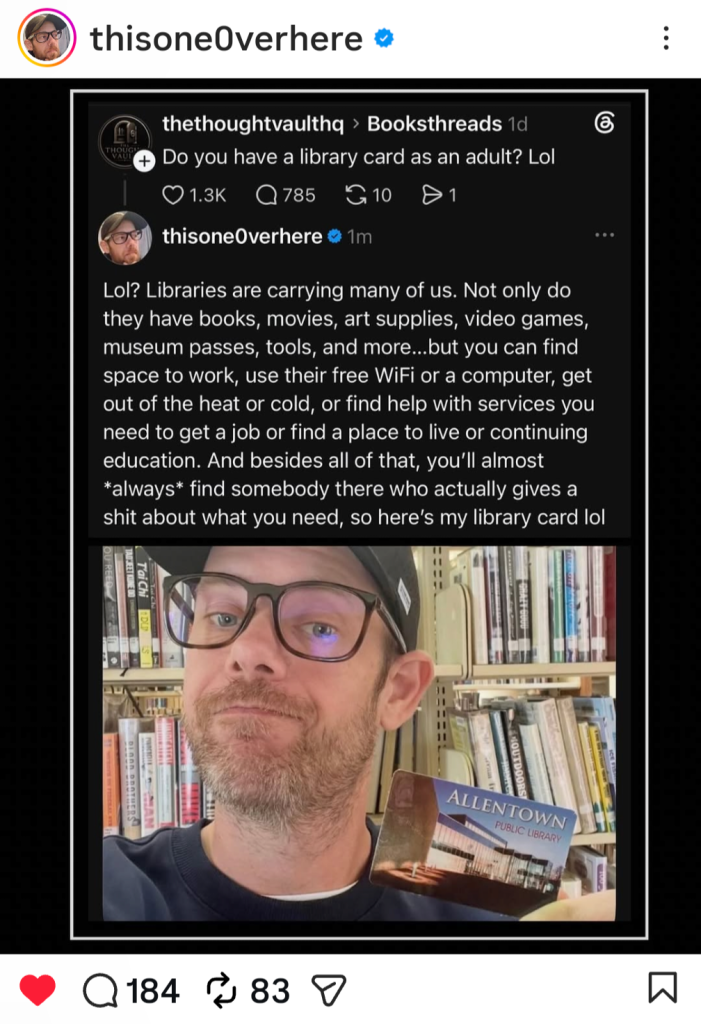
Jonathan Edward Durham, author and one of the funniest people on my IG feed, sums it up.
References
Abrams, S. (15 September, 2025) https://www.aei.org/society-and-culture/the-library-as-a-third-place-amsterdams-new-model-for-civic-life/
Casey, M. E., & Savastinuk, L. C. (2007). Library 2.0: A guide to participatory library service. Information Today.
Leferink, S. (2018, January 24). To keep people happy … keep some books. OCLC Next. https://blog.oclc.org/next/to-keep-people-happy-keep-some-books/
Stephens, M. (2016). The heart of librarianship: Attentive, positive, and purposeful change. ALA Editions.
I’ve had this experience frequently where I’m reading something that connects directly to something else I’ve recently read or heard about or thought about. I’ve decided to call this phenomenon “literary synchronicity,” and I think the story I told in my first post about the editor of The Encyclopedia of Community surreptitiously taking my picture at a protest after I had recently cited her book for INFO 200 falls into this category. Now I find myself with another instance of literary synchronicity on my hands, this time related to INFO 287.
Our current module includes a reading from Wholehearted Librarianship in which Professor Stephens discusses the book Dear Fahrenheit 451 by Annie Spence:
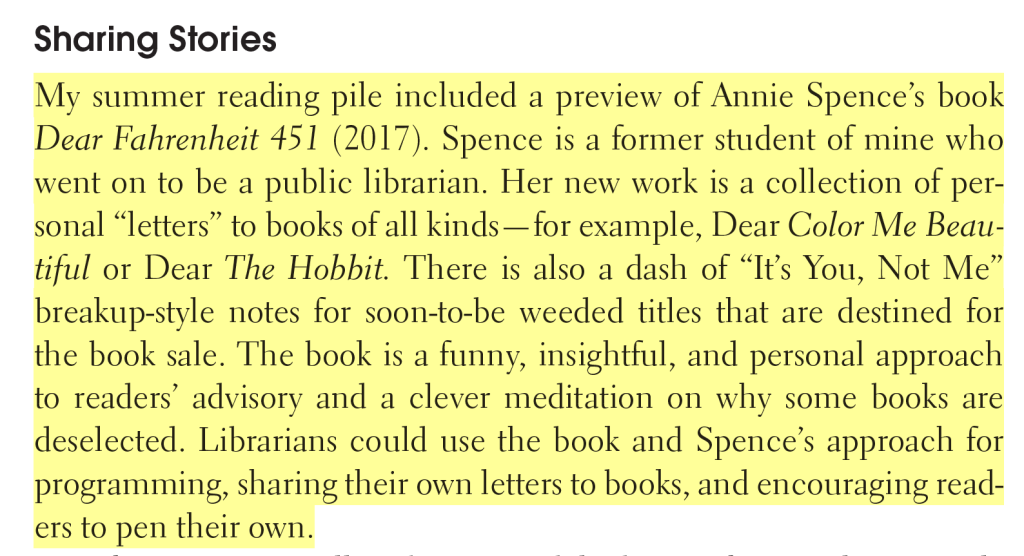
I haven’t read this book yet, but it has been sitting on a shelf above my desk for about two years, ever since I rescued it while weeding books that had been de-selected from my library’s collection. It even made an appearance in the banner of my main SJSU iSchool blog.
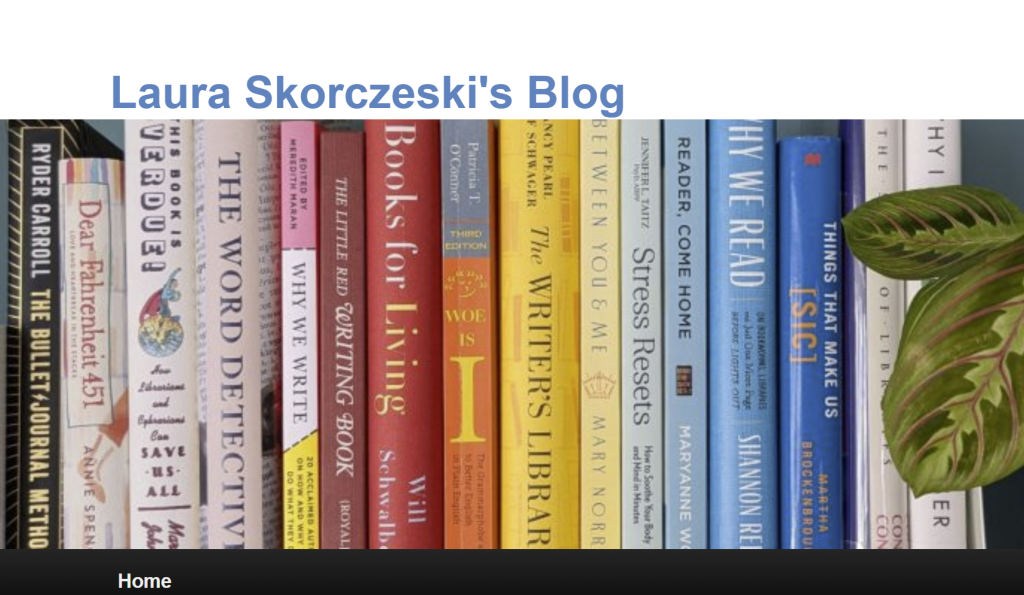
I think this probably means it’s time for me to crack it open and read it! Especially since I’ve expressed that the module on storytelling is the one I’m looking forward to the most. One day I’ll start to keep track of all of these connections, but I figured I’d at least I’d share this one here!