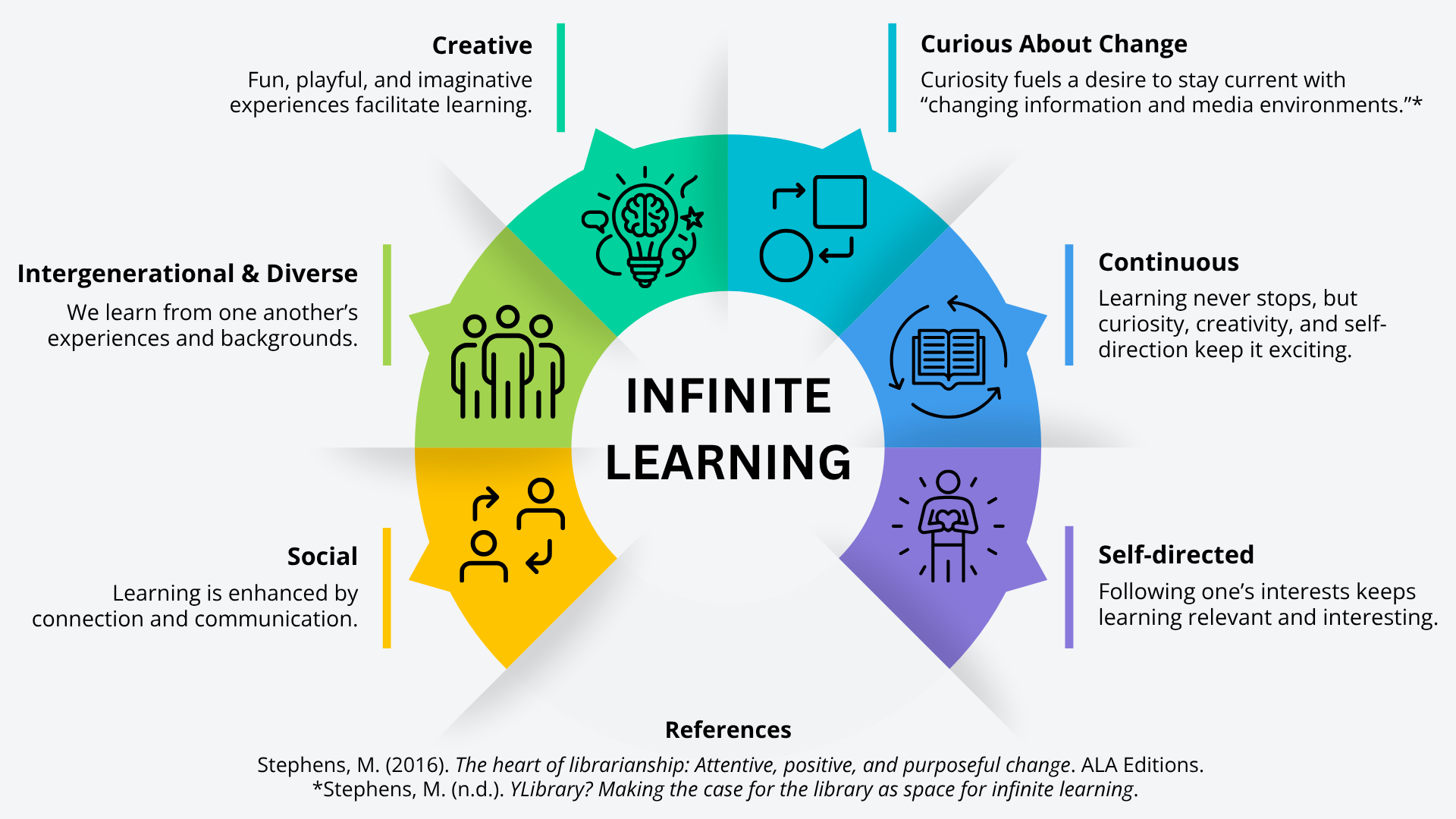
Our INFO 287 “Infinite Learning” modules contained many insightful takeaways about how and why libraries and librarians need to prioritize engaging, participatory learning opportunities—for themselves and their patrons. As Michael Stephens (2016) wrote in The Heart of Librarianship, librarians are no longer (and perhaps never really were) just peddlers of books: they are now “facilitators of learning” (p. 120) and “community learning connectors” (p. 122). I don’t know about you, but I find this framing exhilarating and inspiring. I created an infographic, displayed below, to try to capture some of the characteristics of infinite learning that Stephens presents in his writing.
Libraries have become “collaborative spaces that facilitate lifelong learning and help our communities develop literacies that are necessary for successful functioning in today’s society” (Stephens, 2016, p. 119). Modern libraries can facilitate this learning by adopting what Henry Jenkins (2012) identifies as “a learning ecology within which learning occurs everywhere” and by eliminating “some of the obstacles which block the flow of information, knowledge, skills, and wisdom between different sectors.” I love this idea of breaking down the barriers that exist between different groups of people and the knowledge they possess: What could children learn from community elders? Could an artist and a historian collaborate to create a visual representation of a town’s history? What if a local scientist could explain to residents why a particular ecological phenomenon is occurring in their neighborhood? This kind of approach requires that librarians stay curious and informed about how to shape this learning ecology—as Stephens (2016) notes, this type of facilitation “requires well-trained, user-focused staff who understand how people of all ages can learn socially” (p. 128).
At the heart of this module is the simple fact that change is inevitable, and being a thoughtful and engaged citizen in this world requires that we maintain curiosity about those changes and apply what we learn to our lives (and those of others). I would argue that, in addition to keeping us professionally relevant, adopting a mindset of infinite learning will equip us to deal with many of the major challenges of our time. From the climate crisis to political instability to breakneck technological shifts related to AI, staying curious and keeping ourselves educated about the facts allows us to participate in creating solutions. As Jenkins (2012) noted about a learning ecology, “I especially value the focus here on participation—in the learning process, in the governance of society—since the struggle to achieve a more participatory culture remains one of the central battles of our times.”
Prioritizing self-directed, continuous learning for ourselves and our patrons gives us all a role in constructing the kinds of communities we want to live in. My favorite author, Rebecca Solnit, recently said this about her writing: “I want people to read it, I want them to maybe enjoy the writing, but I also wanted to give them tools to go out into the world and participate in how we change the world because that it’s changing is inevitable. How it changes depends on how we show up” (Defebaugh, 2026). Encouraging and facilitating infinite learning in our libraries is a way that we, too, can help our patrons access the tools they need to participate in changing the world.
References
Defebaugh, W. (Host). 2026, June 23). Rebecca Sonit: Why cynicism feels smart—and isn’t (No. 27) [Audio podcast episode]. In The Nature Of. Atmos. https://atmos.earth/podcast/rebecca-solnit-why-cynicism-feels-smart-and-isnt/
Jenkins, H. (2012, March 1). Connected learning: Reimagining the experience of education in the Information Age. Pop Junctions. https://henryjenkins.org/blog/2012/03/connected_learning_a_new_parad.html?rq=Connected%20Learning
Stephens, M. (2016). The heart of librarianship: Attentive, positive, and purposeful change. ALA Editions.
Stephens, M. (n.d.). YLibrary? Making the case for the library as space for infinite learning. https://www.dropbox.com/scl/fi/4zt1yliwb2ffzr8euix2p/YLibraryInfiniteLearning.pdf?rlkey=m0v6lkd43ufilkp5aktawhlpr&e=2&dl=0
Hello Laura!
Great post! I think this philosophy of infinite learning also makes room for us to learn from those from various backgrounds, generations, and viewpoints rather than just the expert. As we learn and collaborate through community, more viewpoints and types of knowledge become valuable rather than just one academic knowledge. If we have the tools to gather more information on a subject we can be more open to learning from different sources.
Yes, 100%, @mistara! You’re making me think trend #1 from the 2024 IFLA trend report—”1. Knowledge practices are changing – the future holds both opportunities and challenges for improving equity in knowledge systems. This addresses questions about what we count as knowledge, the search for more diverse voices, and rising awareness of misinformation.”