One of the things that stands out to me in our readings about hyperlinked environments is that while the physical space of a library is important, being intentional—and expansive—about creating a welcoming environment is paramount. DOKK1 in Aarhus is an example of cutting-edge library architecture, but its beauty lies not just in its stunning views or sleek shelving but also in the way the space was designed to fully serve the people who use it.
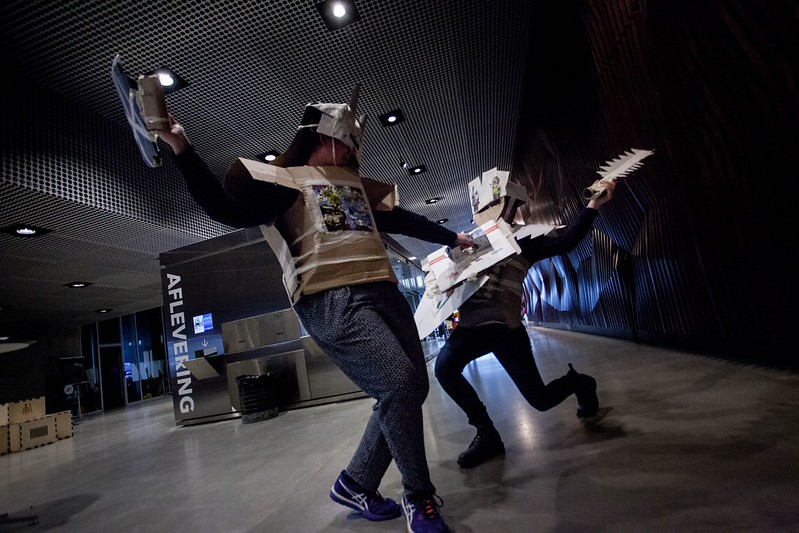
Cardboard Knights at DOKK1: https://www.flickr.com/photos/aakb/28134774212/in/album-72157668074145883
DOKK1 “is based on a vision that is strongly inspired by the [four-space] model,” which describes “four different spaces, or universes, that the library can include” and examines “how the library can be developed from a passive collection of books and other media into an active meeting place to create connections between people, experiences, learning and inspiration” (Skot-Hansen, 2017).
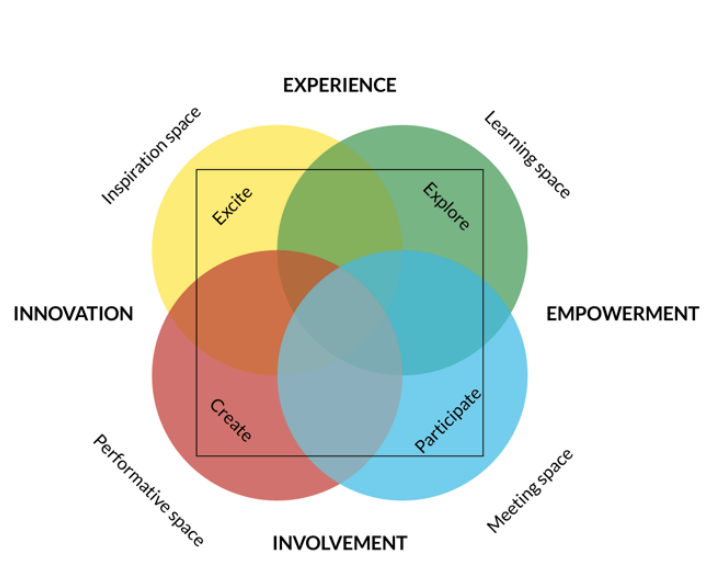
Diagram depicting the four-space model (Skot-Hansen, 2017).
This thoughtful approach to creating hyperlinked, community-focused environments is just as applicable to my neighborhood library as it is to an award-winning feat of design. Smaller public libraries may be working with less money and smaller spaces, but they can still prioritize using the space they have in ways that will best work for their patrons. Given my interest in the intersection of libraries and democracy, I was thrilled to find a recent discussion by Rasmussen and Larsen (2026) about “the democratic role of libraries” (p. 127) based on the four-space model. In their version of the diagram, “Rights, Citizenship, Public Sphere, and Influence … represent the key dimensions of democracy,” while “Access, Education, Dialog, and Participation … broadly illustrate how public libraries can support these chosen dimensions of democracy” (p. 127).
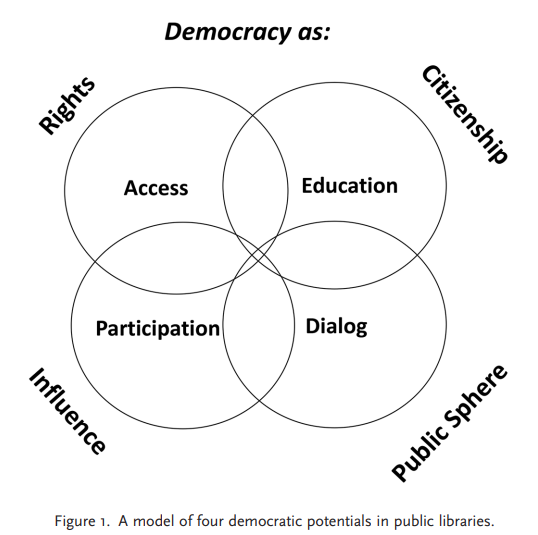
I love the idea that by fostering environments in which folks can learn and have important conversations, libraries are helping to cultivate a healthy democracy. Participatory service is a big part of this, as “participation represents a shift from providing services to their communities to working with them. From a democratic perspective, this approach can be seen as a revitalization of ancient direct democracy, where citizen participation was the foundation of democratic governance” (Rasmussen & Larsen, 2026, p. 127). Maybe this looks like community conversations about local events or issues, or maybe it could look like people learning from each other in more informal environments.
I’ve been amazed at the connections people have made in my monthly book club at the library—connections to each other, but also connections between their own lives and the books we read. A few months ago, we read The Briar Club by Kate Quinn. It’s a novel that takes place in McCarthy-era D.C., and one of the characters ends up working for Margaret Chase Smith—the first woman to serve as both a congressperson and a senator. In the book, the senator from Maine is preparing to deliver her “Declaration of Conscience” in opposition to McCarthyism.
One of my regulars appeared at that book club with handouts. She told us all that “Maggie” Chase Smith was a dear friend of her family’s growing up, and one year as a birthday present Maggie had given her a handwritten copy of the Declaration of Conscience. As a child, she was unimpressed with the gift, but now she was sharing with us how special it was. She then handed out copies of the speech to all of us to reflect upon later. When I think about this story, I see how libraries are perfect places for forging connections, having deep conversations, and cultivating “democratic potentials” (Rasmussen & Larsen, 2026).
References
Grant, R. (November 2021). How Memphis created the nation’s most innovative public library. Smithsonian Magazine.
Rasmussen, C. H., & Larsen, H. (2026). Four democratic potentials in public libraries: A model. The Library Quarterly, 96(2), 123–139. https://www.proquest.com/docview/1154264155/fulltextPDF/BF8F14C994044258PQ/1?accountid=10361&sourcetype=Scholarly%20Journals
Richardson, H. C. (2026, June 1). Margaret Chase Smith’s “Declaration of Conscience,” Narrated by Governor Janet Mills [Video]. YouTube. https://www.youtube.com/watch?v=F13vuHGf44U&list=PL2dS6uX1RkUzLppeUrqtvApwnR6whO7I_&index=46
Skot-Hansen, D. (2017) Library development: From collection to connection. Impact of Humanities Research: 24 Case Studies. University of Copenhagen Faculty of Humanities. https://287.hyperlib.sjsu.edu/wp-content/uploads/2025/02/4-Spaces-Model-from-Univ-Copoenhagen.pdf
@lauraskor First, thank you for including your at username at the top of your blog. Very helpful. I am so glad you linked to Rasmussen and Larson and their article from 2026. I think we need to add this to the course. It is so interesting to see that overlay of democratic potentials on the model of the four spaces. Thank you so much for sharing.