Participatory service is vital because so many elements of library design and service depend upon the patrons being served. It’s a good thing that librarians are committed to lifelong learning so they can approach their work with the “constant and purposeful change” discussed by Casey and Savastinuk in Library 2.0 (2007). Every community (and therefore its library patrons) has different needs! These needs are met in large and small ways—from creating breathtaking architecture that reflects a city’s design aesthetic to deciding where certain collections go so patrons can best find them. I am interested in how librarians can best leverage participatory service to foster social ties and nurture libraries as a vibrant third places in their particular communities.
The “Preferred Third Place”
How can a community’s library become “the preferred Third Place,” as Leferink (2018) put it, “where people let down their guard, relax, be themselves, develop new friendships, and deepen existing ones”? From our readings, it appears clear that one way is via participatory service. In “Age of Participation” from Wholehearted Librarianship, Professor Stephens says that “the era of participatory culture demands that cultural and information professionals play an active, visible role in our communities” (Stephens, 2016, p. 80). This was clear in the videos we watched in Module 4: from the “social librarian” at Dokk1 in Aarhus, Denmark, who engages the marginalized people served by Værestedet through the Dokk1 Writing program, to the gorgeous Oodi library in Helsinki that offers dedicated spaces for video gaming and cooking, to the YOUmedia labs at Chicago Public Library where youth get to be with their friends AND learn something.
While not all of our libraries will look like the Helsinki Central Library Oodi, we can tailor our offerings to the needs of our patrons. Abrams (2025) discusses the University of Amsterdam Library, which opened in September, 2025, and
shows what is possible when an institution takes this mission seriously. The building embodies a careful balance of past and future. … Crucially, the library’s planners sought input from students. They wanted not just a gleaming architectural statement but a place that worked for their daily lives: quiet study nooks, group work areas, and, importantly, stacks of actual books. Their preferences shaped the final design. The result is a building that feels human-scaled and welcoming rather than sterile or intimidating.
Abrams claims that this input from students contributed to its success as a third place and argues that “in an age of polarization and digital isolation, [third places] are more important than ever.”
Personal Connection and Empathy
Libraries already provide so many wonderful resources that people want and need, but analyzing how patrons use these resources and the ways that we can improve our offerings is a continual job. Additionally, fostering the role of libraries as third places means leaning into the personal connections people form there. As Leferink (2018) says, third places are “about sociability, not isolation.” I was reminded of this last week at the meeting of my monthly book club. I usually have about eight regulars, plus an occasional newbie. Several last-minute cancellations and two no-shows meant that I had two people attend that night. TWO! I lamented to other staff and hoped for a fruitful conversation anyway. I had some time beforehand to chat with my most faithful regular, a recent widow who explained to me that she saw a particularly isolating summer ahead as other groups were taking breaks and her friends were traveling with their families. I assured her that book club was still on for the summer months—no matter how many people showed up.
I was struck by Professor Stephens’s statement that “across our communities and across cultures, understanding, empathy, and kindness matter in everything we do. Technology extends human reach but participation requires engaged participants who feel welcome, comfortable, and valued” (Stephens, 2016, p. 81). I look forward to further exploring how to make my library patrons feel this way—now and into the future.
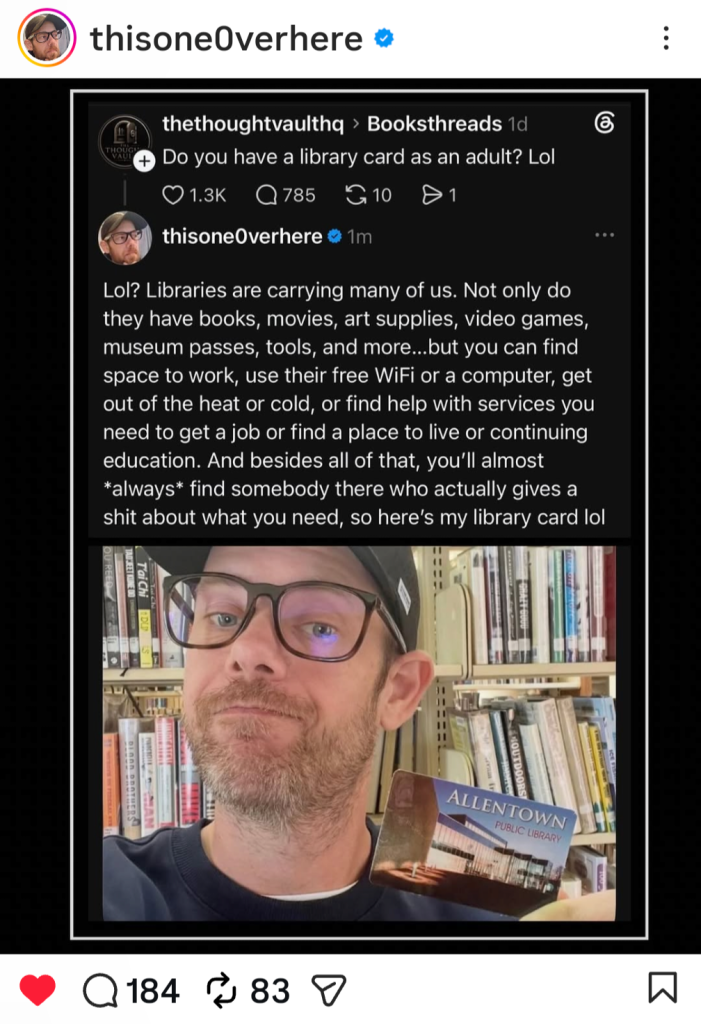
Jonathan Edward Durham, author and one of the funniest people on my IG feed, sums it up.
References
Abrams, S. (15 September, 2025) https://www.aei.org/society-and-culture/the-library-as-a-third-place-amsterdams-new-model-for-civic-life/
Casey, M. E., & Savastinuk, L. C. (2007). Library 2.0: A guide to participatory library service. Information Today.
Leferink, S. (2018, January 24). To keep people happy … keep some books. OCLC Next. https://blog.oclc.org/next/to-keep-people-happy-keep-some-books/
Stephens, M. (2016). The heart of librarianship: Attentive, positive, and purposeful change. ALA Editions.
Laura, I couldn’t agree more with the necessity of making those connections. I work at an academic library and I am always engaging students, faculty, and staff in conversations about their lives, their studies, etc. Showing them that I listen, that I care about what they have to say and offering up the resources that they need to be academically successful. It has paid dividends when out in public and they recognize you and appreciate taking the time to listen and be there for them. While we don’t have a book club, we do have open spaces within our library that students can come and collaborate for class, for their athletic teams, etc. We provide a safe and welcoming place that is far from a sterile environment and many feel so comfortable that we have heard a few of them snoring. 🙂
The inspirations provided by the modules in this class gives me hope for making deeper and more relevant connections in person, online, and in the community. I hope you feel the same.
I do feel the same, @beccaslick! That’s so wonderful to hear about the connections you have made with folks. I find interactions with patrons I’ve gotten to know well so rewarding and encouraging.