The contrast here between straight youth, queer youth, and the further threat to transgender youth highlight the need for safe spaces such as libraries, and safe adults. Librarians are in a great position to be those adults. Glisten (formerly GLSEN, the Gay Lesbian Straight Education Network) reports “81.8% of LGBTQ+ students felt unsafe at school because of actual or perceived personal characteristics” in their 2021 National School Climate Survey (Kartun, 2026). The Trevor Project reports that in 2025 in California, 35% of LGBTQIA+ people ages 13-18 considered committing suicide in the last year. Further, 11% of queer youth in California attempted suicide. These numbers reflect directly on the lack of support that queer youth receive from their communities. Jaymes Black, the CEO of the Trevor Project, says “LGBTQ+ youth are not disproportionately impacted by suicide because of who they are, but rather, because of how they are mistreated, stigmatized and discriminated against” (Trevor News, 2025). Safe spaces for queer youth, with a focus on the needs of trans youth, can be lifesaving. The ALA published “Libraries as Safer Spaces” outlining ways to accomplish this goal, including programming, displays, reference services, instruction, and cataloging through inclusive language (ALA, 2019).
This is why I have chosen to focus on participatory service, specifically with an eye to the needs of queer folks. How can a library support the needs of its members and have positive impact on their lives? By involving users in planning and evaluation, libraries can create programming to support and uplift all library patrons, and for the queer community, this can have a huge impact.
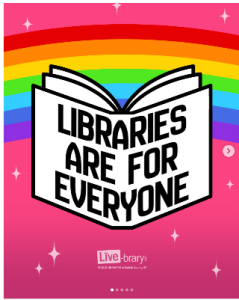 One way that this can be accomplished through the Library 2.0 lens is by participating in social media! Librarians on TikTok, Instagram, and other social media platforms create content that highlights how everyone belongs at the library. The Suffolk County Library in New York on Instagram and features pride posts using the power of hashtags. #librariesAreForEveryone. Users can build and add to the conversation by commenting on posts, using the hashtag, and re-sharing to their social media community.
Apps like The StoryGraph include challenges such as the Queer Alphabet Challenge that brings users together as community, reading and sharing stories. The challenge calls for “read a book by a queer author or with queer main characters, for every letter of the alphabet.” Users can share suggestions for each letter, building a vast catalog of queer books that can be browsed by other users. The Queer Liberation Library is an online-only library that can be accessed through apps like Libby. Anyone can get a library card and browse their collection. “Reaching everyone means using technology to offer new ways to interact with the library, yes, but it also encompasses a wide array of channels for interaction across virtual and physical planes. And one of the things that we always need to keep thinking about is how we can connect with our users, find ways to be present in their lives, and let them know what we can do for them” (Stephens, 2016, p. 41).
There is not one right or wrong way to build community. Library 2.0 and Professor Stephens simply calls on us to do this with humanity and heart. Especially with the queer community, where the stakes for not being connected are so high, participatory service, and bringing people in to build their community in the library, is vital.
References
American Library Association. (2019). Libraries as safer spaces. Retrieved June 19, 2026, from https://www.ala.org/aboutala/libraries-safer-spaces
Kartun, L. (2026). Creating spaces of belonging. Glisten (formerly GLSEN). https://glisten.org/wp-content/uploads/2026/01/GLSEN-Guide_Creating-Spaces-of-Belonging.pdf
Stephens, M. T. (2016). The heart of librarianship: Attentive, positive, and purposeful change. ALA Editions, an imprint of the American Library Association.
Trevor News. (2025, March 5). The Trevor Project Publishes New 50 State Report on LGBTQ+ Youth Mental Health, Suicide Risk & Access to Support. The Trevor Project. https://www.thetrevorproject.org/blog/the-trevor-project-publishes-new-50-state-report-on-lgbtq-youth-mental-health-suicide-risk-amp-access-to-support/
Hello Val,
Naming queer youth specifically as the group in need matters, because the numbers you cite show what happens when they get folded into a general “all patrons” default. They become invisible, and unsafe.
That specificity has a cost you don’t really mention. Shelf space, program budget, and staff attention given to one group are limited, and other patrons notice when they aren’t the group being named that month. That’s not evidence the targeting was wrong. It’s just what participatory service costs when it’s actually working, since responding to one community’s needs means you’re not responding equally to every other need at the same time.
The way libraries seem to handle that is rotation instead of trying to appeal to everyone at once, giving different groups their turn to be named and centered rather than picking one default permanently. If the model you’re building on assumes participatory service can serve everyone at once without anyone feeling passed over, I’d want to see that tested against how libraries actually cycle through whose turn it is.
I’d like to push back a bit on that. I am always learning something new when I see a display that teaches me about a new book or an idea from a group that I don’t belong to. I think that when we focus on and celebrate voices that are not often celebrated in mainstream culture, and that are not featured as frequently in our catalogs, we help everyone.