What a great summer of learning. I have enjoyed this class so much! Here are my big takeaways.
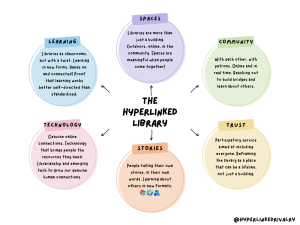
What a great summer of learning. I have enjoyed this class so much! Here are my big takeaways.
The library as classroom is such a wonderful and exciting topic. I am a former middle school teacher (yes, I know… crazy). I taught for 20 years and loved it. But I was ready to shift where my energy went and imagine a new way to be an educator. Libraries offer a space to engage kids with learning in a novel way! While the industrial revolution and changes in our country in the 20th century opened up education for all kids, it also created a limited way of learning. Many liken the current educational system to a factory, producing the same kid with the same specifications, regardless of their passions or unique learning needs (History is Now, 2026).
Technology offers one space where libraries can shine as learning environments. Creating opportunities for patrons to engage with information through online courses, blogs, or social media are just one way that we can redefine learning (Matthews, 2013). My local library offers book recommendations based on patron questions via their Instagram stories.
Physical libraries are increasingly spaces where patrons can engage in dynamic learning. Adults and kids alike can learn to 3D print, kids can meet animals, and art happens in busy spaces (Multnomah County Library, 2026). Libraries are also branching out and making the outdoors an extended classroom! Partnering with science museums and story walks are just a few ways to bring learning outdoors (Lloyd Bookey, 2015).
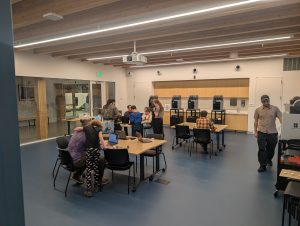
This is the 3D popup lab at my local library, Multnomah County Library – Albina, where I volunteer every week. The library wanted to open the program up so more people could learn to 3D print. By bringing on 3 volunteers each week, the library was able to remove the required prerequisite course. We can help those who have no experience, and support those who are more advanced. It is an amazing program and I’m proud to be a part of it.
References
Impact of the industrial Revolution on Education: From Factories to Classrooms. (2026, June 16). History Is Now Magazine. https://www.historyisnowmagazine.com/blog/2024/3/28/impact-of-the-industrial-revolution-on-education-from-factories-to-classrooms
Lloyd Bookey, J. (2015, April 29). 8 Awesome Ways Libraries Are Making Learning Fun | HuffPost Latest News. HuffPost. https://www.huffpost.com/entry/8-awesome-ways-libraries_b_7157462
Mathews, B. (2013, September 5). Curating Learning Experiences: A Future Role For Librarians? The Chronicle of Higher Education. https://www.chronicle.com/blognetwork/theubiquitouslibrarian/curating-learning-experiences-a-future-role-for-librarians
Multnomah County Library. (2026). Events & Classes. https://multcolib.org/events-classes
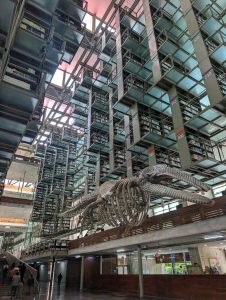
I just got back from a whirlwind trip to visit old friends who live in Mexico City. We had a blast! But it was a lot. They have an 18 month-old and a 6 year-old. I have a 3 year-old and a 7-year old. Needless to say, I’m exhausted. But I had to share about the coolest library! It is called Biblioteca Vasconcelos and it is located in the Buenavista area of Mexico City near the train station. It is an AMAZING space. Glass floors full of books look out onto an open center area. I was dazzled. If you are ever in Mexico City, I highly recommend visiting!
I chose to use AI to help create library programming. I imagined a fictional school library and asked AI to work with me to develop a book recommendation program. Enjoy!
Book Bridges by Val Brownsmith
I have always loved hearing peoples’ stories. Whether via radio programs like The Moth, podcasts, blogs, or just sitting at a coffee shop talking to friends. A good story can bring you to a different place, build empathy, and make connections across huge barriers. I had a friend recently who was telling me about their work with The Shoah Foundation through USC. They work to interview and document stories from Holocaust survivors, building an interactive, visual archive.
“The USC Shoah Foundation records, preserves, and shares survivor and witness testimonies so that all can learn from the past, reflect on the present, and build a better future.
My friend reflected on how important the work is, especially as there are fewer and fewer living Holocaust survivors. There is nothing more powerful than hearing a story directly from someone who lived it, in their own words, with their own emotions coming through.
I’ve thought a lot about storytelling and survival in the past year an a half. I also love the idea of using emojis to connect and bring storytelling to a more accessible space, where anyone can participate, and even my 3 year old can read the stories. So I have created my own:
👶🌴⚽🎵
🎓⛄🎶📚
🌴👩🏫👩❤️👩👶👶
🔥🌄🏡😢
🌲🏠👩👩👧👦📚
I used to live in Altadena, California. I was born there, left a bit for college, then returned and started a family. Then the unthinkable happened. In January, 2025, my home and the homes of over 4,500 other Altadena families were lost in the Eaton Fire. Many of our community spaces were lost: my favorite hardware store, the bar my wife and I had our first date, my family’s favorite restaurant. I still feel like I’m living in an alternate reality. There are some people working on gathering stories. My mother was interviewed for the New York Times. But there isn’t a single, focused collection that I know of yet. My friend did gather keys, in a project known as The Keychain Project, each one from a home or apartment that burned.
My wife and I documented the few months after the fire before we moved with a series of selfies, one on each porch of the temporary houses we stayed in while we were homeless, wandering around LA suburbs, seeking stability for our two kids. A visual story in its own right.
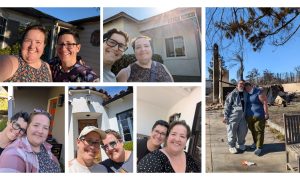
Now my family lives in Portland where we are building new memories. But those stories will always be a part of our lives.
Thinking about new ways that libraries can function in our world is endlessly fascinating. Because there are seemingly unlimited possibilities. In Tom Scott’s YouTube video Why Helsinki’s library robots aren’t important, Romeo Pulli, ICT Specialist at Oodi Library in Helsinki, describes the library as “like a living room for citizens” (2019). I absolutely love this way of thinking about the library. It is a place for coming together around the exchange of ideas. In the modern age where information literacy is key to being an informed citizen, the public library provides services to all people.
In her TED talk, Pam Sandlian Smith describes the way in which learning is made playful at the library. She talks about creativity, experimentation, and collaboration for all at the library. Play opens doors to questions that lead to deep thinking. And all of this is in service of building critical thinking skills. “We are the cornerstones of democracy. Everyone has a seat at the table,” says Smith, emphasizing the importance of library services being available to everyone
In my local library, the spaces are being redefined. The Multnomah County voters passed a bond measure in 2020 authorizing $387 million towards capital improvements for the Multnomah County Library (Multnomah County, 2026). These improvements include new Makerspaces at several branches, where patrons can 3D print and laser cut. There is a sensory room at my local branch which offers sound, touch, and visual sensory breaks or stimuli depending on the needs of the user. One of my favorite improvements has been to move the children’s area somewhat apart from the general library, allowing for boisterous and uninhibited play, singing, and dancing. As a mother of a 3-year old and 7-year old, I am always grateful for this space!
Overall, the library is becoming a place for so much more than books. It is a welcoming hub for community, learning, creativity, play, and so much more.
References
Multnomah County. (2026). Library Capital Bond Project Compliance. https://multco.us/info/library-capital-bond-project-compliance
Scott, T. (2019, October 14). Why Helsinki’s library robots aren’t important [Video]. YouTube. https://www.youtube.com/watch?v=dPb9o3uDF_Q
Tedx Talks. (2013, December 16). What to expect from libraries in the 21st century: Pam Sandlian Smith at TEDxMileHigh [Video]. https://www.youtube.com/watch?v=fa6ERdxyYdo
I have spent a lot of time recently thinking about school libraries. I worked for the past 20 years as a schoolteacher, math and computer science, but I spent a lot of time at my most recent job hanging around the library. Why? It was the place to be on campus. Everyone came together there when they had free time. Teachers at lunch on the patio; students played games, worked on projects, or tucked themselves into the nooks to gossip with friends. High school classes came in to do research facilitated by the librarian, while lower schoolers had free reading time as part of their day. The school paper wrote a piece highlighting the library as a space for all students, filled with activity and energy (Comai, 2024).
This is so very different from the school library of my youth. As a little kid, I was encouraged to sit on the rug and listen to stories read by the librarian. While there was a fair amount of fidgeting and chatter, it was still an adult-led activity. As I got older, the library was a place where I would go to check out books for an assignment, usually with some direction from the librarian. But the assignment and the research were highly structured. There was no noise, no playing, and little self-directed learning happening in the school library that I spent time in as a kid.
But this is shifting! Participatory learning brings the student to the center of the equation. Students are invited to construct their own understanding of how things work, bring their interests to the forefront, and engage in questioning and discussion based on their own ideas. Henry Jenkins describes participatory culture as one that focuses on creation, from zines to YouTube videos, where creating can move from enjoyment into political action. The teacher or librarian takes on the role of a guide, helping students create their own work, harnessing their own ideas. “They don’t need us snooping over their shoulders, but they do need us watching their backs,” Jenkins says, describing this model of support (Edutopia, 2013). This might take the form of supporting appropriate use of technology and developing skills around being safe online (World Economic Forum, 2016; Stone, 2013). While kids are often labeled “digital natives,” Niahm Ni Bhroin asks us to consider things like permissions, privacy, in app purchases, passwords, cookies, and the like. All are big concepts. Kids may be comfortable with the big stuff, like navigating the web, playing games, posting, and sharing, but don’t always fully understand the bigger consequences of their online activities (2019). School libraries as hubs of information can facilitate this student-centered exploration, letting kids take the lead, but providing the support needed to develop the skills to be safe online.
School libraries are becoming community hubs for learning on their school campuses. “Librarians across the country are working to create innovative spaces for their students, to enhance their learning process and nurture their imaginations,” says Sara Luster (2018). The school library looks and acts differently, providing a space that allows students to be the center of their own learning.
@ValB
References
Bhroin, N. N. (2019, February 13). Digital natives or naïve experts? Exploring how Norwegian children understand the internet – Parenting for a Digital Future. Parenting for a Digital Future –. https://blogs.lse.ac.uk/parenting4digitalfuture/2019/02/13/digital-natives-or-naive-experts/
Comai, M. (2024, October 4). Westridge library’s one space serves all: Convenience, cramming, and community. Westridge Spyglass. https://westridgespyglass.org/9897/features/westridge-librarys-one-space-serves-all-convenience-cramming-and-community/
Edutopia. (2013, May 7). Henry Jenkins on participatory culture: Big thinkers [Video]. YouTube. https://www.youtube.com/watch?v=1gPm-c1wRsQ
Luster, S. (2018). Reinvented School Libraries Unleash Student Creativity | NEA. Retrieved July 1, 2026, from https://www.nea.org/nea-today/all-news-articles/reinvented-school-libraries-unleash-student-creativity
Stone, A. (2013, March 19). 12 technologies that will reshape school libraries | K-12 Dive. https://www.k12dive.com/news/12-technologies-that-will-reshape-school-libraries/111708/
World Economic Forum. (2016, June 16). 8 digital skills we must teach our children. Medium. https://medium.com/world-economic-forum/8-digital-skills-we-must-teach-our-children-f37853d7221e
The connection between politics and libraries is a reality that is becoming increasingly important for information professionals to study and become proficient at navigating. Countries around the world are struggling with similar issues, with a rise in right-wing politics affecting libraries across the globe (Hanell, Carlsson, Engström, & Hansson, 2025). With the rise of right-wing politicians arguing against public access to facts, knowledge, and information are key to a well-functioning democracy, institutions that value these must fight to justify their existence. We have seen this already with PBS, where federal funding cuts have shocked many Americans. So how do we build community in an ever divided country?
In Beyond Buzzwords Ten Invitations to Build Library Connection and Community, Michael Stephens suggests several techniques for building community. One that struck me was how we engage online. So many posts are simply talking at you. There is no dialogue. Stephens suggests that we use social media to “foster authentic dialogue” (Stephens, 2025). Rather than simply publishing a post, engage with users. Don’t be afraid of their responses!
Even when engaging with patrons who have views that oppose our own, we must remain neutral and provide the best possible service. Kellian Clink, a librarian who is also a lesbian, describes an encounter with a student in her library where he was looking for information on a paper he was writing opposing gay marriage. “I don’t want his expectation of an informational request turning into an involuntary lesson on the evils of homophobia,” she says, reflecting that she wants to remain a resource for that student and hopefully help him grow in his understanding of those who are different than he is (Clink, 2011).
Building community can be tricky, especially when politics and differing beliefs can be daunting. That is why networking with other librarians is a good starting point (American Alliance of Museums, 2017). How are other libraries navigating these issues? We can share what works, what doesn’t work, and rely on each other to build stronger connections. This will ultimately have a greater impact on our own libraries and our ability to build solid community.
References
Clink, K. (2011). When is the Personal not Professional? An Exploration. In T. Nectoux (Ed.), Out Behind the Desk (pp. 219–231). Library Juice Press.
Hanell, F., Carlsson, H., Engström, L., & Hansson, J. (2025). Canaries of Democracy: The Role of Public Libraries in Times of Political Turmoil. Public Library Quarterly, 44(2), 198–222. https://doi.org/10.1080/01616846.2024.2385741
Professional Networks. (2017, December 18). American Alliance of Museums. https://www.aam-us.org/programs/about-aam/professional-networks/
Stephens, M. (2025). Beyond Buzzwords Ten Invitations to Build Library Connection and Community.
The contrast here between straight youth, queer youth, and the further threat to transgender youth highlight the need for safe spaces such as libraries, and safe adults. Librarians are in a great position to be those adults. Glisten (formerly GLSEN, the Gay Lesbian Straight Education Network) reports “81.8% of LGBTQ+ students felt unsafe at school because of actual or perceived personal characteristics” in their 2021 National School Climate Survey (Kartun, 2026). The Trevor Project reports that in 2025 in California, 35% of LGBTQIA+ people ages 13-18 considered committing suicide in the last year. Further, 11% of queer youth in California attempted suicide. These numbers reflect directly on the lack of support that queer youth receive from their communities. Jaymes Black, the CEO of the Trevor Project, says “LGBTQ+ youth are not disproportionately impacted by suicide because of who they are, but rather, because of how they are mistreated, stigmatized and discriminated against” (Trevor News, 2025). Safe spaces for queer youth, with a focus on the needs of trans youth, can be lifesaving. The ALA published “Libraries as Safer Spaces” outlining ways to accomplish this goal, including programming, displays, reference services, instruction, and cataloging through inclusive language (ALA, 2019).
This is why I have chosen to focus on participatory service, specifically with an eye to the needs of queer folks. How can a library support the needs of its members and have positive impact on their lives? By involving users in planning and evaluation, libraries can create programming to support and uplift all library patrons, and for the queer community, this can have a huge impact.
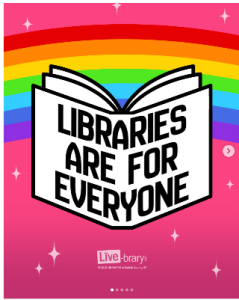 One way that this can be accomplished through the Library 2.0 lens is by participating in social media! Librarians on TikTok, Instagram, and other social media platforms create content that highlights how everyone belongs at the library. The Suffolk County Library in New York on Instagram and features pride posts using the power of hashtags. #librariesAreForEveryone. Users can build and add to the conversation by commenting on posts, using the hashtag, and re-sharing to their social media community.
Apps like The StoryGraph include challenges such as the Queer Alphabet Challenge that brings users together as community, reading and sharing stories. The challenge calls for “read a book by a queer author or with queer main characters, for every letter of the alphabet.” Users can share suggestions for each letter, building a vast catalog of queer books that can be browsed by other users. The Queer Liberation Library is an online-only library that can be accessed through apps like Libby. Anyone can get a library card and browse their collection. “Reaching everyone means using technology to offer new ways to interact with the library, yes, but it also encompasses a wide array of channels for interaction across virtual and physical planes. And one of the things that we always need to keep thinking about is how we can connect with our users, find ways to be present in their lives, and let them know what we can do for them” (Stephens, 2016, p. 41).
There is not one right or wrong way to build community. Library 2.0 and Professor Stephens simply calls on us to do this with humanity and heart. Especially with the queer community, where the stakes for not being connected are so high, participatory service, and bringing people in to build their community in the library, is vital.
References
American Library Association. (2019). Libraries as safer spaces. Retrieved June 19, 2026, from https://www.ala.org/aboutala/libraries-safer-spaces
Kartun, L. (2026). Creating spaces of belonging. Glisten (formerly GLSEN). https://glisten.org/wp-content/uploads/2026/01/GLSEN-Guide_Creating-Spaces-of-Belonging.pdf
Stephens, M. T. (2016). The heart of librarianship: Attentive, positive, and purposeful change. ALA Editions, an imprint of the American Library Association.
Trevor News. (2025, March 5). The Trevor Project Publishes New 50 State Report on LGBTQ+ Youth Mental Health, Suicide Risk & Access to Support. The Trevor Project. https://www.thetrevorproject.org/blog/the-trevor-project-publishes-new-50-state-report-on-lgbtq-youth-mental-health-suicide-risk-amp-access-to-support/