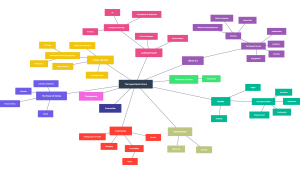
For the virtual symposium I created a mind map to reflect on the various course concepts, themes, and takeaways. Mapping these out helped me see how much the class has helped expand my view of the library world. It’s been such a fun learning experience diving into the hyperlinked library with you all!
Love to Learn. Photo by Tim Mossholder on Unsplash
I’ve learned so much this summer while taking this course. Through lecture materials, readings, and videos, I’ve gained an understanding of the hyperlinked library model and expanded my viewpoints on the library field. But there is infinite learning to be done as a library professional. For this reflection blog post I wanted to explore personal learning experiences for library professionals and look to the future of how I can continue to learn throughout my career.
Some questions for consideration:
What are my motivations for learning?
What is my learning style?
What is the formula for success?
Learning Motivations
I believe motivation is a vital component to learning and developing professional growth. Without it, learning can be a struggle and may lead to letting go of learning opportunities because of a lack of interest. Whether the motivation is external such as to obtain a promotion, internal such as personal interest and curiosity, or a combination of factors, motivation gives a learner the strength to push past when the confusing or challenging aspect of learning arises. It helps a learner to continue to contemplate, process, and digest new information and knowledge.
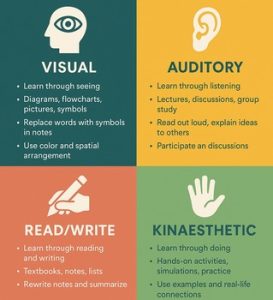
Learning Styles. Image by Sumner College. https://www.sumnercollege.edu/blog/how-learning-style-impacts-you/
Learning Styles
“Learning to Learn” in The Heart of Librarianship reminded me that learning is a skill on its own that is especially crucial in the ever evolving library field (Stephens, 2016, p. 140). This brought to mind learning styles, something I was taught in previous schooling. Everyone has their own learning style and understanding this can help someone optimize the learning process. Learning styles include the following: visual, read/write, auditory, and kinesthetic. I have discovered that I personally learn best by reading and writing and struggle most with auditory learning. To accommodate my learning preferences, I will often turn on captions of lecture videos and find I better absorb the information by reading the captions along with watching the video.
Formula for Success
In Wholehearted Librarianship, Stephens provides a formula for success to build a librarian (Stephens, 2019, pp. 30-31):
Essential Skills + Mindset2 x Support = Success
The part of this equation I want to focus on is support. Who can I turn to during the learning process to support my professional growth? I think peers and mentors in the library and information science field are essential to this variable. Already in my MLIS journey I have gained invaluable learning experiences by conversing with peers, professors, and other library professionals be it online or in face-to-face conversations. Conferences are extremely meaningful, not just for the information presented at them, but for opportunities to connect and engage with others in the field.
Between motivation, learning style, and support, I’m starting to see what sustains lifelong learning for me. Recognizing what my learning incentives are, playing to my strengths, and adjusting when learning conditions aren’t ideal are all important pieces to keep in mind to sustain momentum for learning over the course of my career.
References
Stephens, M. (2016). The heart of librarianship: Attentive, positive, and purposeful change. ALA Editions.
Stephens, M. (2019). Wholehearted librarianship: Finding hope, inspiration, and balance. ALA Editions.
For this assignment, I decided to investigate digital technologies that can be implemented to enhance visitor experience at the Charles M. Schulz Museum and Research Center. Click below to view the pdf report:
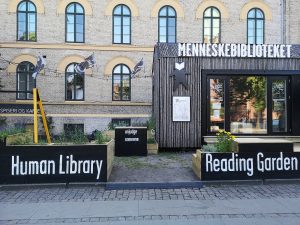
The Human Library. Photo by Ronni Abergel on Tripadvisor.
As a self-proclaimed bookworm, this is stating the obvious, but I love stories. In a previous blog post, Hyperlinked Communities Reflection Blog: Libraries for All, I discussed the healing power of books. From a reader’s perspective, stories allow one to put themselves in another person’s shoes and to grow empathy and understanding for other people. This week’s course module about the power of stories also highlights how empowering it is from the storyteller’s perspective to be able to share their own story and connect with others.
The human library takes storytelling to another level, connecting community members through stories. Originating in Denmark in 2000, human libraries consist of volunteers called human books (Wentz, 2013). Human libraries have expanded internationally, with the first event held in the United States by the Bainbridge Public Library and Santa Monica Public Library in 2008. Community members can meet with these human books and have one-on-one conversations, aligning with the mission of libraries to provide safe learning environments to share information and knowledge. Volunteers bring their unique personal experience and often have been stereotyped in some way. These conversations can pave the way for deeper understanding and connection, and like their motto provide opportunities to “unjudge” someone and challenge prejudices (Wentz, 2013).
I really enjoyed learning about the human library from this week’s readings and it got me thinking about the many different formats of storytelling. Besides the many books on library shelves, how can libraries tell the stories of their community members? I envision community whiteboards, video recordings, photographs, and artwork. What other types of library events and programming can draw people together and foster community? In what ways can libraries help their community keep, make, and share stories? In my library practice, I hope to carry forward this spirit of storytelling so that my community members feel heard and that their stories help create a diverse and inclusive library.
What’s next on the horizon for libraries? From the New Horizons module, I’ve learned that this is an important question for library professionals to pose. Library professionals need to keep looking forward and adapt to emerging technologies and trends. I recall when my local library, early on in the pandemic, began providing hotspots to patrons to address the digital inequities emphasized by the shift to remote learning and work. This kind of innovative solution to community problems exemplifies the need for libraries to remain forward thinking and up to date in an ever-evolving technological landscape.
Artificial Intelligence. Image by Steve A Johnson on Unsplash.
I’m sure we’re all aware of the dominant emerging technology at the current moment: Artificial Intelligence (AI). A lot about AI remains unknown, and its current iterations are far from perfect. Issues related to AI are plentiful: AI hallucinations (creating made-up information), algorithm biases, copyright disputes, data privacy risks, and inadequate safeguards, to name a few.
The 2026 EDUCAUSE Horizon Report: Teaching and Learning Edition offers a useful lens to view emerging trends in the field, and this year’s edition highlights the many ways AI is shaping the current landscape. As the report shows, AI is influencing the relationships between students and teachers, instructional design, and student support. There is also a growing awareness of its environmental cost (Robert et al., 2026).
So how do we move forward, using AI in an ethical and responsible manner? AI isn’t going away anytime soon. There are use cases for AI such as automating tasks and analyzing large datasets. But many people still have questions about AI, or are unsure of how to use it properly. I believe that as library professionals, we can play a large role in educating our communities about emerging technologies so that they can make informed decisions on their own. To do that, we have to take the time to learn about and understand these technologies. I don’t yet have all the answers, but this course module has taught me to keep watching the horizon and to approach the unknown with a critical eye while remaining open and curious to the possibilities.
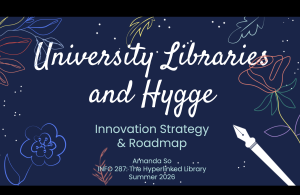
For this assignment, I designed a strategy and roadmap to incorporate Hygge concepts into the Peter J. Shields Library at UC Davis and create a cozy library space supporting student well-being. Please click on the image below to view my Google Slides presentation, University Libraries and Hygge.
In this reflection blog, I wanted to take a deep dive into academic libraries and explore how they fit the hyperlinked library model. The readings from this module gave me a lot to think about regarding how academic librarians can serve their community, largely consisting of students. Two themes from the readings I will discuss further are connection and exploration; these concepts embody the foundational values of the hyperlinked library model.
Connection:
As Brian Mathews (2015) discusses in his article “The Evolving & Expanding Services Landscape Across Academic Libraries,” the services that academic libraries provide to their students have grown beyond traditional reference transactions. Academic libraries offer services that focus on fostering students’ academic development and wellbeing. This includes offering writing centers, study spaces, and career services. Mathews also describes scenarios in which professors and other individuals utilize the academic libraries for meeting spaces to facilitate discussions. When I look back at my own experiences at university, I remember the numerous hours spent at the library studying for exams. However, I also can recall many occasions in which the library provided opportunities encouraging connections with others. Examples that come to mind are my friends and I petting puppies at stress relief events during finals, and student study groups in library rooms scribbling away on whiteboards.
“Reference questions are declining but the questions amongst our communities are only becoming more complex and interpersonal. One of the best things we can do is provide the literal and figurative table for people to meet and get the help they need” (Mathews, 2015).
Exploration:
Another important aspect for academic librarians is to encourage exploration. At the center of their studies, curiosity is needed of students to accomplish their academic pursuits. Deitering and Rempel (2017) discuss ways that academic librarians can encourage exploration including urging students to select topics that they know little about, contextualizing goals around curiosity rather than on just locating information sources, creating opportunities for student success in the information search process, introducing new information resources, and reducing the stakes of in-class assignments. In my academic studies, I developed the ability to seek out information I was intrigued by. This skill has remained vital even beyond my university days. As library and information professionals, I think this is a crucial skill that we can impart to individuals, giving them the tools to be curious and satisfy their curiosity.
In summary, the academic library setting carries the core essence of the hyperlinked library model. They are open, participatory, and collaborative places that can cultivate an environment full of meaningful connection and exploration. The next important step, I believe, would be for the library departments to market these services to their student populations whether through the classroom or other outreach avenues. With the vital services the library provides, it’s critical that students know these services are available to them.
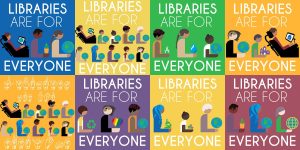
Image via hafuboti.com, reproduced in Libfocus (2019). https://www.libfocus.com/2019/07/accessibility-and-libraries.html
Community is at the heart and soul of library work. Many of the readings from Module 5 Hyperlinked Communities emphasized the importance of reaching all members of the diverse communities libraries serve, and providing adequate access to meet their different needs.
I really enjoyed the reading in the Hyperlinked Communities module by Jessica Klinker about the healing power of books. In her blog post, she highlights the importance of books for showcasing diverse perspectives and experiences, as well as providing different formats of books so all patrons can access them (Klinker, 2020). Klinker poses an important question: how do we reach the people who aren’t already reading? As I mentioned in my Assignment Xpost on the Four Space Model, the library is so much more than books. However, I also agree with Klinker’s take that books can serve as both mirrors and lenses: a way to see oneself reflected in a story, and also a way to gain new perspectives and see the world from others’ points of view. As a bookworm myself who finds comfort and solace while reading a good book, I want to ensure that libraries provide all patrons with access to books. Klinker describes various formats of books (audiobooks, e-books, large print, different languages) that help expand access to books for different types of readers. At the library I work at I learned about another format, VOX books, which are children’s books with attached audio narration of the stories.
Many of the other resources in the module express similar ideas of centering diversity and accessibility in library spaces. For example, the Multnomah County Library evaluated the diversity within their staff and made changes so that it better reflected their community (American Library Association, 2019). One comment in the video that stood out to me was the positive reaction from patrons and that it created a more welcoming environment. Furthermore, I think back to a previous module in the course that discussed self-service libraries that extended the hours of public access availability (Zulkey, 2019). This is another form of increasing library accessibility for users who may want to use the library outside of typical hours.
Creating inclusive, accessible library spaces and services is central to my library practice philosophy. This module has helped me to contextualize the diverse needs of library community members and ways in which libraries can meet these needs. When making changes to libraries, I plan to keep this perspective in mind and work to overcome possible barriers to access.
To end this reflection blog, I want to share a quote that really resonated with me about library accessibility:
“One book does not fit all–there isn’t one magical book, or even canon, that will speak to every reader. The answer is access and choice” (Klinker, 2020).
References:
American Library Association. (2019, June 17). Multnomah County Library: Creating conditions for equity to flourish [Video]. YouTube. https://www.youtube.com/watch?v=SKGlxh-zc0Y
The core concepts of the Hyperlinked Library include participation and fostering human connections, and the early modules in this course emphasize collaboration between libraries and their communities to provide meaningful library services. One model that provides a lens to examine the types of services libraries can provide is the four-space model developed by Danish researchers Dorte Skot-Hansen, Casper Hvenegaard Rasmussen, and Henrik Jochumsen. These researchers have shared their model at library conferences all over the world, influencing library visions such as that of the DOKK1 library in Denmark, and encouraging collaboration with other disciplines such as architecture and urban planning (University of Copenhagen, 2017). I was intrigued after reading the impact case of this model in Module 3 and wanted to explore it further in Assignment X.
What is the four-space model?
Graphic created with Canva, adapting the four-space model framework (Jochumsen et al., 2017) into quadrant form.
The model provides a framework to support the goals of the library, which the researchers identified as: experience, involvement, empowerment, and innovation (Jochumsen et al., 2017, p. 40). To achieve these goals, the library has four different spaces:
Inspiration Space: This space is for meaningful experiences that transform perceptions. Examples of such a space include the art gallery in my nearby library showcasing inspiring works of art from local artists and the DOK Delft library’s Heritage Browser allowing its users to share photographs and stories.
Learning Space: This space provides a place for exploration and discovery, allowing for people to expand their knowledge through access to information. Examples of learning spaces in the library that come to my mind are Project Read, an adult literacy learning program, and library children’s play areas that offer children opportunities to learn in interactive play environments.
Meeting Space: This space is where people can come together and interact with one another through both accidental meetings and planned meetups. Library meeting spaces provide a safe space where people from diverse cultural backgrounds can meet and engage with one another. For this, I think of patrons at my local library who have become friends and converse with each other when they both visit the library, as well as students who use the library meeting rooms for study groups.
Performative Space: This space offers users the ability to create and innovate. What first comes to mind as an example of performative spaces in the library is makerspaces. At my local library, the makerspace provides equipment such as 3D-printers, sewing machines, Cricut machines, and more tools for patrons to bring to life their imagination and creativity. As shared previously on this course website, the UCF Hitt Maker Podcast Studio allows its users to create their own podcasts.
One initial curiosity I had was whether this Danish model could be applied to US public library systems in the same way. The impact case answers this as the researchers developed the model based on visiting libraries and interviewing library managers across multiple countries, including Denmark, Norway, and the United States, before synthesizing what they found.
As a bookworm myself, I love borrowing books from the library and am grateful for the book repositories that exist in libraries. As a future library professional, however, I want to go beyond book collections in my library practice. To me, the four-space model is a way to view library services and evaluate what they bring to community members. With these spaces, libraries can connect communities in ways that inspire, empower, and encourage innovation and experience. I plan to incorporate these guiding principles into my own library values.
References:
Jochumsen, H., Skot-Hansen, D., & Hvenegaard Rasmussen, C. (2017). The four spaces of the public library. In D. Baker & W. Evans (Eds.), The end of wisdom? The future of libraries in a digital age (pp. 39–44). Elsevier. https://doi.org/10.1016/B978-0-08-100142-4.00002-6
My name is Amanda and I am starting my third semester of the MLIS program at SJSU.
I am interested in both public and academic librarianship and hopefully will gain more insight into what career path I want to pursue as I continue on in the program. When I initially applied to the program, I was especially curious about cataloging and data organization. This summer, I have the opportunity to complete a cataloging internship and can’t wait to gain hands-on experience in this field.
The title of this course intrigued me and I’m excited to explore the concept of the hyperlinked library this semester. The idea of a participatory service model and focusing on user-centered library services aligns with my own philosophy. I’m looking forward to a semester of learning how emerging technology and trends can be utilized in library spaces to create communities and support human connections. This blog site will show my journey as I explore these topics and gain a better understanding of what the hyperlinked library entails!
To live up to the blog name, I’ll end this post by sharing some of my favorite recent reads: Homeseeking by Karissa Chen, All Systems Red by Martha Wells, Bat Eater and Other Names for Cora Zeng by Kylie Lee Baker, The Fox Wife by Yangsze Choo, and The Raven Scholar by Antonia Hodgson.