Community-led Libraries
The concept of community-led libraries as discussed in the article, “How to conduct community-led planning” (Lenstra & Barbakoff, 2024) and Community-Led Libraries Toolkit (Working Together Project, 2005) challenges many assumptions about library services. First, the traditional view that libraries should be led by library professionals. Second, the orthodox assumption that library services should stay in the physical space of the library. Third, libraries should serve their communities through outreach. Community-led libraries require the continual development and cultivation of relationships with the community. They require identification of community goals and needs through partnering with the community by “joining organizations, spending time in spaces, and contributing to local celebrations” (Lenstra & Barbakoff, 2024).
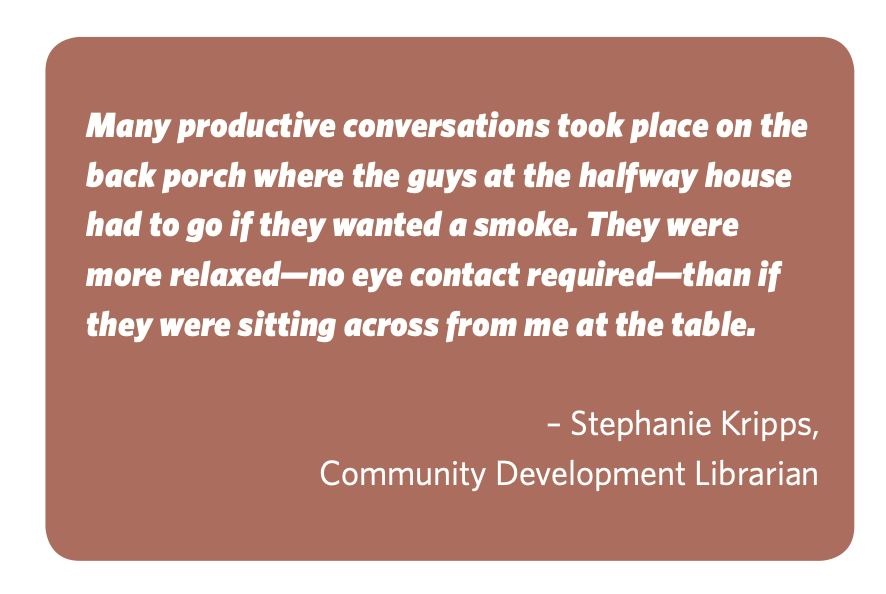
(Working Together Project, 2005, p. 64).
This quote exemplifies the assumptions that must be challenged to develop community-led libraries. Prior to reading these resources, I did not ever consider walking around the neighborhood, taking inventory of important places and people, or spending time in community spaces. However, as I read through these resources, the ideas presented make so much sense. I love the focus on mutual, reciprocal partnerships and the importance of relationship building. It challenges the “savior” model that supremacy culture often upholds in institutions such as libraries. A concern that shows up would be around health – in this specific instance, exposure to second-hand smoke – around stigmas related to socially excluded populations. How can libraries face and dismantle existing oppressive mindsets and practices in order to support staff buy-in?
I believe this is an important priority for community-led libraries to create sustainable investments and practices. However, I know that it is difficult from a first-hand perspective as a founding member of a high school that strives for innovation in the way of social justice, equity, inclusion, and access. We started with a tiny staff – I thought this would make it feasible for staff-buy in and alignment. However, working closely with my staff revealed to me how these traditional views have deep and complex roots for some people, making it extremely difficult for them to be open to change and innovation. This impeded overall change and innovation in the development of our school, and continues to. However, I wonder if our school shifted to a community-led model, would we move closer to our goals?
To move closer to community-led libraries, do all staff need to buy at the start, or will it happen gradually and throughout the journey?