This module’s reading argues that libraries should keep, share, and make stories. What isn’t covered is what happens to a patron’s reaction to any of that. Right now at my library, feedback exists only as comments students make at the circulation desk or during a reference question, and none of it gets recorded anywhere a colleague could later search. The three screens below are an attempt to fill that gap: an actual record of the reaction itself.
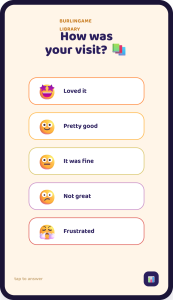
The first screen, “How was your visit?”, is the direct descendant of a touchscreen described in this module’s reading at Grand Valley State University’s library, which rates a visit from angry through “meh” to “eyes filled with love.” My version breaks that into five discrete, labeled options instead of a continuous spectrum. That design choice has a precedent in the same chapter: Facebook expanded its single “like” button into a set of labeled reactions because one blunt signal left too much room for ambiguity. Five labeled options do the same work here: a tap on “Not great” tells a librarian something a single thumbs-down never could.
The second screen, “how u feelin?”, asks for mood instead of a rating, using six mood words in a plain grid, with copy written the way a student would text it. The register matches a habit already documented in the same chapter: 92 percent of people online communicate with emoji, and emoji use has displaced netspeak abbreviations like LOL almost entirely. A middle schooler already has this 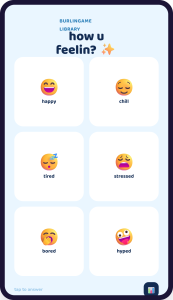 vocabulary; a screen written in complete sentences would just be translating what students already say plainly. The harder question this screen has to answer is consent. Wentz (2013) describes the Human Library model as depending on an adult freely narrating their own story as a “human book.” Apply that model directly to a population of minors and a consent problem appears that Wentz’s own source, built around adult volunteers in public libraries, never has to solve. My building runs on one librarian and PTA-funded volunteer hours, well short of the staff a formal consent process would need. Eberhart (2018) describes StoryCorps DIY as raising the bar here: even a program built for consenting adults dedicates part of its own curriculum to ethics and consent forms. A mood-check screen clears that bar by avoiding the problem at its source: it asks only for an emotional state, leaving no narrative content for a consent process to protect.
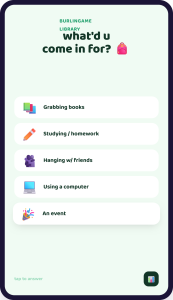 The third screen, “what’d u come in for?”, is closer to a purpose-of-visit log thaneither of the first two. I spent years in post-production before this job, and the discipline behind a screen like this is the same one an edit bay runs on raw footage: material that isn’t logged and organized at the point of capture is functionally lost later, no matter how good it was. Eberhart (2018) makes the same point about StoryCorps DIY, whose curriculum builds archiving into the process from the start, before interviews have a chance to pile up unsorted. This screen works the same way. Every tap sorts itself into one of five categories automatically, so the library never has to go back and manually organize a pile of raw comments into something usable.
This module’s reading supplies the evidence that emoji-based, low-friction feedback is already how this population communicates, plus the design precedent for turning one ambiguous signal into several labeled ones, both usable as is. Eberhart supplies a discipline that’s already usable as is: a raw response only stays useful if it’s organized as it comes in, before it becomes a backlog. Wentz is the one that needed adapting: the Human Library model depends on adult narration, which a population of minors can’t meet without a consent process a single-librarian, PTA-funded building doesn’t have the staff to run.
Collecting these taps only matters if someone reviews them on a schedule. Eberhart’s (2018) account of the StoryCorps DIY curriculum shows the discipline is achievable: it goes further than archiving alone, walking an organization through editing and sharing what it collects. The concrete next step is picking one service or space decision worth testing against a month of tallies once the screens have been running that long, so the data gets used for something instead of just accumulating the way the circulation-desk comments already do.
References
Eberhart, G. M. (2018, February 10). Sharing people’s stories: StoryCorps partners with public libraries. American Libraries Magazine.
Stephens, M. (2019). Telling stories. In Wholehearted Librarianship: Finding Hope, Inspiration, and Balance (pp. 92–95). ALA Editions. (Originally published in Library Journal, October 18, 2017.)
Wentz, E. (2013, April 26). The Human Library: Sharing the community with itself. Public Libraries Online.
Hi Nicholas,
Thanks for this great post! I love the examples of feedback from patrons and how that connects to the power of stories and especially to the idea that emojis are great universal communicators. I also really appreciate all your thoughts and connections to literature about the importance of collecting patron feedback and need to actually review it. I also agree that these needs to be a discipline in reviewing or else what’s the point!