Reflection Blog: Infinite Learning (Library as Classroom)
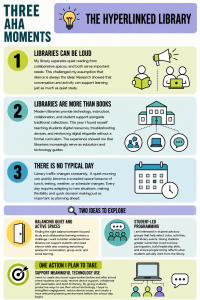
Infinite learning gets framed here as something a library offers students. It’s worth noticing that whoever’s running the room is presumably on the same continuous, unscheduled timeline the module describes for kids. A few things from this year seem relevant to that.
Brian Mathews, a librarian writing for The Chronicle of Higher Education, splits library staff work into four tiers: installer, participant, partner, developer. Looking at a typical week, I seem to move through all four, just not in equal amounts. Installer covers the basics, where to print, how to check out a book. Participant is daily troubleshooting and material requests. Partner is the PTA and staff relationships that get the space used for something beyond its default hours. Developer, the rung Mathews treats as rarest, turns out to be the one thing I do almost every day, in whatever downtime is available, thinking ahead about what the space could become. Tiffany Nash, an architect who designs library spaces, lays out a planning framework for that kind of thinking that starts before anything else with who’s actually going to use the space and how, before getting into staffing, storage, or layout. Medfield Public Library’s makerspace is one working example of that starting question answered: open to all ages but staffed specifically for supervised teen access a few afternoons a week, stocked differently for younger patrons than for teens and adults. Mathews describes his ladder with a university library’s technical staff in the background, a team spread across the tiers. Here it’s one person moving between all four in the same afternoon.
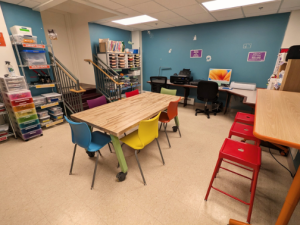
Getting stuck or visibly behind isn’t necessarily proof that something has failed. Joshua Block, a classroom teacher writing for Edutopia about project-based learning, quotes Frederick Douglass to frame that kind of discomfort as necessary rather than a warning sign: “If there is no struggle, there is no progress.” That idea sits behind the choice to let a project stay confusing for a while instead of smoothing it over early, and it’s a loose enough idea that a lot of a school year ends up fitting under it somewhere.
The last day of school felt like a version of that. A district meeting meant closing the library early, right at the hour usage tends to peak. It was also the last day, so a number of students wanted the room for reasons that had nothing to do with books, mostly social and emotional ones I didn’t want to turn away. Once the door opened even slightly, the room filled anyway, and at one point I ended up asking several groups to leave because things had gotten loud and hard to manage. Messy in the moment, and worth remembering for next year, if only as a small thing to flag to the district ahead of time.
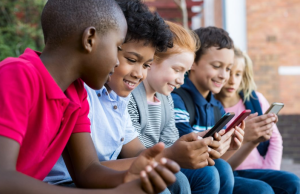
Yuhyun Park, writing for the World Economic Forum, lays out a digital intelligence framework naming eight areas kids need directly taught, not assumed: identity, safe use, security, emotional intelligence online, communication, literacy, rights. Little of that came from an MLIS program in any real depth. Coursework gave background and scope; the rest seems to come from doing the job, at roughly the same pace for me as for the students. Average tween screen time runs five hours and thirty-three minutes a day, jumping to eight hours and thirty-nine minutes by the teen years, and only 34 percent of teens say they actually enjoy the social media they’re spending that time on. That’s worth sitting with alongside the framework: the population getting the most contact with these tools isn’t necessarily the population best served by them, and neither the students nor I came in with much formal preparation for that gap.
At Fauquier High School in Warrenton, Virginia, librarians Becca Isaac and Rebecca Webster deliberately left their library’s doors wide open, and the Edutopia video documenting it shows students visibly rebuilding social skill in public, loud, unfocused, phones down only gradually, with the librarians treating that as the point rather than a problem. It made me wonder whether the person running a room like that gets the same kind of space to be visibly unfinished.
References
Block, J. (2014, January 7). Embracing messy learning. Edutopia.
Common Sense Media. (2022). The Common Sense census: Media use by tweens and teens, 2021.
Edutopia. (2024, June 14). Making the library a more welcoming space [Video]. https://www.youtube.com/watch?v=dT-X-kVSzpc
Mathews, B. (2013, September 5). Curating learning experiences: A future role for librarians? The Chronicle of Higher Education.
Medfield Public Library. (2025, January 4). Makerspace. https://www.medfieldpubliclibrary.org/using-the-library/makerspace/
Nash, T. (2017, July 5). 10 questions to ask before you plan your library makerspace. Demco Interiors.
Park, Y. (2016, June). 8 digital skills we must teach our children. World Economic Forum.
Reflections Blog: The Power of Stories (Closing the Feedback Loop)
This module’s reading argues that libraries should keep, share, and make stories. What isn’t covered is what happens to a patron’s reaction to any of that. Right now at my library, feedback exists only as comments students make at the circulation desk or during a reference question, and none of it gets recorded anywhere a colleague could later search. The three screens below are an attempt to fill that gap: an actual record of the reaction itself.
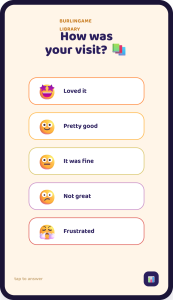
The first screen, “How was your visit?”, is the direct descendant of a touchscreen described in this module’s reading at Grand Valley State University’s library, which rates a visit from angry through “meh” to “eyes filled with love.” My version breaks that into five discrete, labeled options instead of a continuous spectrum. That design choice has a precedent in the same chapter: Facebook expanded its single “like” button into a set of labeled reactions because one blunt signal left too much room for ambiguity. Five labeled options do the same work here: a tap on “Not great” tells a librarian something a single thumbs-down never could.
The second screen, “how u feelin?”, asks for mood instead of a rating, using six mood words in a plain grid, with copy written the way a student would text it. The register matches a habit already documented in the same chapter: 92 percent of people online communicate with emoji, and emoji use has displaced netspeak abbreviations like LOL almost entirely. A middle schooler already has this 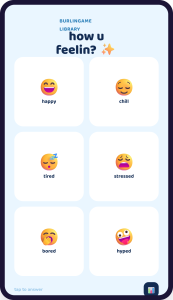 vocabulary; a screen written in complete sentences would just be translating what students already say plainly. The harder question this screen has to answer is consent. Wentz (2013) describes the Human Library model as depending on an adult freely narrating their own story as a “human book.” Apply that model directly to a population of minors and a consent problem appears that Wentz’s own source, built around adult volunteers in public libraries, never has to solve. My building runs on one librarian and PTA-funded volunteer hours, well short of the staff a formal consent process would need. Eberhart (2018) describes StoryCorps DIY as raising the bar here: even a program built for consenting adults dedicates part of its own curriculum to ethics and consent forms. A mood-check screen clears that bar by avoiding the problem at its source: it asks only for an emotional state, leaving no narrative content for a consent process to protect.
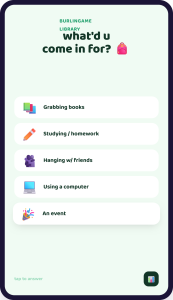 The third screen, “what’d u come in for?”, is closer to a purpose-of-visit log thaneither of the first two. I spent years in post-production before this job, and the discipline behind a screen like this is the same one an edit bay runs on raw footage: material that isn’t logged and organized at the point of capture is functionally lost later, no matter how good it was. Eberhart (2018) makes the same point about StoryCorps DIY, whose curriculum builds archiving into the process from the start, before interviews have a chance to pile up unsorted. This screen works the same way. Every tap sorts itself into one of five categories automatically, so the library never has to go back and manually organize a pile of raw comments into something usable.
This module’s reading supplies the evidence that emoji-based, low-friction feedback is already how this population communicates, plus the design precedent for turning one ambiguous signal into several labeled ones, both usable as is. Eberhart supplies a discipline that’s already usable as is: a raw response only stays useful if it’s organized as it comes in, before it becomes a backlog. Wentz is the one that needed adapting: the Human Library model depends on adult narration, which a population of minors can’t meet without a consent process a single-librarian, PTA-funded building doesn’t have the staff to run.
Collecting these taps only matters if someone reviews them on a schedule. Eberhart’s (2018) account of the StoryCorps DIY curriculum shows the discipline is achievable: it goes further than archiving alone, walking an organization through editing and sharing what it collects. The concrete next step is picking one service or space decision worth testing against a month of tallies once the screens have been running that long, so the data gets used for something instead of just accumulating the way the circulation-desk comments already do.
References
Eberhart, G. M. (2018, February 10). Sharing people’s stories: StoryCorps partners with public libraries. American Libraries Magazine.
Stephens, M. (2019). Telling stories. In Wholehearted Librarianship: Finding Hope, Inspiration, and Balance (pp. 92–95). ALA Editions. (Originally published in Library Journal, October 18, 2017.)
Wentz, E. (2013, April 26). The Human Library: Sharing the community with itself. Public Libraries Online.
Reflection Blog: New Models
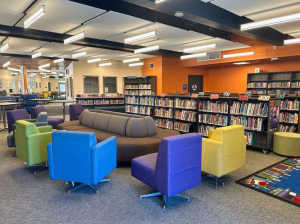
I’m a first-year librarian, fresh out of my MLIS, and it took less than a year in this library to watch the same room solve the same problem the same way without anyone deciding to solve it, quiet study tables on one side, student-run club meet-ups on the other, split by a few feet of floor space and a norm nobody wrote down. Comfort for one side means noise and movement, comfort for the other means the opposite of both, and the room has never had to choose between them out loud because nobody’s forced the choice yet. That’s the question underneath all four of this module’s readings, what a library actually does when meeting one population’s comfort costs another population theirs, and whether “new models” means anyone’s actually named that cost or just built around it.
This module’s reading on hygge frames comfort programming as pure addition, yoga, game night, quiet reading, stacked on top of each other with no sense that any of it consumes a room or a population’s attention another program might have claimed. The strongest image in it, new parents ringing a bell to mark a birth in Dokk1’s shared mediaspace, only works if nobody nearby minds becoming part of someone else’s ritual, which the chapter never checks. It’s reaching for what Shera called the “quiet stir of thought” (Stephens, 2019, p. 65), and my building shows that stir has a cost, one that’s been handed to teenagers to sort out informally instead of named as policy.
Klinenberg pushes past comfort into necessity, arguing libraries have become “a crucial part of the safety net” (Klinenberg, 2018), a claim that reads to me as an argument that comfort isn’t optional once the library is the only warm, staffed place some of his listed populations have left, though that reading is mine. But his own list, a toddler’s parent next to an immigrant studying for a citizenship exam, never asks what happens when the parent’s noise conflicts with the student’s need for silence in the same room at the same hour. I don’t have evidence my own split has broken under that pressure yet, only that nothing’s tested it.
Anythink answers what Klinenberg’s gap actually costs to fix, land, since fifteen acres bought enough distance that a mud-pit, wildlife-encounter population and a quiet-reading population never have to share a room, built explicitly as “the next evolution” of what a library offers (Anythink Libraries, 2026). It’s also a genuinely unfair comparison. My building runs the same problem on a single room and a taped-off convention instead of an outdoor campus, and the convention mostly holding is not proof the tension is solved, just proof nothing has forced it yet.
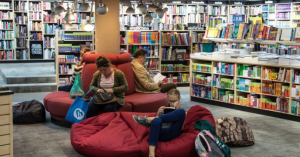
The National Literacy Trust survey finds gaming’s literacy benefits concentrated among boys and reluctant readers specifically, not universally, a finding the survey never follows into what happens when a library courts that population toward louder engagement while a quiet reader shares the same shelf (National Literacy Trust, 2020). The result is worth weighing against its limits, 2019 UK data, self-reported, produced jointly with a games trade body and a publisher. Under the shared-cart system still in place, computer time was rationed by scarcity, which kept that collision theoretical. Next year’s 1:1 MacBook Neo rollout removes that scarcity entirely, which means the tension the survey raises stops being theoretical and becomes a scheduling decision my library actually has to make on purpose.
None of these sources says who loses out when someone else is made more comfortable. My library hasn’t figured that out either, the decision just gets left to a whoever claims the space first. Once every student has a personal device next year, the physical divide may shift.
References
Anythink Libraries. (2026, July 14). Anythink Nature Library opens Aug. 8 as nation’s first public nature library [Press release].
Burlingame Intermediate School. (n.d.). Burlingame Intermediate School Library. Burlingame School District. https://bis.burlingameschools.org/apps/pages/index.jsp?uREC_ID=3570343&type=d&pREC_ID=2402959
Klinenberg, E. (2018, November 11). Q&A with Eric Klinenberg (M. Gaetani, Interviewer). Center for Advanced Study in the Behavioral Sciences, Stanford University.
National Literacy Trust. (2020, August 12; updated 2025, June 16). Video game playing and literacy: A survey of young people aged 11 to 16.
Stephens, M. (2019). Hygge state of mind. In Wholehearted Librarianship: Finding Hope, Inspiration, and Balance (pp. 63–66). ALA Editions.
Reflection Blog: Hyperlinked Environments in the Middle School Library
A hyperlinked library has a few specific components rather than one single quality. Anderson (2006) sets the baseline principle: if a service requires training to use, the service needs to change, not the user (p. 7). Stephens describes two more specific pieces, one outward-facing, libraries doing outreach and partnerships, becoming part of their community (2019, p. 78), and one aimed at non-users specifically, finding people who aren’t using the library and asking directly what they need (2016, p. 41). Loertscher and Koechlin (2014) describe the structural version of this vision, a “learning commons” with expanded staff, reading specialists, tech coaches, counselors, working alongside the librarian, in flexible, redesignable space (p. E5). Put together, a hyperlinked library adapts its services to actual users, builds real outward partnerships, actively seeks out people who aren’t showing up, and has the staffing to do all of that.
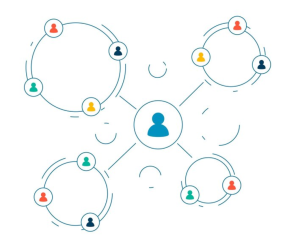
The age split in my library runs younger students toward the space and older students away from it. 6th and 7th graders use it for reading, games, quiet privacy, and socializing. By 8th grade, most students have stopped coming in regularly, splitting into tight social groups that meet elsewhere or a small number of habitual solo users. Joing (2023) documents a similar curve in a French middle school: 89% positive association among the youngest students, dropping to 52% by the oldest grade (p. 782), caused by an enforced silence rule that pushed older students out even during assigned group work. My library’s drop-off has a different cause. No rule excludes 8th graders directly. The relationship thins instead, staff-to-student ratio stretches as kids get older, and materials like bookfair displays still target a younger reader, signaling without any stated rule that the space wasn’t built with them in mind.
My library does enforce quiet in specific zones, the half with the book collection is patrolled for food, drink, and noise, while the other half, computers and communal tables, allows normal conversation. Two semi-private workrooms with doors and windows exist for testing, group work, or privacy, and students want access to them specifically because they feel less supervised there, which also produces more behavioral issues, since students forget how visible and audible they still are through the windows. Joing’s librarian enforced silence even inside rooms meant to be exceptions to it; my library’s rooms aren’t policed the same way, but the same underlying tension shows up, a space meant to give students freedom still carries enough visibility that adults end up managing behavior in it anyway.
Staffing runs from single digits on quiet days up to a hundred or more during lunch rushes, testing periods, or bad weather, managed by one librarian, occasionally two. Terrell (2011) documents her library going from four staff positions to one within a year, kept running through unpaid student labor and a reduced schedule. My library never had four positions to lose. It relies on PTA funding and volunteer time to fill staffing gaps. Loertscher and Koechlin’s model assumes a larger paid team. Terrell’s case shows a librarian absorbing a staffing cut internally. My library covers the same kind of gap with outside funding and volunteer labor instead.
This year the library was given responsibility for teaching students digital resources and etiquette, informally, with no curriculum or formal lesson plan. Stephens (2016) argues an institution should notice a gap and adapt to it (p. 41). The task landed on the library without anyone naming it as that kind of response. Ní Bhroin (2019) found that Norwegian children recognize digital concepts without holding the operational skill behind them, they know what a password is without managing one reliably. That same gap shows up on my library’s own desktop computers. Some students easily bypass restriction software. Others can’t complete basic tasks like formatting a document. No formal process checks for it either way.
Students use my library as a refuge for reasons beyond books or computers, avoiding bad weather, avoiding other students, or wanting a familiar space. Luster (2018) makes a similar claim about libraries functioning as safe spaces but offers no evidence behind it. My library’s version has specific, observable causes, and the comfort spreads student to student, one telling another how easy it is to do something there, building familiarity that brings them back.
Based on what I’ve actually found this year, a hyperlinked library isn’t one thing a space either has or doesn’t have. It’s at least two separate jobs, reaching outward to build real community partnerships, and actively finding the people who’ve stopped showing up, and a library can be doing one without doing the other. Mine is doing a version of the second job, informally, through the digital-etiquette role, and not really doing the first, since the PTA partnership serves people already coming in rather than reaching anyone new.
Three things I’d do next. Name the PTA relationship for what it actually is instead of counting it as outreach. Follow up directly and consistently with students who’ve stopped coming in instead of treating a handful of conversations as a full answer. Decide on purpose whether the digital-etiquette role should become a real, planned part of the job, since right now it’s happening without anyone having chosen it.
References:
Anderson, R. (2006). Away from the “icebergs”: Row your library boat into the Web 2.0 environment. NextSpace, (2), 7. OCLC.
Joing, I. (2023). The school library: An important place for adolescents’ well-being. An ethnographic experience in a French middle school. Journal of Library Administration, 63(6), 777–796. https://doi.org/10.1080/01930826.2023.2240192
Loertscher, D. V., & Koechlin, C. (2014). Climbing to excellence: Defining characteristics of a successful learning commons. Knowledge Quest, 42(4), E1–E10.
Luster, S. (2018). Reinvented school libraries unleash student creativity. NEA Today.
Ní Bhroin, N. (2019). Digital natives or naïve experts? Exploring how Norwegian children understand the internet. LSE Parenting for a Digital Future. https://blogs.lse.ac.uk/parenting4digitalfuture/2019/02/13/digital-natives-or-naive-experts/
Stephens, M. (2016). Reaching all users. In Heart of librarianship: Attentive, positive, and purposeful change (p. 41). ALA Editions.
Stephens, M. (2019). Libraries in balance. In Wholehearted librarianship: Finding hope, inspiration, and balance (p. 78). ALA Editions.
Terrell, N. (2011). One school librarian plus positive attitude equals a quality school library program. Knowledge Quest, 40(2), 18–23.
Inspiration Report: Use it, Don’t Lose It
Innovation Roadmap: The Launchpad
Reflection Blog: Hyperlinked Communities (Ideals and Realities)
The hyperlinked library, as Michael Stephens described it in Wholehearted Librarianship, envisions “wide-open libraries, libraries doing outreach and partnerships and becoming a real part of their community” (Stephens, 2019, p. 78). In The Heart of Librarianship he makes the charge specific: “Who doesn’t use the library? Who in your community could benefit from access, services, assistance? Find them. Go to them, ask them what they want and need” (Stephens, 2016, p. 41).
I spent my first year in a middle school library watching students cluster around single screens in groups of three or four, one driving, the others watching and occasionally taking over, knowledge moving through the group without any adult organizing it. The range within a single cluster was wide enough that one student was teaching while another was still learning to navigate the browser. Jessamyn West, writing in 2014 about the digital divide, observed that in connected environments ”
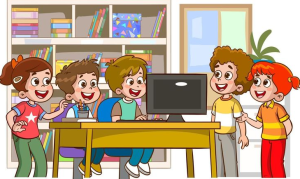
Trust builds before engagement does, and in a school the conditions for it are structurally different from anywhere else in the building. The librarian doesn’t grade you, doesn’t control your schedule, isn’t attached to any department. Within two weeks of starting at my school, students had come to me with things they hadn’t brought to teachers or administrators. Lynn Silipigni Connaway’s 2015 synthesis of OCLC user behavior research found the same pattern: “if they know us and trust us, they will seek us out when they need information and they will recommend us and our services to others” (Connaway, 2015, p. ii), with users citing rapport as the deciding factor even in interactions where they left without an answer.

Trust accumulates through small decisions about what the library is willing to be for people. Saying yes to the group sharing a screen, yes to the study group that becomes something unplanned, yes to the request that has nothing to do with books extends the library’s position into parts of the community it hadn’t reached yet. The student at the edge of the cluster who never would have walked in on their own has already been reached.
References
West, J. (2014). 21st century digital divide. librarian.net. http://librarian.net/talks/rlc14
Connaway, L. S., comp. (2015). The library in the life of the user: Engaging with people where they live and learn. OCLC Research. https://doi.org/10.25333/C3SP9X
Stephens, M. (2019). Libraries in balance. In Wholehearted librarianship: Finding hope, inspiration, and balance (p. 78). ALA Editions.
Stephens, M. (2016). Reaching all users. In The heart of librarianship: Attentive, positive, and purposeful change (p. 41). ALA Editions.
Assignment X: New Hardware, Same Question
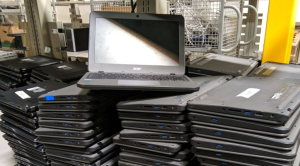
I spent years in post-production before I worked in a library. In that time the storage format changed four times: tape, then discs, then solid state, now cloud. Each one was treated as the obvious upgrade, faster and cheaper than the last. The actual work, cutting footage, telling a story with what you had, stayed the same the whole time. I think about that now, working in a school library and watching the same hardware shuffle happen again: a Chromebook cart this year, a 1:1 laptop program next year.
Rick Anderson wrote something in 2006, in an essay for OCLC’s NextSpace, that’s become foundational to what librarians call participatory service: “if our services can’t be used without training, then it’s the services that need to be fixed, not our users” (Anderson, 2006, p. 7). I’d extend that past services and onto the device itself. A new tool replacing an old one is not automatically better for the person using it. Anderson’s sentence assumes something it doesn’t say outright, that someone checked.
Right now, technology at my school mostly means Chromebook carts. Teachers wheel them into classrooms and hand them out like textbooks, for specific tasks: presentations, reports, tests. My own view of this is narrow. The library where I work doubles as the overflow site for testing accommodations, so what I mostly see is the most controlled version of Chromebook use there is, a student, a test, a timer.
A 2015 study in RMLE Online followed one middle school team for four years as they rolled out 1:1 laptops (Downes & Bishop, 2015). In the early years, the teachers gave little attention to classroom culture, and the laptops made things worse. One eighth grader described that year’s group project work bluntly: “a living hell” (Downes & Bishop, 2015, p. 5). By year four, the same team had spent three weeks on relationship-building before academics started, and one teacher recalled overhearing students that year: “I’ve heard students just kind of hanging out together with each other and saying, ‘This is the best team; this is us, I love this team'” (Downes & Bishop, 2015, p. 6).
The study’s authors are careful to note that their findings come from a single team and shouldn’t be read as a prediction for every 1:1 program. I’m reading my own situation against it anyway, since it’s the closest thing I have to a real account of what a rollout like this looks like from the inside.
Next year my school moves to 1:1 MacBook Neos, student-owned, taken home, with no word yet on how that will be managed day to day. A 2022 EdSurge piece on Mississippi’s statewide rollout is direct about what that gap actually costs a program. The state’s chief information officer for educational technology said it plainly: “Everybody gets so caught up in the device procurement, but it’s such a small sliver of the overall question of ‘What’s needed to make these devices valuable for students?'” (Peters Hinton & Burstein, 2022). Mississippi built connectivity support, device repair, and ongoing teacher training around the hardware.
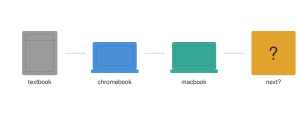
What I want to carry forward from this is the difference between a school deciding to modernize and a school deciding to ask, and the fact that they’re not mutually exclusive. The MacBook rollout could go either direction, and I’d rather be part of figuring out which one it becomes than just observe from the library and report back. If the rollout doesn’t yet have a plan for things like training or support, that’s not a verdict, it’s an opening, and maybe a place where the library has something to offer that hasn’t been asked for yet.
References
Anderson, R. (2006). Away from the “icebergs”: Row your library boat into the Web 2.0 environment. NextSpace, (2), 7. OCLC.
Downes, J. M., & Bishop, P. A. (2015). The intersection between 1:1 laptop implementation and the characteristics of effective middle level schools. RMLE Online: Research in Middle Level Education, 38(7), 1–16.
Peters Hinton, V., & Burstein, R. (2022, August 24). What is the true cost of a 1:1 device program? One state’s careful rollout offers a look. EdSurge. https://www.edsurge.com/news/2022-08-24-what-is-the-true-cost-of-a-1-1-device-program-one-state-s-careful-rollout-offers-a-look
Hello :)
Hi everyone. I’m Nick Haynes, a librarian and tech assistant at a middle school in the Bay Area, finishing my MLIS at SJSU. My role covers standard library duties, student PC and print support, and a 1-to-1 laptop program currently transitioning from Chromebooks to MacBook Neos. That means checking out books, troubleshooting devices, managing print queues, and preparing for a hardware rollout.
I came to this work after ten years in post-production and advertising in San Francisco. The hyperlinked library model is exciting because of what it opens up for students in terms of access. A middle school library that functions as a genuinely connected, participatory space could change how students relate to research, to reading, and to information generally.
The harder question is who does that work. Librarians are already carrying responsibilities that go well beyond what the job title suggests. Adding the infrastructure, training, and ongoing maintenance that a hyperlinked model requires means asking already stretched staff to take on something substantial. The students I work with would benefit from that kind of access, and I want to build toward it, but getting there while managing a hardware transition is a lot to hold at once.
I’m curious whether others in the course are running into the same tension and how they’re thinking about it.