I’m a first-year librarian, fresh out of my MLIS, and it took less than a year in this library to watch the same room solve the same problem the same way without anyone deciding to solve it, quiet study tables on one side, student-run club meet-ups on the other, split by a few feet of floor space and a norm nobody wrote down. Comfort for one side means noise and movement, comfort for the other means the opposite of both, and the room has never had to choose between them out loud because nobody’s forced the choice yet. That’s the question underneath all four of this module’s readings, what a library actually does when meeting one population’s comfort costs another population theirs, and whether “new models” means anyone’s actually named that cost or just built around it.
This module’s reading on hygge frames comfort programming as pure addition, yoga, game night, quiet reading, stacked on top of each other with no sense that any of it consumes a room or a population’s attention another program might have claimed. The strongest image in it, new parents ringing a bell to mark a birth in Dokk1’s shared mediaspace, only works if nobody nearby minds becoming part of someone else’s ritual, which the chapter never checks. It’s reaching for what Shera called the “quiet stir of thought” (Stephens, 2019, p. 65), and my building shows that stir has a cost, one that’s been handed to teenagers to sort out informally instead of named as policy.
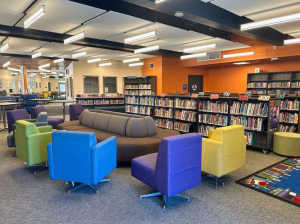
Klinenberg pushes past comfort into necessity, arguing libraries have become “a crucial part of the safety net” (Klinenberg, 2018), a claim that reads to me as an argument that comfort isn’t optional once the library is the only warm, staffed place some of his listed populations have left, though that reading is mine. But his own list, a toddler’s parent next to an immigrant studying for a citizenship exam, never asks what happens when the parent’s noise conflicts with the student’s need for silence in the same room at the same hour. I don’t have evidence my own split has broken under that pressure yet, only that nothing’s tested it.
Anythink answers what Klinenberg’s gap actually costs to fix, land, since fifteen acres bought enough distance that a mud-pit, wildlife-encounter population and a quiet-reading population never have to share a room, built explicitly as “the next evolution” of what a library offers (Anythink Libraries, 2026). It’s also a genuinely unfair comparison. My building runs the same problem on a single room and a taped-off convention instead of an outdoor campus, and the convention mostly holding is not proof the tension is solved, just proof nothing has forced it yet.
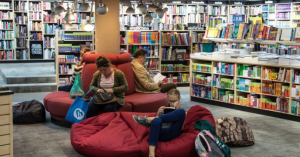
The National Literacy Trust survey finds gaming’s literacy benefits concentrated among boys and reluctant readers specifically, not universally, a finding the survey never follows into what happens when a library courts that population toward louder engagement while a quiet reader shares the same shelf (National Literacy Trust, 2020). The result is worth weighing against its limits, 2019 UK data, self-reported, produced jointly with a games trade body and a publisher. Under the shared-cart system still in place, computer time was rationed by scarcity, which kept that collision theoretical. Next year’s 1:1 MacBook Neo rollout removes that scarcity entirely, which means the tension the survey raises stops being theoretical and becomes a scheduling decision my library actually has to make on purpose.
None of these sources says who loses out when someone else is made more comfortable. My library hasn’t figured that out either, the decision just gets left to a whoever claims the space first. Once every student has a personal device next year, the physical divide may shift.
References
Anythink Libraries. (2026, July 14). Anythink Nature Library opens Aug. 8 as nation’s first public nature library [Press release].
Burlingame Intermediate School. (n.d.). Burlingame Intermediate School Library. Burlingame School District. https://bis.burlingameschools.org/apps/pages/index.jsp?uREC_ID=3570343&type=d&pREC_ID=2402959
Klinenberg, E. (2018, November 11). Q&A with Eric Klinenberg (M. Gaetani, Interviewer). Center for Advanced Study in the Behavioral Sciences, Stanford University.
National Literacy Trust. (2020, August 12; updated 2025, June 16). Video game playing and literacy: A survey of young people aged 11 to 16.
Stephens, M. (2019). Hygge state of mind. In Wholehearted Librarianship: Finding Hope, Inspiration, and Balance (pp. 63–66). ALA Editions.
I really liked your point that none of the readings actually asks who loses when someone else’s comfort is prioritized. That felt like the thread connecting everything. Your example from your own library made it much more concrete because it shows how often these decisions aren’t really decisions at all. They’re just informal norms that develop over time. I’m also curious to see what happens after the 1:1 device rollout. It seems like removing one constraint could expose a whole new set of space and noise challenges that have been hidden until now.