Author: Nicholas Haynes
Hyperlinked Communities: Ideals and Realities
The hyperlinked library, as Michael Stephens described it in Wholehearted Librarianship, envisions “wide-open libraries, libraries doing outreach and partnerships and becoming a real part of their community” (Stephens, 2019, p. 78). In The Heart of Librarianship he makes the charge specific: “Who doesn’t use the library? Who in your community could benefit from access, services, assistance? Find them. Go to them, ask them what they want and need” (Stephens, 2016, p. 41).
I spent my first year in a middle school library watching students cluster around single screens in groups of three or four, one driving, the others watching and occasionally taking over, knowledge moving through the group without any adult organizing it. The range within a single cluster was wide enough that one student was teaching while another was still learning to navigate the browser. Jessamyn West, writing in 2014 about the digital divide, observed that in connected environments “

Trust builds before engagement does, and in a school the conditions for it are structurally different from anywhere else in the building. The librarian doesn’t grade you, doesn’t control your schedule, isn’t attached to any department. Within two weeks of starting at my school, students had come to me with things they hadn’t brought to teachers or administrators. Lynn Silipigni Connaway’s 2015 synthesis of OCLC user behavior research found the same pattern: “if they know us and trust us, they will seek us out when they need information and they will recommend us and our services to others” (Connaway, 2015, p. ii), with users citing rapport as the deciding factor even in interactions where they left without an answer.

Trust accumulates through small decisions about what the library is willing to be for people. Saying yes to the group sharing a screen, yes to the study group that becomes something unplanned, yes to the request that has nothing to do with books extends the library’s position into parts of the community it hadn’t reached yet. The student at the edge of the cluster who never would have walked in on their own has already been reached.
References
West, J. (2014). 21st century digital divide. librarian.net. http://librarian.net/talks/rlc14
Connaway, L. S., comp. (2015). The library in the life of the user: Engaging with people where they live and learn. OCLC Research. https://doi.org/10.25333/C3SP9X
Stephens, M. (2019). Libraries in balance. In Wholehearted librarianship: Finding hope, inspiration, and balance (p. 78). ALA Editions.
Stephens, M. (2016). Reaching all users. In The heart of librarianship: Attentive, positive, and purposeful change (p. 41). ALA Editions.
Assignment X: New Hardware, Same Question
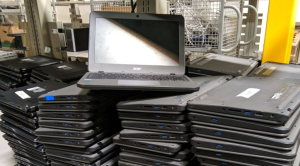
I spent years in post-production before I worked in a library. In that time the storage format changed four times: tape, then discs, then solid state, now cloud. Each one was treated as the obvious upgrade, faster and cheaper than the last. The actual work, cutting footage, telling a story with what you had, stayed the same the whole time. I think about that now, working in a school library and watching the same hardware shuffle happen again: a Chromebook cart this year, a 1:1 laptop program next year.
Rick Anderson wrote something in 2006, in an essay for OCLC’s NextSpace, that’s become foundational to what librarians call participatory service: “if our services can’t be used without training, then it’s the services that need to be fixed, not our users” (Anderson, 2006, p. 7). I’d extend that past services and onto the device itself. A new tool replacing an old one is not automatically better for the person using it. Anderson’s sentence assumes something it doesn’t say outright, that someone checked.
Right now, technology at my school mostly means Chromebook carts. Teachers wheel them into classrooms and hand them out like textbooks, for specific tasks: presentations, reports, tests. My own view of this is narrow. The library where I work doubles as the overflow site for testing accommodations, so what I mostly see is the most controlled version of Chromebook use there is, a student, a test, a timer.
A 2015 study in RMLE Online followed one middle school team for four years as they rolled out 1:1 laptops (Downes & Bishop, 2015). In the early years, the teachers gave little attention to classroom culture, and the laptops made things worse. One eighth grader described that year’s group project work bluntly: “a living hell” (Downes & Bishop, 2015, p. 5). By year four, the same team had spent three weeks on relationship-building before academics started, and one teacher recalled overhearing students that year: “I’ve heard students just kind of hanging out together with each other and saying, ‘This is the best team; this is us, I love this team'” (Downes & Bishop, 2015, p. 6).
The study’s authors are careful to note that their findings come from a single team and shouldn’t be read as a prediction for every 1:1 program. I’m reading my own situation against it anyway, since it’s the closest thing I have to a real account of what a rollout like this looks like from the inside.
Next year my school moves to 1:1 MacBook Neos, student-owned, taken home, with no word yet on how that will be managed day to day. A 2022 EdSurge piece on Mississippi’s statewide rollout is direct about what that gap actually costs a program. The state’s chief information officer for educational technology said it plainly: “Everybody gets so caught up in the device procurement, but it’s such a small sliver of the overall question of ‘What’s needed to make these devices valuable for students?'” (Peters Hinton & Burstein, 2022). Mississippi built connectivity support, device repair, and ongoing teacher training around the hardware.
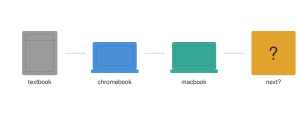
What I want to carry forward from this is the difference between a school deciding to modernize and a school deciding to ask, and the fact that they’re not mutually exclusive. The MacBook rollout could go either direction, and I’d rather be part of figuring out which one it becomes than just observe from the library and report back. If the rollout doesn’t yet have a plan for things like training or support, that’s not a verdict, it’s an opening, and maybe a place where the library has something to offer that hasn’t been asked for yet.
References
Anderson, R. (2006). Away from the “icebergs”: Row your library boat into the Web 2.0 environment. NextSpace, (2), 7. OCLC.
Downes, J. M., & Bishop, P. A. (2015). The intersection between 1:1 laptop implementation and the characteristics of effective middle level schools. RMLE Online: Research in Middle Level Education, 38(7), 1–16.
Peters Hinton, V., & Burstein, R. (2022, August 24). What is the true cost of a 1:1 device program? One state’s careful rollout offers a look. EdSurge. https://www.edsurge.com/news/2022-08-24-what-is-the-true-cost-of-a-1-1-device-program-one-state-s-careful-rollout-offers-a-look
Hello :)
Hi everyone. I’m Nick Haynes, a librarian and tech assistant at a middle school in the Bay Area, finishing my MLIS at SJSU. My role covers standard library duties, student PC and print support, and a 1-to-1 laptop program currently transitioning from Chromebooks to MacBook Neos. That means checking out books, troubleshooting devices, managing print queues, and preparing for a hardware rollout.
I came to this work after ten years in post-production and advertising in San Francisco. The hyperlinked library model is exciting because of what it opens up for students in terms of access. A middle school library that functions as a genuinely connected, participatory space could change how students relate to research, to reading, and to information generally.
The harder question is who does that work. Librarians are already carrying responsibilities that go well beyond what the job title suggests. Adding the infrastructure, training, and ongoing maintenance that a hyperlinked model requires means asking already stretched staff to take on something substantial. The students I work with would benefit from that kind of access, and I want to build toward it, but getting there while managing a hardware transition is a lot to hold at once.
I’m curious whether others in the course are running into the same tension and how they’re thinking about it.