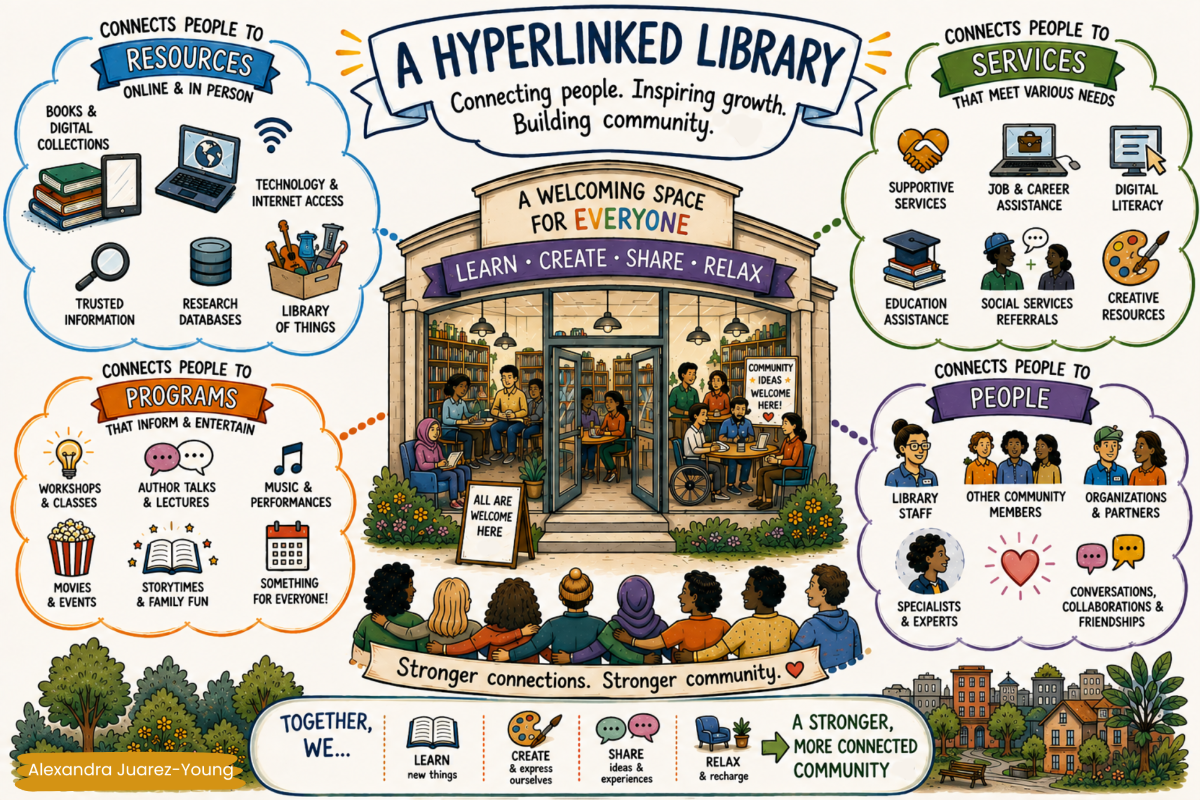
For my virtual symposium I wanted to create a visual of what I think a hyperlinked library is based on what I learned from this course. To me a hyperlinked library is a community space that facilitates and fosters connections. It connects people to resources online and in person that helps encourage learning and growth. It connects people to services that can meet various needs, from supportive to creative services. It connects people to programs that can be informative and entertaining. And it connects people to people. Staff members, organizations, specialists, and other community members can meet at the library to build connections and create a stronger community. The hyperlinked library welcomes everyone in and encourages them to learn, create, share, and relax. Based on this, I used ChatGPT to help me create a visual image.
Libraries are situated within communities to meet the various needs of their patrons, including being a hub for programs and classes that encourage lifelong learning. In the introduction for the Infinite Learning Module, @michael discusses how learning is moving beyond classrooms, and libraries have an opportunity to design spaces and services to encourage curiosity and continued learning. While organizations such as community centers or local colleges offer classes to the public, there is usually a fee associated with the class. This can make it difficult for people who are interested in taking these classes but are financially unable to afford the fees. This is where the library can fill a need within the community by offering free classes to their patrons. From technology classes to cooking demonstrations, libraries are coming up with unique programs that can help their patrons continue to grow and learn.
In Bookey’s (2015) article, two programs caught my attention. The first was the Lit Room at Richland public library, which is a room that uses lights, sounds and movements to interact with a story and provide a visual representation of the emotions and actions taking place. I thought this sounded fascinating and offered a new way to use technology to enhance a reading experience. Another program Bookey (2015) highlights is The Supper Club at Madison Public Library, which is a monthly program that provides dinner and information about the many different children’s apps that are available. With apps being developed daily and privacy settings changing frequently, this program can provide valuable information to parents and their children.
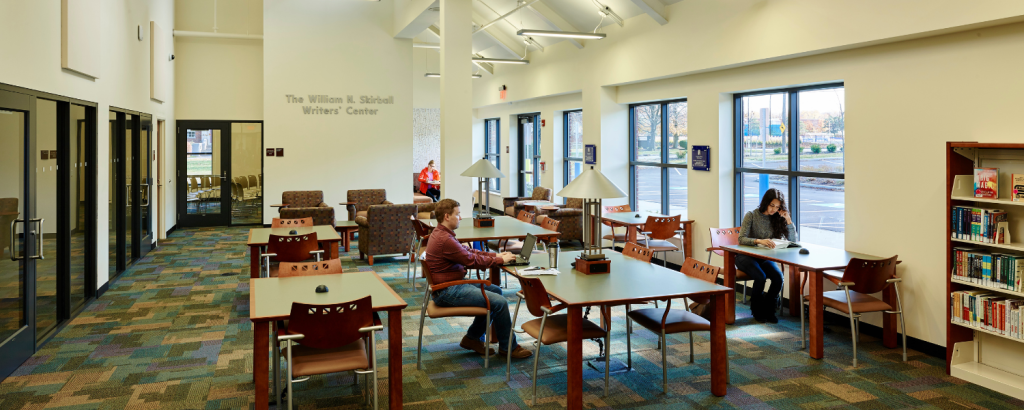
Another service I want to highlight from one of my local libraries is The William N. Skirball Writers’ Center at Cuyahoga County Public Library (Cuyahoga County Public Library, n.d.). Within the South Euclid-Lyndhurst Branch, there is a dedicated space for writers with private rooms, laptops, and a special collection available to patrons. Additionally, there is a writer in residence that offers advice and regular workshops. This type of service is one example of how a library can support learning outside of a classroom and provide resources and classes to help patrons pursue their passions.
Image of William N. Skirball Writers’ Center from Cuyahoga County Public Library website.
While working through the materials for this module, two organizations stood out to me the most, The Human Library and StoryCorps. Both organizations focus on speaking directly to people and encouraging them to share their stories to build connections and uplift voices that may otherwise go unheard. It can be easy to stay engulfed in our own little world, speaking to the same people every day, moving within our own social circle, and listening to similar viewpoints. There are not many opportunities to speak with someone you would not normally interact with, which is why I was excited to read about these two organizations.
The Human Library features “human books,” which are people that volunteer to share their unique stories and perspectives with “readers,” opening themselves up to questions and sharing their experiences (Wentz, 2013). While this program originated in Denmark, it has expanded to several other countries and now even has an online video platform available (Human Library, n.d.; Wentz, 2013). In a recent study, Aarne-Skidmore (2021) found there is an overall positive impact from these programs, and many readers reported they began to reflect on their own biases and behaviors after attending a program. I believe this shows how important it is to listen to other people’s stories. By taking the time to have these open conversations, we can become more empathetic and reevaluate our own perceptions and biases.
StoryCorps is another organization that encourages people to share their stories. One difference is that instead of having “human books” available for checkout, stories are recorded as an interview between an individual and a loved one (Eberhart, 2018). Recordings are then posted online, archived in the Library of Congress, and played on NPR’s “Morning Edition,” making these stories widely available (Eberhart, 2018). While The Human Library makes it possible to have a one-on-one conversation with a new person, I appreciate that StoryCorps makes it easy for more people to share their stories. With their DIY tools and StoryCorps App, people can record a conversation and share it at any time (StoryCorps, n.d.-b). Additionally, if someone does want to meet someone new, StoryCorps has a new program called “Connect250” that matches people together to have a conversation and share their experiences as part of a time capsule for America’s 250th anniversary (StoryCorps, n.d.-a).
Both organizations make it possible for people to share their stories and build connections, which can help broaden viewpoints and lead to more empathetic communities. Within a library setting, I can see both models being used as a way to encourage communication between the many different people that come into the library. Not only can these types of programs help facilitate conversations between patrons, but they can also help librarians build better relationships with people they interact with every day.
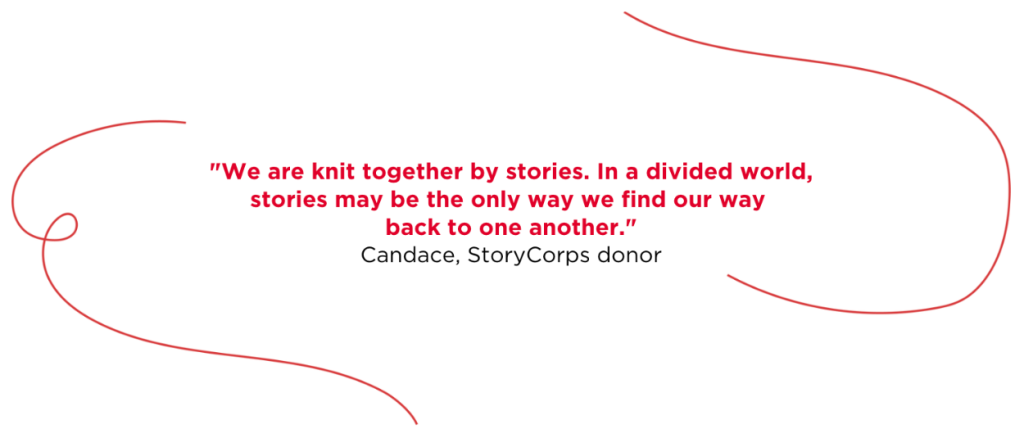
Quote from Impact page on StoryCorps website. https://storycorps.org/impact/
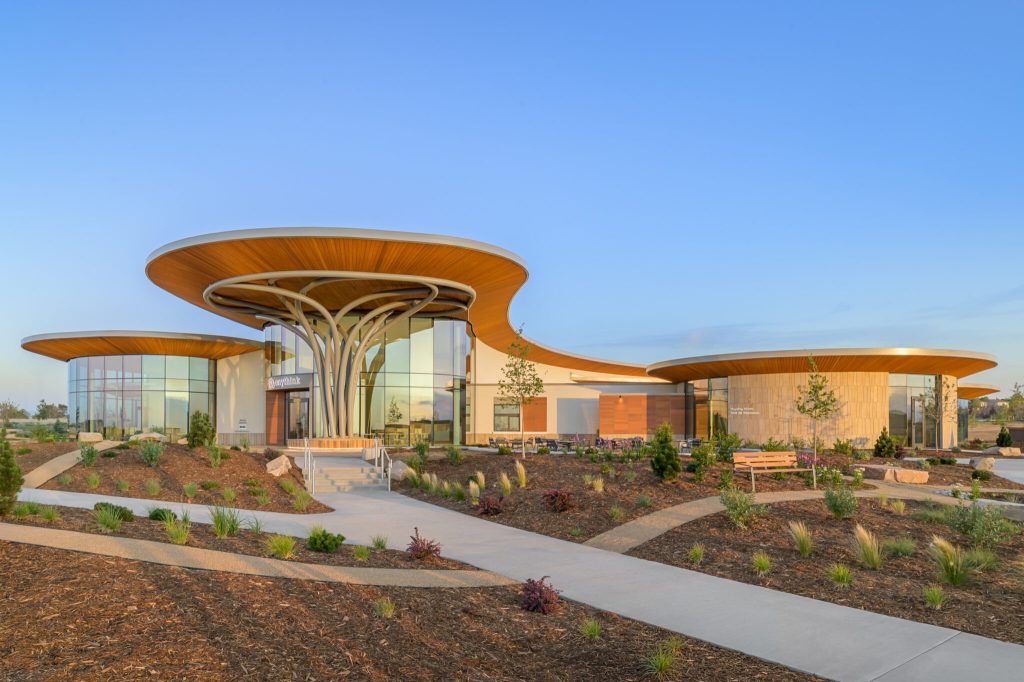
Libraries around the world are experimenting with non-traditional buildings and services, and I found the examples presented in the New Models module inspiring. In particular, I was impressed by the Anythink Nature Library, which is an experience-driven space that focuses on exploring our connection to nature (Anythink Libraries, 2025). I have not seen an experience-driven library space before, but I love the idea of incorporating interactive spaces into a library setting. Instead of only offering spaces to sit, read, and work on a computer, this type of environment can help encourage active participation from community members through different activities.
Image of Anythink Nature Library from Anythink Libraries website.
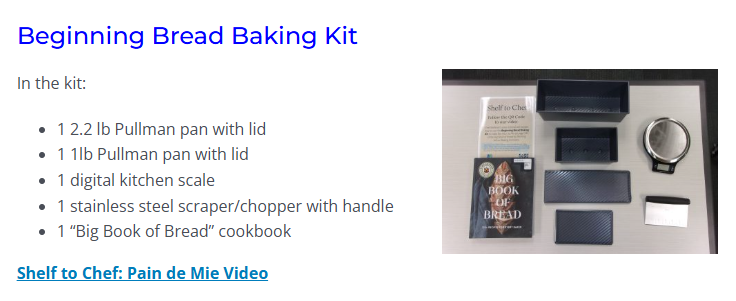
In addition to new building models, libraries are also exploring new service models. The “library of things” is a type of service that many libraries are starting to invest in. From cake pans to exercise equipment, libraries are offering more than just books to their patrons to check out. The Traverse Area District Library has a large selection of musical instruments that patrons can barrow, which is helpful for patrons who want to play an instrument but cannot afford the pricey equipment (Traverse Area District Library, n.d.). The Mentor Public Library also started a new “Shelf to Chef” kit service that provides patrons with the equipment, instructions, and link to a video tutorial for specific recipes, which can help patrons pursue their cooking interests without investing in expensive pans and tools (Mentor Public Library, n.d.). These examples show how libraries are starting to expand their services to meet the various interests and needs of their community members.
One example of Mentor Public Library’s Shelf to Chef kits.
On top of the various materials becoming available in libraries, I am also excited to see more libraries offering free passes to local attractions. I have personally used this service from my local library, and I think it is a great idea that makes different attractions more accessible to patrons who are unable to afford normal ticket prices. For example, the San Diego Zoo is a popular attraction but one ticket costs $78 (San Diego Zoo, n.d.). Thankfully, the San Diego County Library’s Discover & Go pass provides free access for several adults and children (San Diego County Library, n.d.). This type of service meets a need in the community that goes beyond what traditional library materials and services can address, and I am glad more libraries are investing in these passes.
“Kitchen Connections” is a new service that focuses on fostering community connections through various culinary programs. By working together, participants can connect with their neighbors, practice their culinary skills, and learn something new. To learn more, click on the link below to view the full presentation. Information regarding Willowick Public Library is based on my personal observation from my time working there.
For this post, I wanted to focus on international libraries. I think we can learn a lot from looking at what other countries are doing. While each community has their own unique needs, there are similar issues that can affect libraries all around the world, such as adapting to new technologies and remaining relevant to their patrons. By researching what is, or is not, working well for other libraries we can gain inspiration for how to improve our own spaces.
DOKK1 Aarhus Main Library in Denmark is one library that we can learn from. Ni Rian and Engberg (2019) state that DOKK1 is far from the stereotypical library. Instead of a dusty and quiet space, it is a thriving community center that was built with various areas to meet a multitude of needs. Ni Rian and Engberg mention that there are still quiet areas, but also playgrounds, community spaces, creative spaces, a café, beautiful views, and so much more. Following the four-space model, DOKK1is a great example of how a library can create inspiration, learning, meeting, and performative spaces all in one place to meet the needs of their community (Skot-Hansen, 2017). The community centered approach of this library is one reason it is so loved. Marie Ostergaard, head of community engagement, has stated that DOKK1 is the “living room of the city,” and on average 4,000 people visit per day (Morehart, 2016). DOKK1 is a well-used community space that can provide inspiration and ideas for how to think outside of the box for library services.
One of the playgrounds at DOKK1. Image by RhinoMind, 2015, Wikimedia Commons, https://commons.wikimedia.org/wiki/File:Dokk1_(Kloden).jpg
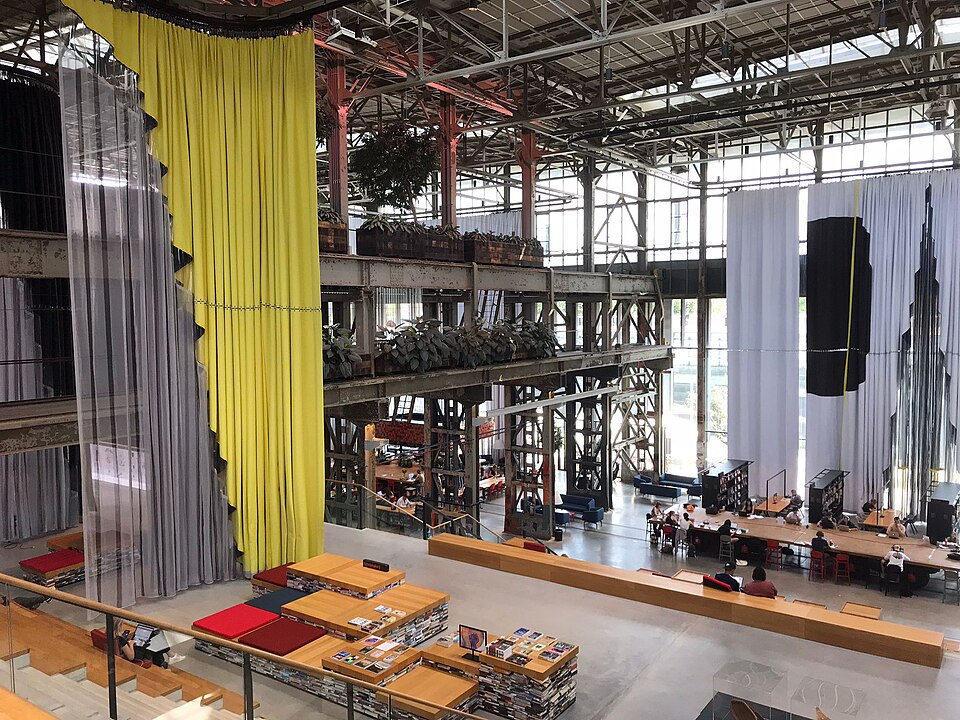
Another library I was fascinated to learn about is the LocHal public library in Tilburg, Netherlands. Built in a converted 80 year-old train shed, this is a beautiful library that has a unique charm and takes advantage of flexible spaces (Schwab, 2019). Schwab describes the library as a “center for civic life,” where there are spaces to meet many different needs. There is a game lab, maker space, writing space, time lab, future lab, café, and large open areas (The LocHal Library, n.d.). One aspect of this library that I found impressive was that most of the furniture and features of the spaces are flexible. Schwab (2019) mentions that many of the bookshelves are moveable, and there are large curtains to section off areas into small meeting spaces. I think this is a great idea that allows the library to easily adjust the space for future changes. The LocHal library demonstrates how unique spaces can be reimagined and adapted to meet the changing needs of a community.
Inside LocHal. Image by Brandpunt, 2023, Wikimedia Commons, https://commons.wikimedia.org/wiki/File:Loc_hall_inside_2.jpg
These are just two examples of innovative libraries that we can explore and learn from, but there are many other libraries in this world that can provide insight and inspiration.
References
The LocHal Library. (n.d.). https://www.bibliotheekmb.nl/vestigingen/lochal.html
In the introduction for this module, Professor Stephens states that part of engaging hyperlinked communities is “weaving the library into the fabric of the community, ensuring that our services resonate with and reflect the diverse voices we aim to support” (Stephens, 2025). Reaching out and encouraging community members to share their ideas and opinions is one-way libraries can support the needs and interests of various user groups. A great example of this is highlighted in Smith’s (2017) article about Madison Public Library’s (MPL) takeover. To reorient MPL towards community-led initiatives, the library undertook the Library Takeover project. Through this project, community members were given full control of creating and leading three library programs, resulting in unique programming that was never done before at the library.
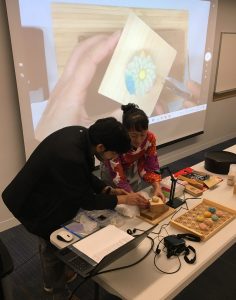
In Smith’s (2017) article, one of MPL’s librarians mentions that not knowing what was going on and giving up some control of the program planning was scary, but the results were great and they were able to learn from community members and reach different users. I think this is a great example of how community input can lead to diverse programs that appeal to the interests of different community members. In my own experience, I have worked at a library where programming was repetitive and appealed to only a set type of community member. My goal when I joined their library was to introduce programs that would appeal to different user groups. When proposing my ideas, there was some pushback from the branch manager who thought the programs would not appeal to our patrons. I think there was a fear that doing something different would be a waste of our resources and result in low attendance numbers. However, the results were great, and we found there was an interest in our community for diverse programs that appealed to different interests. Pictured below is one example of a program that was different from what we usually offered, but that was well received by community members.
Partial image of Japanese wagashi program flyer.
Image of a patron participating in wagashi making program.
From my experience, I saw how a library can fall into a routine that, while comfortable for staff, can exclude community members. Trying something different may be scary, but as demonstrated through MPL’s Library Takeover, the results can be surprising and lead to new connections. For smaller libraries, a similar project may not be possible, but community input can be gathered through surveys, outreach, or even an advisory group that includes community members. To ensure that we are reflecting the various interests and needs of our community members, it is important to gather their input and be brave enough to step out of our comfort zones.
While reading Casey’s (2011) article, one quote really stood out to me. He states, “the ideas of participation and transparency are no longer new – many in our community now expect these things as a standard part of organizational operations” (p. 3). After reading that, I stopped for a minute thinking about my own expectations, and I agree. The web and social media sites have become so engrained in our society that it is expected for most organizations to have a website and at least one social media account. If I want to find more information about an organization, my first step is to look for their website, and if I want to check for recent information, I look for their social media account.
Most libraries have a website and at least one or two social media accounts. However, not every library takes full advantage of using these sites to create a participatory environment with their patrons. While browsing through my own library’s Facebook page, I noticed that many of the posts focused on announcements regarding holiday closures, past events, and upcoming programs. A few people commented, but comments were limited to tagging someone else or expressing excitement for a program. Participation was limited and seemed one-sided.
So, how can libraries encourage participation?
Different Ways to Participate
While widely used, social media has its limits. For example, if you do not have a Facebook account, you are limited in what you can view. Additionally, Facebook/Meta is testing a new restriction on businesses that limits their posts (Hutchinson, 2025). If a business does not pay a monthly fee to verify their account, then it can only make two posts with links in them per month. This limits the number of posts and types of content a library can share on their Facebook page. To address these limitations, encourage participation, and reach more people, libraries need to explore different options.
In Casey and Savastinuk’s (2007) article discussing Library 2.0, they state:
“Library 2.0 empowers library users by giving them the opportunity to assist in the creation and content management of services. This can be accomplished through current and potential user feedback, as well as through the offering of services that rely on active input, such as customer-submitted book reviews or tags that go in the catalog” (p. 6)
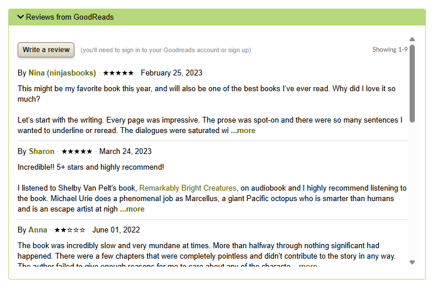
These active input services can help encourage participation and are appearing in more library catalogs. For example, in the Willoughby-Eastlake Public Library’s online catalog, patrons can rate books and connect to GoodReads to leave a review.
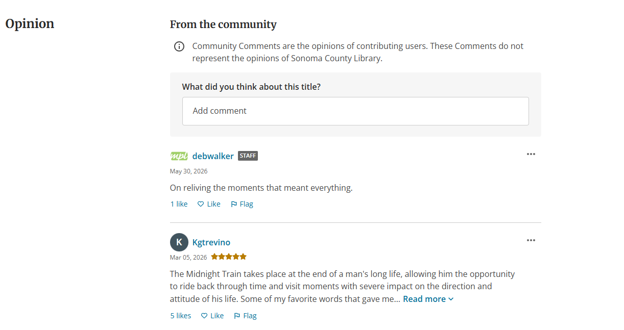
In the Sonoma County Library’s catalog patrons can interact with materials by leaving a comment, adding quotes, summaries, and videos related to an item. Patrons can also create their own book lists to share on the library website.
Offering these services gives patrons a chance to interact with materials in various ways and encourages patrons to give feedback regarding a library’s collection. Additionally, having more options gives patrons a choice in how they want to provide feedback, which may encourage more participation.
Community Driven Programming
Programming is another area that patrons should be encouraged to participate in. Casey (2011) emphasizes that “the community should be involved in the brainstorming for new ideas and services, they should play a role in planning for those services, and they should definitely be involved in the evaluation and review process” (p. 2). Libraries are for the community, and the programming and services offered should meet their needs and interests.
When planning a program, I try to think of what I can do that would be informative, interesting, and meet the needs of our patrons. However, gathering input from patrons has been challenging. At the end of a program, I ask patrons to fill out an evaluation form to review the program and provide suggestions for future events. Most patrons do not fill these out, so I have also started directly asking patrons for their opinions. Some patrons will provide ideas, but their responses are often similar to what we already offer. I find this limits our programming and caters to a small group of people in the community.
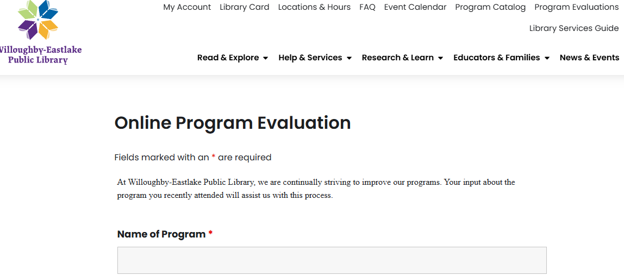
Gathering information and input from everyone in a community is challenging, but there are some options that libraries are exploring. For example, the Willoughby-Eastlake Public Library added a program evaluation form on their website. If a patron previously attended an event but did not want to fill out a paper form, they can use the online option to provide their feedback and suggestions. This gives patrons a chance to participate anonymously and not feel pressured to fill out a form in front of a presenter.
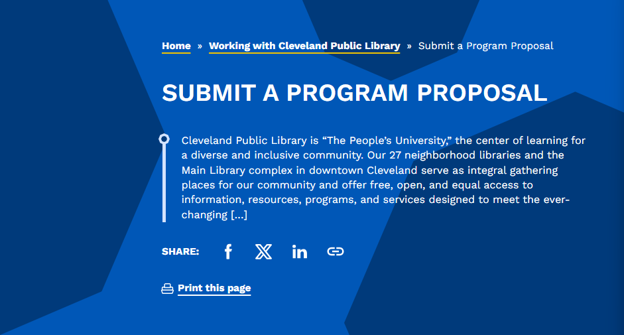
The Cleveland Public Library takes this a step further and has a program proposal form available on their website. Through this page, patrons can propose a program that they want to lead at the library. I think this is an excellent idea that truly lets patrons participate in the creation of programs.
A great example of this is the Roots and Remains exhibit that was installed at the Cleveland Public Library’s Rice Branch.
The idea and creation of this exhibit was led by local residents and organizations who are passionate about addressing an issue in their community, and together with the library they were able to bring this program to life. I think this is a fantastic example of how a library can work together with community members to create a program that meets their needs.
Final Thoughts
Libraries are more than just book depositories; they are essential community centers geared towards enriching the lives of everyone in their communities. To ensure libraries continue to meet the needs of their patrons it is important to encourage participation and explore different opportunities for patrons to provide feedback.