While reading Casey’s (2011) article, one quote really stood out to me. He states, “the ideas of participation and transparency are no longer new – many in our community now expect these things as a standard part of organizational operations” (p. 3). After reading that, I stopped for a minute thinking about my own expectations, and I agree. The web and social media sites have become so engrained in our society that it is expected for most organizations to have a website and at least one social media account. If I want to find more information about an organization, my first step is to look for their website, and if I want to check for recent information, I look for their social media account.
Most libraries have a website and at least one or two social media accounts. However, not every library takes full advantage of using these sites to create a participatory environment with their patrons. While browsing through my own library’s Facebook page, I noticed that many of the posts focused on announcements regarding holiday closures, past events, and upcoming programs. A few people commented, but comments were limited to tagging someone else or expressing excitement for a program. Participation was limited and seemed one-sided.
So, how can libraries encourage participation?
Different Ways to Participate
While widely used, social media has its limits. For example, if you do not have a Facebook account, you are limited in what you can view. Additionally, Facebook/Meta is testing a new restriction on businesses that limits their posts (Hutchinson, 2025). If a business does not pay a monthly fee to verify their account, then it can only make two posts with links in them per month. This limits the number of posts and types of content a library can share on their Facebook page. To address these limitations, encourage participation, and reach more people, libraries need to explore different options.
In Casey and Savastinuk’s (2007) article discussing Library 2.0, they state:
“Library 2.0 empowers library users by giving them the opportunity to assist in the creation and content management of services. This can be accomplished through current and potential user feedback, as well as through the offering of services that rely on active input, such as customer-submitted book reviews or tags that go in the catalog” (p. 6)
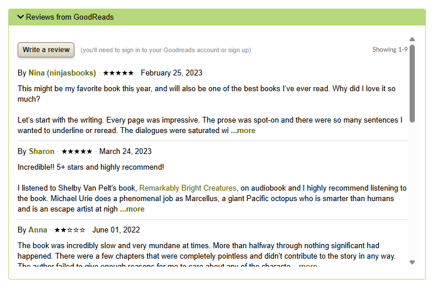
These active input services can help encourage participation and are appearing in more library catalogs. For example, in the Willoughby-Eastlake Public Library’s online catalog, patrons can rate books and connect to GoodReads to leave a review.

In the Sonoma County Library’s catalog patrons can interact with materials by leaving a comment, adding quotes, summaries, and videos related to an item. Patrons can also create their own book lists to share on the library website.
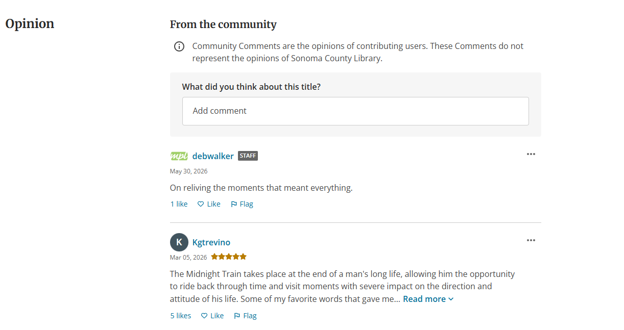

Offering these services gives patrons a chance to interact with materials in various ways and encourages patrons to give feedback regarding a library’s collection. Additionally, having more options gives patrons a choice in how they want to provide feedback, which may encourage more participation.
Community Driven Programming
Programming is another area that patrons should be encouraged to participate in. Casey (2011) emphasizes that “the community should be involved in the brainstorming for new ideas and services, they should play a role in planning for those services, and they should definitely be involved in the evaluation and review process” (p. 2). Libraries are for the community, and the programming and services offered should meet their needs and interests.
When planning a program, I try to think of what I can do that would be informative, interesting, and meet the needs of our patrons. However, gathering input from patrons has been challenging. At the end of a program, I ask patrons to fill out an evaluation form to review the program and provide suggestions for future events. Most patrons do not fill these out, so I have also started directly asking patrons for their opinions. Some patrons will provide ideas, but their responses are often similar to what we already offer. I find this limits our programming and caters to a small group of people in the community.
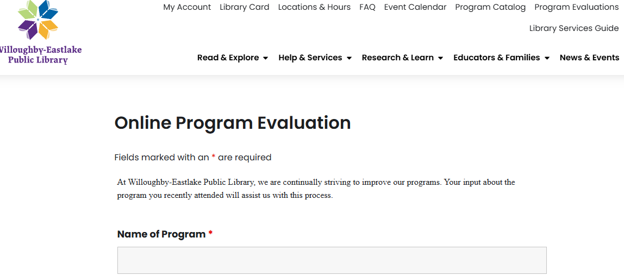
Gathering information and input from everyone in a community is challenging, but there are some options that libraries are exploring. For example, the Willoughby-Eastlake Public Library added a program evaluation form on their website. If a patron previously attended an event but did not want to fill out a paper form, they can use the online option to provide their feedback and suggestions. This gives patrons a chance to participate anonymously and not feel pressured to fill out a form in front of a presenter.
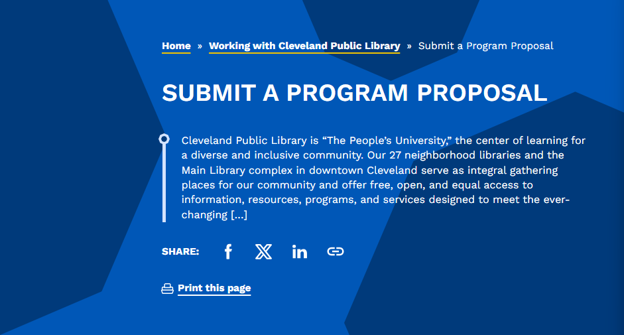
The Cleveland Public Library takes this a step further and has a program proposal form available on their website. Through this page, patrons can propose a program that they want to lead at the library. I think this is an excellent idea that truly lets patrons participate in the creation of programs.
A great example of this is the Roots and Remains exhibit that was installed at the Cleveland Public Library’s Rice Branch.
The idea and creation of this exhibit was led by local residents and organizations who are passionate about addressing an issue in their community, and together with the library they were able to bring this program to life. I think this is a fantastic example of how a library can work together with community members to create a program that meets their needs.
Final Thoughts
Libraries are more than just book depositories; they are essential community centers geared towards enriching the lives of everyone in their communities. To ensure libraries continue to meet the needs of their patrons it is important to encourage participation and explore different opportunities for patrons to provide feedback.
References
Casey, M. (2011, October 20). Revisiting participatory service in trying times – a TTW guest post by Michael Casey. Tame the Web. http://287.hyperlib.sjsu.edu/wp-content/uploads/2026/06/Revisiting-Participatory-Service-in-Trying-Times-%E2%80%93-a-TTW-Guest-Post-by-Michael-Casey-%E2%80%93-Tame-the-Web.pdf
Casey, M. E., & Savastinuk, L. C. (2007). Library 2.0: A guide to participatory library service. Information Today.
Cleveland Public Library. (2025, November 13). Root and remains: Legacies in the land. Retrieved June 19, 2026 from https://cpl.org/roots-and-remains-legacies-in-the-land/
Cleveland Public Library. (n.d.). Submit a program proposal. Retrieved June 19, 2026 from https://cpl.org/working-with-cleveland-public-library/submit-a-program-proposal/
Hutchinson, A. (2025, December 17). Meta is considering charging business pages to post links. Social Media Today. Retrieved June 19, 2026 https://www.socialmediatoday.com/news/meta-considering-charging-business-pages-to-post-links/808099/
Willoughby-Eastlake Public Library. (n.d.). Online program evaluation. Retrieved June 19, 2026 from https://we247.org/ninja-forms/16bgkf/
Hi, Alexandra,
I enjoyed your post and all the concepts that you discussed in it. The one I really like is the idea of the anonymous feedback system since it will probably increase participation from those who might be too afraid to share their opinion because of the potential risks of being discovered. Still, I think that some form of moderation would be needed in this case as well since the anonymity of the platform might attract unconstructive criticism, as well as harassing behavior and bullying on part of other users. In addition, I also wonder how many more community members would participate in feedback process if reminded about the fact that they are supporting library services with their tax money. It may not be the most inspiring motivation for participation, but still, it will make people more proactive in terms of providing their feedback.
As a Goodreads user, I find another concept from Module 5, “Hyperlinked Communities” very interesting, speaking to patrons as people rather than just users of services. Personal reviews tend to be more convincing than official descriptions of a book. Personal reviews often communicate a book’s impact more effectively than formal descriptions. Even something as simple as featuring a reader review in a display could help create stronger connections between patrons and library materials.
I agree that it is expected that most organizations have a website and a social presence. I also know from experience that it really depends on who is managing either or both, how much information is shared and how much interaction is conducted. My library’s own social media is sorely lacking and needs an overhaul to make it more integrated and connected to the community. Getting feedback has been a challenge too, and in that I also agree. Surveys are seldom filled out and some programs are asking for completed feedback forms before leaving the program. The act of anonymous submissions does alleviate some anxiety, but it also creates an out of sight out of mind approach or excuse for some. Like you, I try to figure out what other ways one could gather feedback on programming and events and I admit, I hit a wall at times. But I like that the libraries that you showed in your post didn’t give up. Libraries are so much more than books!