For this post, I wanted to focus on international libraries. I think we can learn a lot from looking at what other countries are doing. While each community has their own unique needs, there are similar issues that can affect libraries all around the world, such as adapting to new technologies and remaining relevant to their patrons. By researching what is, or is not, working well for other libraries we can gain inspiration for how to improve our own spaces.
DOKK1 Aarhus Main Library in Denmark is one library that we can learn from. Ni Rian and Engberg (2019) state that DOKK1 is far from the stereotypical library. Instead of a dusty and quiet space, it is a thriving community center that was built with various areas to meet a multitude of needs. Ni Rian and Engberg mention that there are still quiet areas, but also playgrounds, community spaces, creative spaces, a café, beautiful views, and so much more. Following the four-space model, DOKK1is a great example of how a library can create inspiration, learning, meeting, and performative spaces all in one place to meet the needs of their community (Skot-Hansen, 2017). The community centered approach of this library is one reason it is so loved. Marie Ostergaard, head of community engagement, has stated that DOKK1 is the “living room of the city,” and on average 4,000 people visit per day (Morehart, 2016). DOKK1 is a well-used community space that can provide inspiration and ideas for how to think outside of the box for library services.
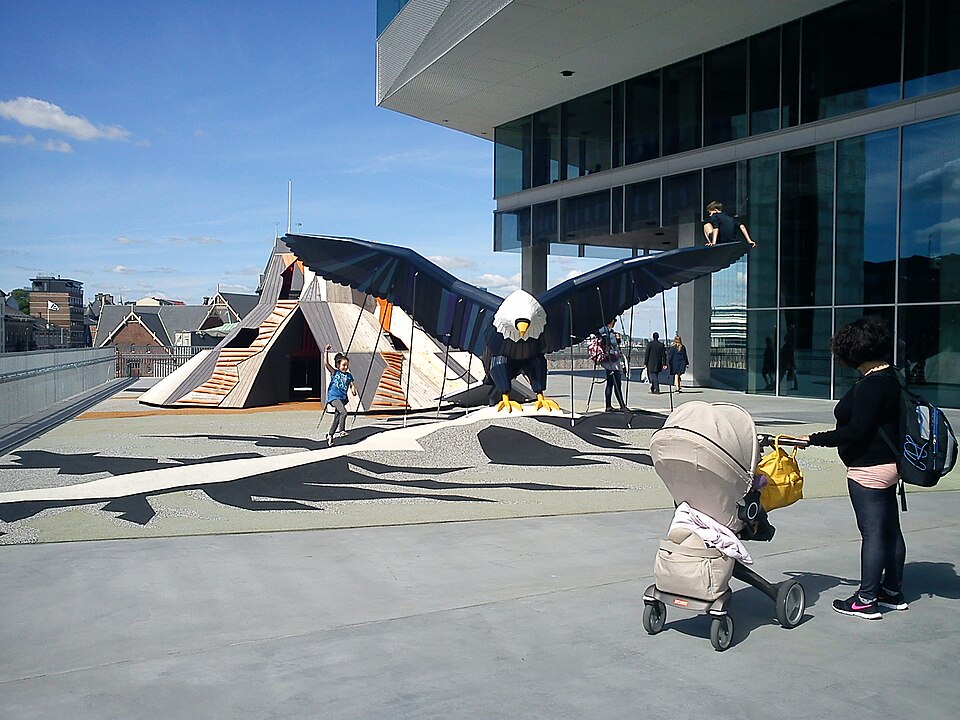
One of the playgrounds at DOKK1. Image by RhinoMind, 2015, Wikimedia Commons, https://commons.wikimedia.org/wiki/File:Dokk1_(Kloden).jpg
Another library I was fascinated to learn about is the LocHal public library in Tilburg, Netherlands. Built in a converted 80 year-old train shed, this is a beautiful library that has a unique charm and takes advantage of flexible spaces (Schwab, 2019). Schwab describes the library as a “center for civic life,” where there are spaces to meet many different needs. There is a game lab, maker space, writing space, time lab, future lab, café, and large open areas (The LocHal Library, n.d.). One aspect of this library that I found impressive was that most of the furniture and features of the spaces are flexible. Schwab (2019) mentions that many of the bookshelves are moveable, and there are large curtains to section off areas into small meeting spaces. I think this is a great idea that allows the library to easily adjust the space for future changes. The LocHal library demonstrates how unique spaces can be reimagined and adapted to meet the changing needs of a community.
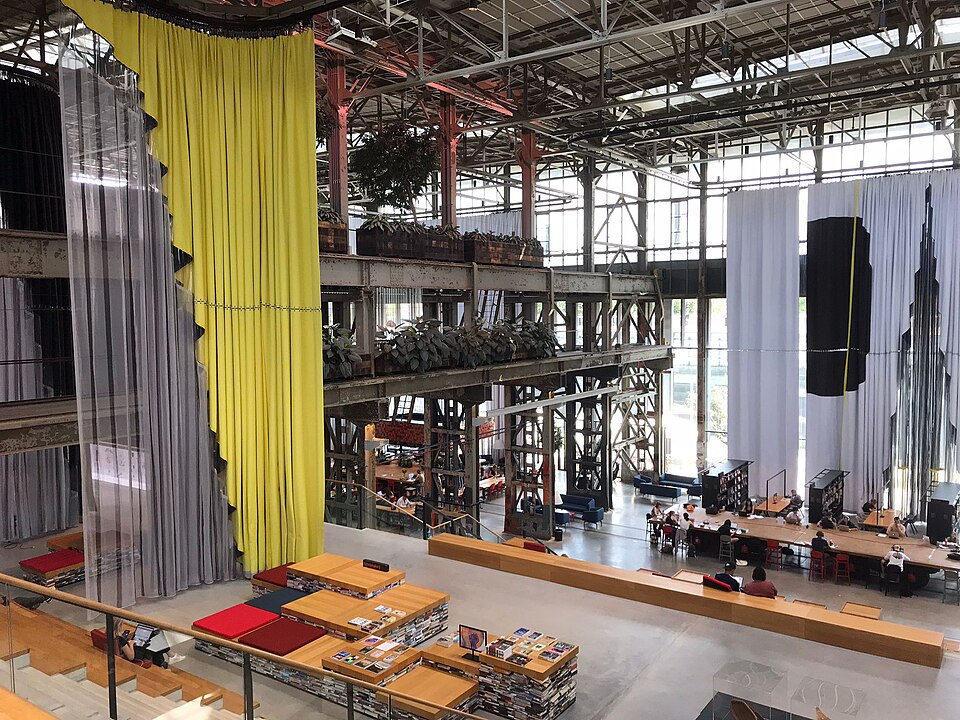
Inside LocHal. Image by Brandpunt, 2023, Wikimedia Commons, https://commons.wikimedia.org/wiki/File:Loc_hall_inside_2.jpg
These are just two examples of innovative libraries that we can explore and learn from, but there are many other libraries in this world that can provide insight and inspiration.
References
The LocHal Library. (n.d.). https://www.bibliotheekmb.nl/vestigingen/lochal.html
Morehart, P. (2016, August 17). Moving beyond the “third space.” American Libraries Magazine. https://americanlibrariesmagazine.org/blogs/the-scoop/library-design-moving-beyond-third-place/
Ni Riain, C. and Engberg, J. (2019). DOKK1 Main Library, Aarhus: So good they put it on a stamp. Library Planet. https://libraryplanet.net/2019/02/15/dokk1-aarhus-main-library-denmark-so-good-they-put-in-on-a-stamp/
Schwab, K. (2019). The library of the future is an 80 year-old converted train shed. Fast Company. https://www.fastcompany.com/90316219/the-library-of-the-future-is-in-an-80-year-old-converted-train-shed?fbclid=IwAR17fZ3TDaYY2n-fQEvpGJLrXw8ft-ZoxoX4VO7CbXno6eKEz0xCRrBzA2Q
Skot-Hansen, D. (2017). Library development: From collection to connection. University of Copenhagen. https://287.hyperlib.sjsu.edu/wp-content/uploads/2025/02/4-Spaces-Model-from-Univ-Copoenhagen.pdf
Hey Alexandra! Thanks for sharing your reflection 🤩 The DOK11 library is such an inspiring model of a library’s potential as a significant center for community- 4,000 visitors a day is incredible. It is fascinating how the largest automated parking structure in all of Europe was built underneath DOK11… it can hold 1,000 cars as well as park and retrieve a car in under a minute!!! (Source: https://www.dezeen.com/2015/11/20/largest-automated-robotic-car-park-europe-lodige-industries-below-library-schmidt-hammer-lassen-aarhus-denmark/) I wonder how the U.S. can take steps towards investing in such innovation for their information organizations.
@alexandrajy I’m so glad you pulled out the detail about all the movable furniture at the DOKK1 library. In the work that we’re doing in Elk Rapids, I’ve told the story many times about the flexible, movable furniture and much of what we put into the new library will be of that type.