Reflection Blogging: CYOA (Hyperlinked Environments)
It took me a minute to figure out how I wanted to go about this reflection blog. I was most inspired by the articles on technology and digital skills in the school library category of CYOA, particularly this quote from Park’s 2016 article 8 digital skills we must teach our children:
“Children are using digital technologies and media at increasingly younger ages and for longer periods of time. They spend an average of seven hours a day in front of screens — from televisions and computers, to mobile phones and various digital devices.”

This made me reflect on the digital habits of the kids who visit my library, as my library continues to see screen time go up and book circulation go down.
Every year my colleagues and I discuss how to increase book circulation with our middle school and upper school students. We invite the English teachers to bring their classes to the library and promote popular and new books, we keep up with the latest releases and we try to cater to requests and get extra copies of books that suddenly soar in popularity due to BookTok and word of mouth.
We usually see an uptick in book circulation at the beginning of the year from all the new sixth graders who are exploring our library for the first time, and then after homework picks up, circulation decreases again. Which, I totally get. I do not remember having a lot of time to read for fun in middle and high school.
For context, my K-12 school has two libraries- one for TK-5th, and one for 6th-12th. My assistant position allows me to work in both libraries, so I had the unique experience of getting to know a lot of the fifth grade students last year and then welcoming them to their new library as sixth graders this year. I was really excited to welcome this particularly awesome group of readers into our space, and for the most part a lot of them visit the library and still check out books!
While I love seeing the students come in, I can’t help but notice there are a couple of boys who have not set foot in the library despite being daily visitors in fifth grade. I’m bummed, I was really looking forward to showing them our collection of sports non-fiction, historical fiction, and whatever new genres and stories they wanted to explore.
However, sixth grade is when students are required to start having laptops for class. Both of the boys I mentioned have older sisters who are also awesome readers, and one of the girls told my colleagues and me that her brother now spends all his time on his computer. My hope is that he has not stop reading altogether. He likely has books at home to read, maybe even a Kindle or other reading device? Maybe he uses the public library? Still, it is sad to lose a regular library visitor, even an anticipated one.
I know there are ways to embrace technology in the library and to encourage a love of libraries in ways besides books, and I believe my library is doing what we can. We offer e-books and audiobooks, fun programming (some that is reading and book-centric, some that is not), crafts and games, and allow academic computer gaming. The computer games are approved by teachers and administrators- the librarians are not really in a position to promote or allow videogames in the library or on campus in general.
I know patrons come and go, I just hope those boys are still reading even if they aren’t visiting the library, and I still hope to see them visit occasionally, whether it’s a class visit or on their own.
Reflection Blogging: Module 5 (Hyperlinked Communities)
For this reflection blog post, I was inspired by Beyond Buzzwords: Ten Invitations to Build Library Connection and Community by @michael. Specifically, number six:
“Big plans matter. But so do quick gestures: a personalized reading suggestion, a kind reply on social media, a creative response to feedback. Sometimes a single conversation can shift someone’s view of what the library is. Sometimes a dog-eared note on a whiteboard invites a flood of community stories. Ask: What small moment will you make possible today?”
I LIVE for small moments. At a time when “big moments” (particularly joyful ones) feel scarce, boy do I appreciate the small ones. I’m talkin’ my favorite song plays on the radio, my colleague surprises me with Starbucks, or a kindergartener asks me to read one of my favorite books to them (basically any Elephant & Piggie book by Mo Willems. Or Dog Vs. Strawberry by Nelly Buchet, because to properly read it aloud, one must use their best sports announcer voice. Add it to your read-aloud rotation asap). Creating that feeling for my patrons? That’s one of my favorite parts of the job!
Added bonus of giving a read-aloud your all- the students will pick up on your joy and enthusiasm for reading! Effortless library fun.
Something I learned in a past course was that, in order for your patrons and your community to be invested in your library, they must be invested in you and your library staff. To me this means getting to know them and building a rapport, which is why I enjoy the hospitality aspect of library work. My boss is really good at this, and one reason is because she is gifted at small talk. It never stays small for long. She asks deeper, intentional questions early on and makes the conversation fun and meaningful, rather than surface-level.
I admire her skill and I have tried my hand at it too, especially when I spot a lone, new student seeking refuge in the safe haven of the library. No one wants to be the person standing in a corner during orientation, snacking on a bagel by themselves. Yes, I did witness that scenario in my library and I was very happy to introduce myself and talk to the student!
I love being able to greet students by name when they enter the library, and follow up on how they are doing. How did the test go that they studied for all last block? Are they ready for the next book in the series they are currently obsessed with? Maybe they recommend a new book we should add to our collection! I aim to congratulate as many students as I can on their great performance in the school musical over the weekend. The librarians love supporting the theatre program! All of these are examples of ways I can make students feel seen and valued at my library, and, as Stephens notes, “build connection and community.”
Assignment X: Get With the Program(ming)
I was fired up by Jina DuVernay’s article, There is Joy for All: Tips for Joyous Library Programming. I thought YES! Exactly! I want my library to be a safe and fun space, and if we sprinkle a little participatory service in there while we are at it and invite the patrons to help us come up with cool stuff and useful resources, we are golden.

This year my colleagues and I are going to focus on fostering a love for libraries through fun programming and a newly designated “games and crafts zone” for our middle schoolers. For context, our school library is shared by middIe school and upper school students, so we designated a study area for upper schoolers, a study area/“laptop zone” for middle schoolers, and a games and crafts zone. The zones will mostly be enforced in the mornings before classes start, which is typically a busier time.
My school’s policies state that middle school students are prohibited from using their phones at all during the school day, and they are not allowed to use their laptops for gaming or other non-academic purposes. Since we must also enforce these policies in the library, we are offering more screen-free alternatives.
Two weeks into the school year it is going well, and I am excited to collaborate with students to find more ways to unplug and connect. We are keeping an eye on what seems to be popular, and asking students for game recommendations.
So far the UNO cards have been taken out every morning, Rubiks cubes have been completed, and even the classic Etch-a-Sketch is getting some love. It is great to see students coming in at lunch as well to check out books, socialize with friends, and take a nice brain break with our games.
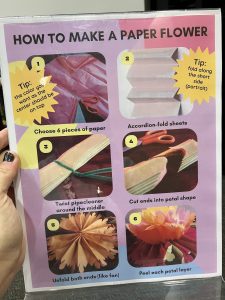
We have tried little things like this in the past, like offering chess boards and puzzles, and one tissue paper flower craft. This year I get to personally spearhead new arts and crafts programming. I was born for this.
“Joy is contagious, so if you exhibit joy in being at your library program, attendees will see and feel it” (DuVernay).
I spent my summer as a camp counselor leading the arts and crafts workshop, and I noticed that the student counselors enjoyed making lanyards and bracelets, so we are bringing them into the library. In his article Think Like a Start Up, Mathews states that three qualities that successful “products” (or programming) must have are “usability, feasibility, and value.”
I chose the lanyards and bracelets because they are: 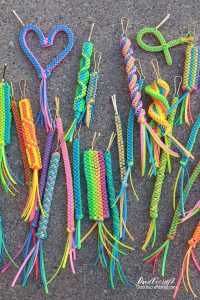
- Easy
- Fast enough to be completed during a short lunch break or free block
- Relatively mess-free (if beads spill on the ground it is not the end of the world, at least they won’t stain)
- Already proven to be popular with middle schoolers over the summer
On paper, this programming should be effective. I am excited to give it a try in the library and see what happens.
It will take some trial and error to see what programming and activities are most successful. “We shouldn’t look at failure as finality, but rather as a test bed to help ideas evolve” (Mathews). I am eager to get ideas for programming and games from the students themselves, and honest feedback about what works and what does not. I want them to know that their opinions are valued, so they can help the library invest time, money, and energy into things that they will actually use and enjoy!

Camille’s Spiel
By spiel, I mean introduction. I have a couple of elective courses under my belt now and was thrilled to snag a spot in this class. Anyone who keeps up with the SJSU Class Recs Facebook group knows taking Hyperlinked Libraries with Dr. Stephens is a must during our MLIS journeys. I’m excited to learn what makes an effective, user-focused library in 2026 and beyond, and apply our findings to my job as a library assistant at my K-12 school.
I do have a special interest in school libraries, but I am still very open to learning about all types of libraries and all the different paths to librarianship.
P.S. If you appreciate my blog name reference, let me know what book you’re on in the Dungeon Crawler Carl series!