
The community college library I currently work at recently underwent major renovations. Part of the renovations included creating a Student Engagement Room which acts as a sort of lounge space. There is comfortable seating, board games, and a large TV with a PS5 hooked up to it. Students can check out controllers and games from the library for up to 2 hours at a time. The room and the PS5 have been very popular. However, we’ve had some patrons, typically older students or professors, who have questioned why we provided such a space. Some gripe about video games and how everyone in there should probably be studying and the people who deserve to enjoy the space are probably busy studying.
Because of this experience, the National Literacy Trust’s page on video games and literacy really resonated with me. It was very interesting to see an organization focused on literacy highlight the benefits of video games when so much of the messaging surrounding video games is negative or solely focused on entertainment value.
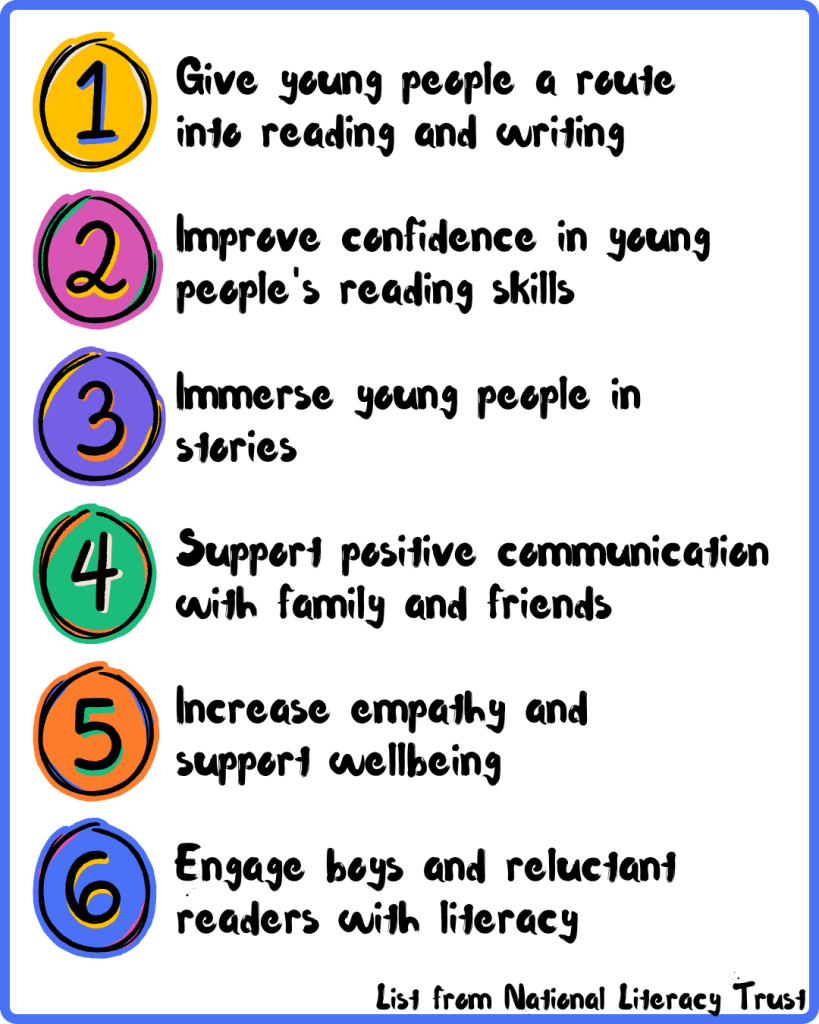
This graphic shows the 6 potential benefits of video games highlighted by the National Literacy Trust.
Video games can…
I want to focus on a couple of the points made here.
“Video games can improve confidence in young people’s reading skills”
My little brother was never much of a reader. He tried a bunch of different books but nothing quite clicked for him. However, he loved video games. One surprising side effect from playing so many video games was he learned how to read really fast. In story-rich games, there are lots of dialogue boxes and other chunks of text that are important to navigating the game. He got really good at reading things quickly so he could progress faster.
“Engage boys and reluctant readers with literacy”
This holds true with my little brother’s experience but it also has proven true with the Engagement Room at the college. The PS5 has proven to be a bridge between the library and patrons who wouldn’t otherwise interact with our resources. The PS5 brings in students who might be more hesitant to engage with literacy or the library. They interact with library workers when checking out the controllers and games, become more comfortable with the workers through those interactions, and discover more about the library and the resources available to them. The video games helped break down the barrier between reluctant students and the library.
From my experience with the library and video games, I have learned the importance of meeting patrons where they are and not judging a solution or service before examining potential benefits first. If we allowed the negative assumptions people had about video games to prevent us from incorporating them into the library space, we would have missed important connections and opportunities for outreach and learning.
Hi Adalie! This was a really interesting read, and it’s a perspective I haven’t considered before, but it makes a lot of sense for the library to take a role in combating those negative assumptions about video games. I feel like those assumptions are similar to ones I still hear from parents about graphic novels, even though it helps break through that reluctance towards reading. Thanks for such a thorough post about video games and literacy!