Reflection on Hyperlinked Environments: Library Signage

In Signage by Design, Edward Luca and Bhuva Narayan examine the power of signage within libraries to make or break a library user’s experience. They write specifically about the importance of signage in mitigating library anxiety. Good signage allows patrons to navigate the library and feel more comfortable in the space.

Library End Cap Signage

The community college library I work at recently underwent extensive renovations. As part of the renovation, I was tasked with creating new end cap signs for the library shelves. Before sitting down to design the signs, I hadn’t really considered how many decisions had to be made concerning the signs. As I began to look up signage from other libraries, I realized that there were so many factors to consider.

Check out this Pinterest Board with different examples of end cap signage
  • Color
    • White background with black text?
    • Black background with white text?
    • Multicolored?
  • Font
    • Do you choose a serif or sans serif font?
    • Do you use one font or multiple?
    • How big do you make the font?
    • Should all the text be the same size or should you have a larger font size for the call number ranges
  • Alignment and Arrows
    • Is it enough to align the call number and subject headings to the correct side of the endcap or do you also need to have arrows pointing to the aisle for greater emphasis?
  • Call Numbers (we use the Library of Congress Classification System)
    • Do you include call numbers or just subject headings?
    • If you include call numbers, how specific do you make the range?
      • Just the general class?
      • All the way to the Cutter Number?
  • Subject Headings
    • Should you include subjects on the signage or does it make it too cluttered?
    • If you do include subject headings, how many do you put on the signs?
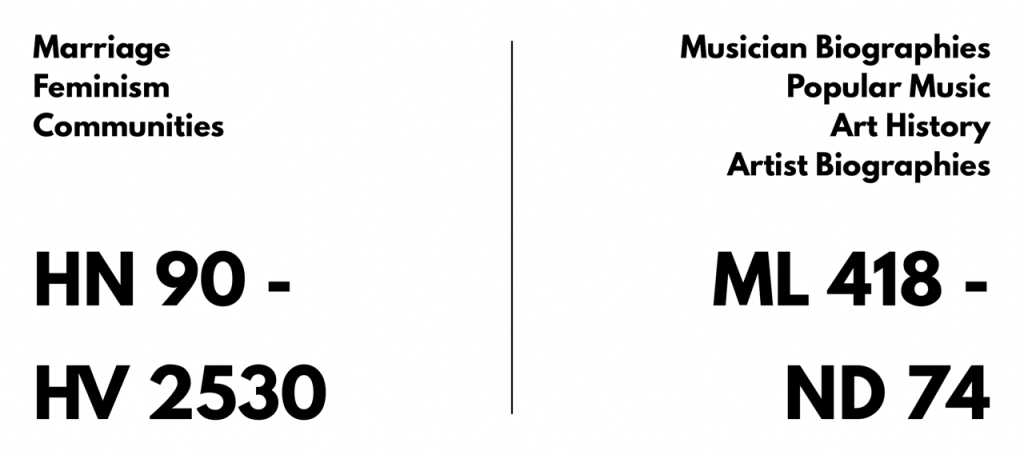
white background with black text. A line in the middle of the image divides two sides. The left side has the following words in a smaller print: Marriage, Feminism, and Communities. In larger font at the bottom it says HN 90 - HV 2530. On the right side of the image in smaller font are the words Musician Biographies, Popular Music, Art History, and Artist Biographies. In larger font at the bottom it says ML 418 - NF 74.

The goal of all of these decisions was to create helpful signage. The signage had to be easily legible, accessible, and provide enough information for most students to feel comfortable navigating the shelves without assistance. It also had to be flexible enough to allow for minor shifting of books. I landed on a white background with a black, sans serif font. We use this same font in most other signage around the space.

Helpful Tip: I highly recommend choosing a few fonts to use in signage that can help “brand” your library. We have three primary fonts we use: two sans serif fonts (one bolder and more compact than the other) and one font that is a little more youthful and fun. We can always use a font outside of our brand guide if it fits an occasion better, but having consistent fonts on signage helps cut down on visual clutter.

The call number ranges include the general class and the first set of numbers defining the subject. The librarians determined the most popular subject headings within the range to include on the signage. I don’t think there is such a thing as perfect signage, but intentionally designing signage for legibility, accessibility, and navigability can help make your space more welcoming and useful for patrons.

Posted in Reflection Blogging | 3 Comments

Reflection on Hyperlinked Communities: Inviting and Including Students with Children in a Community College Library

Academic libraries can be intimidating, especially for students who have children. Academic libraries are often geared towards silent study, and students who have small children may feel anxious about interrupting that silence. Community college libraries serve many untraditional students, including students who take care of small children. How do we combat their feelings of intimidation in a college library and create an inviting space for them and their children?

In Do You Want to Dance? Inclusion and Belonging in Libraries and Beyond, Christian Lauersen states “diversity is being invited to a party. Inclusion is being asked to dance.” My experience working at a community college library has shown me that it’s easy to invite students and say everyone is welcome, but true inclusion requires specific and individual efforts to show students that they belong in a space. 

At my job, I noticed we had a few students who came in with young children. They’d usually come to the front desk to request a book and leave as soon as they got their materials. While talking with the library workers at the desk, they sometimes had to run after their child or anxiously tell their child to quiet down as their child got increasingly antsy standing by their side. We could invite them to use the library and reassure them that they were welcome, but we weren’t “asking them to dance” and showing them that they were welcome in the space. I set out to change that.

My main inspiration came from the family-friendly study room at the Harold B. Lee Library which has a play fort, story books, rocking chairs, and much more. We did not have the space or funding for anything quite as extensive, but I looked for ways we could adapt their service to fit within our much smaller space.

image of a small table with two chairs and a bookcase with books and toys.

Through grant funding, our team was able to create two spaces centered on inviting and including students who had children. The first space is a children’s waiting area in the lobby. Children who come in with their adults can immediately go to the small table, grab a book, play with toys, color, or otherwise occupy themselves while their parent gets the assistance they need at the circulation desk.

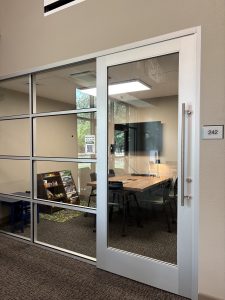
picture of a room with glass wall and door. Inside the room is a table with 5 chairs, a TV, a small table, a bookcase with toys and books, and a play rug.

The second space is a child-friendly study room. This space is reservable for up to 4 hours a day per student. The space has a white board, table, and computer like our other study rooms. It also has a child-sized table, picture books, toys, outlet covers, and corner protectors on all the sharp edges.

Both spaces have been very popular, and we’ve received a lot of positive feedback from students and staff members. Students who would usually leave right after picking up materials now sit with their children in the waiting area and play with them. They don’t have to rush out of the library to avoid disturbing the peace. By creating spaces designed for their needs, we have asked them to dance with us in the library.

Posted in Reflection Blogging | 2 Comments

Assignment X: Building participatory service through social media

Participatory service is about moving beyond simply providing resources. It’s about involving users, encouraging participation, and being open and transparent about the library process and services. Social media can be a tool for participatory service.

Social media has come a long way since 2011, yet Michael Casey’s commentary in “Revisiting Participatory Service in Trying Times” on the potential of social media as a vehicle for participatory service still rings true. In the article, he observes that most of the content on library Facebook pages are “one-way” posts.

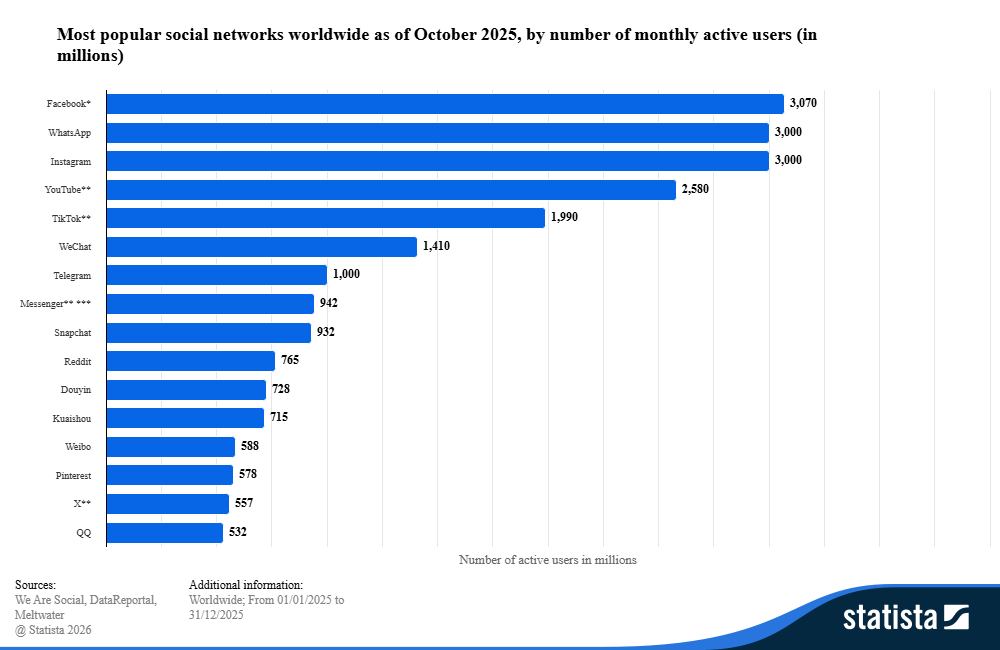
At the time he wrote the article, Facebook had over 800 million active users. Now, according to Statista, Facebook and Instagram both have around 3 billion users and TikTok has around 2 billion users.

“So with this huge audience available to us, why haven’t we made greater use of the tools at hand? Why haven’t we moved beyond the idea of just talking to our community to actually engaging them?” – Michael Casey

My experience: Tips for building engagement

3 years ago, I was tasked with revamping the social media account for our community college library. I researched social media strategies and looked at popular library accounts, but ultimately, the only way to really learn how to create engaging content was to start posting.

*note: I have linked examples of the posts I talk about below. Unfortunately, most are on Instagram only and can’t be fully embedded into this post. They may require logging in to view them.

Show the resources

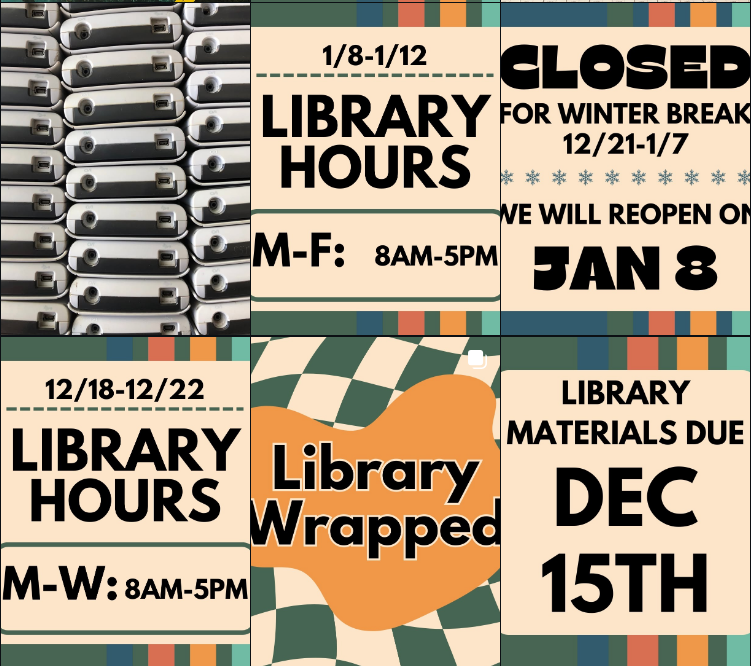
My first goal with social media was to create a place students could go for timely information about the library. (i.e. semester due dates, library hours, availability of Chromebooks, etc.) This set the foundation for being a trusted source for library information but very much exemplified the “one-way” content Casey observed.

Show the numbers

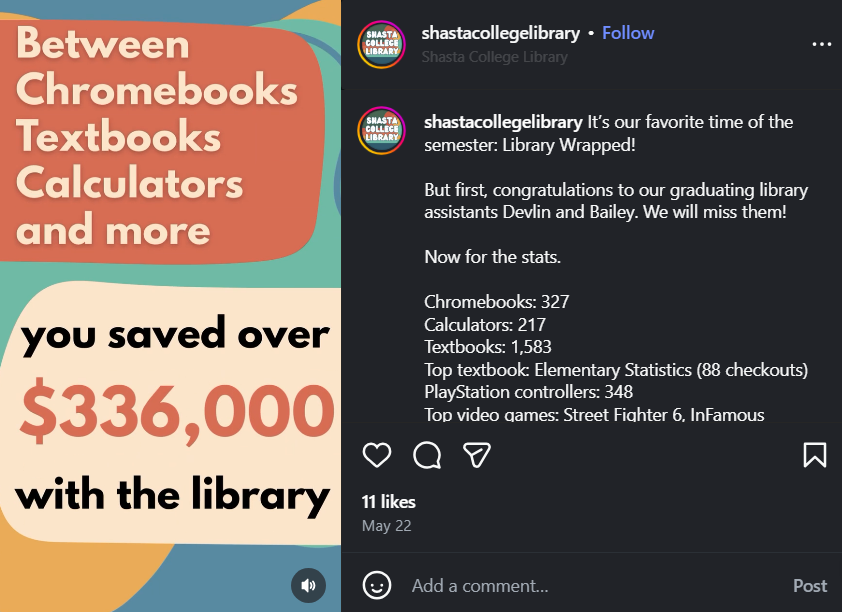
Sharing statistics is a great next step to providing transparent service and encouraging engagement. Piggybacking off of the popularity of Spotify Wrapped, I created a Library Wrapped. The post included stats such as the number of Chromebooks, calculators, and textbooks checked out, which textbook was the most popular, etc. People “liked” the post, shared it with others, and approached us about what we reported in the post. We now post a Library Wrapped at the end of each semester.

Show the space

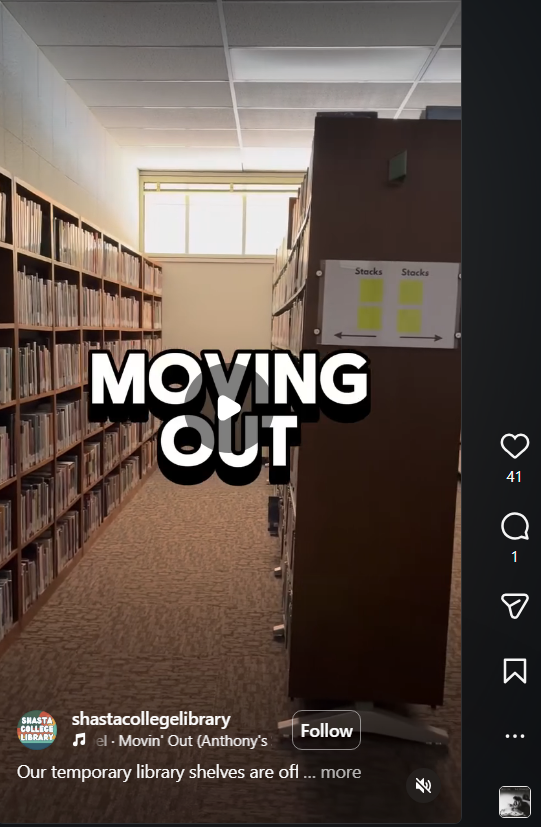
Showing our space was essential to improving engagement. When I first started at the college, we were in a temporary location while our building underwent extensive renovation. Our first post to get over 1,000 views was a video set to Movin’ Out by Billy Joel. It started with our full, temporary shelves and then transitioned to empty shelves. Other posts featuring library spaces have also done well. Our most recent library tour video has over 20,000 views and 90+ comments between Facebook, Instagram, and TikTok.

People want to see the physical library space. While libraries are so much more than just books, people take comfort from being surrounded by books as explored by Saskia Leferink in “To Keep People Happy…Keep Some Books.” Showing these book-filled spaces on social media can help reassure potential users that the library is a place of comfort and familiarity which can lead to an increased willingness to participate in the library.

Show the people

What improved our engagement the most was showing the people behind the library. Last semester, we started Meet the Team Tuesday which involved posting a photo and short intro of each library worker. These were the posts that finally got people commenting.


“It is easier to relate to a group of people than it is to a building.” – Aaron Schmidt in Earning Trust

As users learn more about library workers, they begin to trust the library more. Our aforementioned Library Tour video features one of our library assistants running through the library and shouting out different spaces and resources. The engagement on this post far exceeds engagement on our other posts. Multiple people have even approached the worker in person and said you’re the library tour guy! They’re more comfortable approaching him and other workers because of that video. We’ve showed many of these spaces and resources on our account before. However, because there is a person on the screen showing them to the viewer, it feels more like a conversation and less like a PowerPoint presentation. People are more comfortable asking questions and participating when there is a human on the other side of the screen.

@shastacollegelibrary

200 building speed tour! Need help finding something? Ask one of our friendly library workers 🙂 Video description: a man runs through the library and tutoring center building, pointing out different services as he runs through. #shastacollegelibrary #shastacollege #collegelibrary #library #speedtour

♬ original sound – Shasta College Library

At the end of the day, the library is about people. We provide books and resources, but those are pointless without people to use them. Social media can be a great way to engage people and help them feel more comfortable participating with the library and helping shape the services we provide them.

Posted in Assignment X | 2 Comments

An Intro to Adalie

Hello all! My name is Adalie, and I am in my last year of SJSU’s MLIS program. In my search for a final elective course, I came across many recommendations for The Hyperlinked Library. I currently work at a community college as a library information technician, and I am always looking for ways to update our services and improve our reach. This class seemed like a good match for me.

Growing up, I used to joke a lot about becoming a librarian because it seemed like a very stereotypical path for an avid reader like myself. In college, I started as a math education major and then switched to art history and curatorial studies. While earning my bachelor’s degree, I got a job at my university library’s special collections and archive. I absolutely fell in love with library work and decided to pursue an MLIS. My hope is to work in a museum or special collections, but I am open to a wide variety of paths.

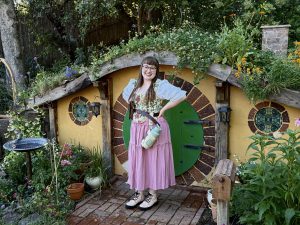
In my free time, I love reading, singing, playing piano, gardening, and making puppets. I spend a lot of time at the Hobbit Hole in my backyard gardening, watching the birds, or petting the neighborhood cats who wander by.

picture of a woman holding up a fox and raccoon puppet.

Two puppets I made for a local production of Cinderella

picture of a smiling woman standing in front of a low, yellow building with a green door. Plants cover the roof and ground surrounding the building.

My ren faire garb and the aforementioned Hobbit Hole


Posted in intro | 5 Comments