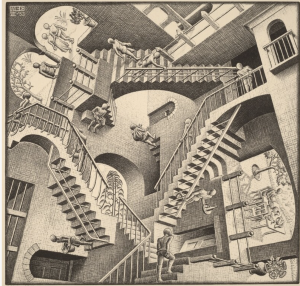
For the Hyperlinked Environments module, I decided to check out international libraries. I was intrigued by the themes involving architecture, specifically what was originally envisioned during the planning process, and how the surrounding community embraces the library, transforming it into something that is reflective of the people itself and its social fabric. Just as important is the personal significance that libraries hold for individuals and communities across the world.
I first came across Biblioteca Vasconcelos in another LIS course. It was one of those brief features on a beautifully ambitious library, but I never followed up on it until I read Carr’s piece in Architectural Review. The fact that this library is thriving at all is a testament to the community that sees its value as a gathering place. Although the architect, Alberto Kalach, had an agenda to create a space that makes “literacy and knowledge…physically immersive,” the effect is more like a grand academic-like library, akin to a sacred nave within a church (ArchEyes, 2025). This is perhaps where they unintentionally went in the wrong direction. Stephens states that “library planning begins with the people who will be using it” (2019, p. 63). Even if the community wasn’t asked for their input on the library or if it was simply disregarded, ultimately, they made the space into what they valued and wanted. The library director admits that the current atmosphere isn’t conducive for studying or quiet reading; however, I don’t see this quirk as a failure (Carr, 2019).
Much of this correlates to a matter of debate in what makes a library successful, and how we measure value and impact. Lauersen acknowledges that libraries must often use hard data on its usage to convey how well it serves a community (2021). Yet the impact and value libraries have on individuals can be invisible due to the unquantifiable nature of these attributes. How would one indicate “value” on a line graph? Some of the reasons why people come to the library veer into emotional and sentimental territory, and those reasons are also perfectly valid and should count for something in data collection. The guide to the Impact Compass is a step to better understanding user experiences and insights via the compass framework and the parameters set. It distinctly places value on people and their perspectives rather than the effects of their actions; by asking “why” instead of “how” brings more humanity to the data collection on libraries and why we need them.
Lauersen is definitely on to something when he states that libraries can be a “solution to some of the problems and challenges that societies face” (2021). Unerringly, he points to the loneliness epidemic and the crippling era of misinformation we live in. Libraries are and have always been beacons of hope and stability in the midst of social, political, and economic upheaval in any global setting, and it’s reassuring to find that library professionals everywhere still look to the best of humanity and lifelong learning to lead the way.
References
ArchEyes (2025, May 2). Biblioteca Vasconcelos by Alberto Kalach. Retrieved from https://archeyes.com/vasconcelos-library-by-alberto-kalach/
Carr, L. (2019, January 7). Revisit: Biblioteca Vasconcelos. The Architectural Review. Retrieved from https://www.architectural-review.com/buildings/revisit-biblioteca-vasconcelos
Escher, M.C. (1953) Relativity. [Screenshot]. Retrieved from https://www.nga.gov/artworks/54256-relativity
Lauersen, C. (2021, April 19). A haven in our community: The impact and value of public libraries. The Library Lab. Retrieved from https://christianlauersen.net/2021/04/19/a-haven-in-our-community-the-impact-and-value-of-public-libraries/
Stephens, M. (2019). “Dream. Explore. Experiment.” Wholehearted Librarianship: Finding Hope, Inspiration, and Balance. (p. 63). ALA Editions.