In a similar vein to one of my prior reflection blogs, questioning how we could define a “library” in today’s world, this module made me reflect on the array of services that libraries can and do provide. The innovative services to be provided in the Anythink Nature Library are so exciting (Anything Nature Library, n.d.). The ingenuity and inclusivity of fellow librarians never ceases to amaze me! And, I am excited about contributing to this welcoming nature of libraries myself. We never know what our patrons will ask or what their backstories are; but we certainly can aim to provide an inclusive and welcoming space for everyone (Sandlian Smith, 2013).
One part of this module’s lecture that I particularly loved was the photo of a children’s area in a library in Copenhagen. The caption read, “Playing is an accepted part of library behavior… these days. 25 years ago it was totally forbidden!”
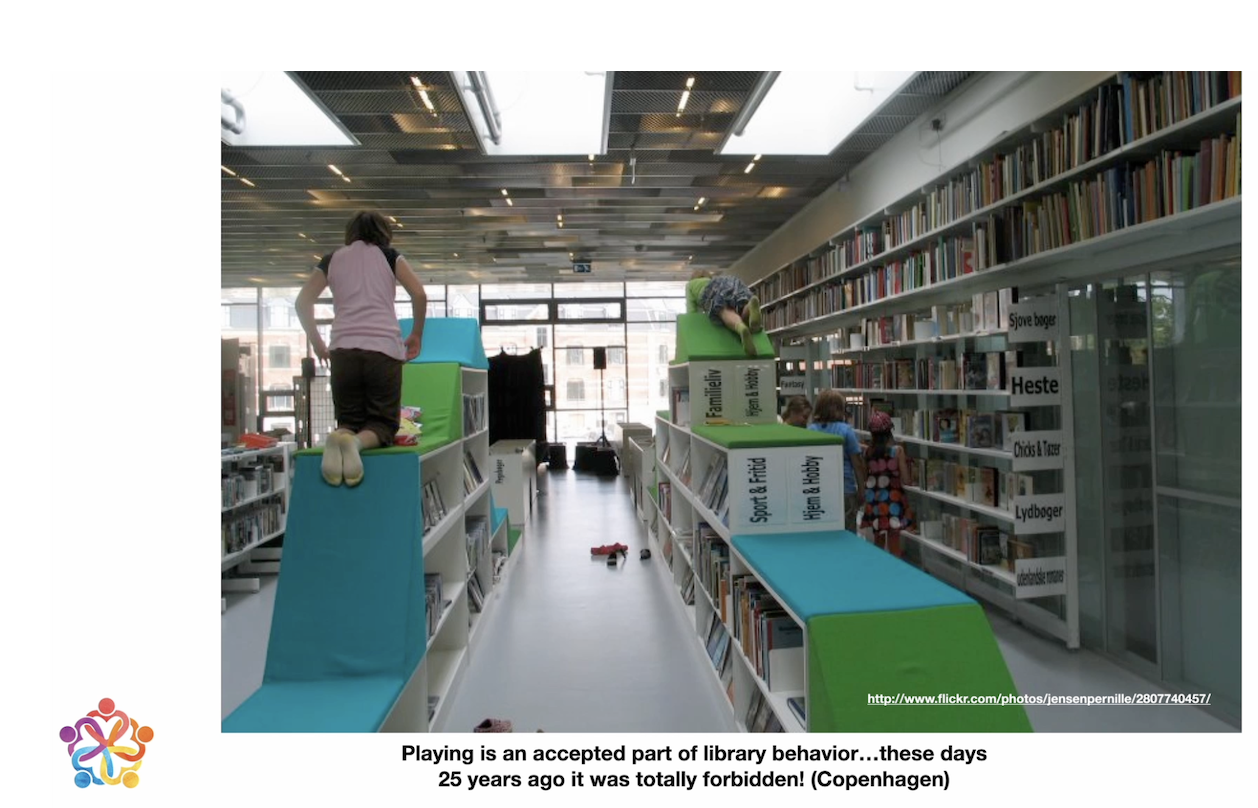
Michael said it felt “comfortable and lived in” and invited us to reflect on how models like this might help people feel welcome and be inclusive. I personally love the idea that a children’s area should be made for children to actually use—as children—regardless of where it is. The play-like structure of these bookshelves, including the padding, invites kids to use the space as kids naturally would. As noted in some of this module’s readings, environment and design can have a huge impact on creating community and social connections (Gaetani, 2018). Having such a space will encourage kids to want to come to the library, engage with other services and information, and will encourage their family members to seek community in the library as well.
Rather than requiring a quiet, traditional library space, this seems more fitting for a children’s area. This is especially so when considering kids with sensory needs or ADHD; allowing movement in their space is hugely beneficial. Of course, having quiet, traditional library spaces will certainly be appropriate in some contexts. But considering your user base and how they want to use their space seems key.
Sources:
Anything Nature Library. (n.d.). Anythink. https://www.anythinklibraries.org/anythink-nature-library/?fbclid=IwAR2DgO-k8nU6kNUODo7vTlRXKiEiYSoSeQMC8Aq0QnoLMZoT3d-QKpbSl5M
Gaetani, M. (2018, November 11). Q&A with Eric Klinenberg. https://casbs.stanford.edu/news/qa-eric-klinenberg
Sandlian Smith, P. (2013). What to expect from libraries in the 21st century: Pam Sandlian Smith at TEDxMileHigh. https://www.youtube.com/watch?v=fa6ERdxyYdo&time_continue=176&source_ve_path=MjM4NTE&embeds_referring_euri=https%3A%2F%2F287.hyperlib.sjsu.edu%2F
@gbateman I agree with your statement that the libraries should consider how users want to use a space, instead of how they think a space should be used. I have a one year old daughter who is very wiggly and likes to run around everywhere. We have a few libraries in the area, but I usually gravitate to the libraries with more open children’s areas with toys and interactive activities. These spaces feel more welcoming and I am more comfortable letting my daughter walk around without worrying she will run into a bookshelf at every turn. From a user’s perspective I love when a library takes into consideration that children love to play and do not sit still.
Hi Gemma,
I agree that children’s spaces where they can do more than just sit and read are so important. I love libraries that have flexible spaces for kids, teens and adults, and really wish the library where I work could implement something like this. I’ve seen some children’s areas that have tents and furniture that’s built to be like a fort or treehouse. Those are so fun for kids and encourage them to want to spend time in the library, which is always a great thing. Thanks for a great post!
@gbateman I actually brought that neat image from Copenhagen up to my library board one night when we were talking about what the children’s space would look like in the new library and how encouraging play and encouraging the little ones to feel that the space was theirs was so important.