Category Archives: Uncategorized

Reflection Blog: Module 6 – Hyperlinked Environments & Issues

For this module’s reflection blog post, I decided to focus on the topic of global libraries.

In one video, discussing the Dokk1 Urban Media Space in Aarhus, Denmark, a Project Manager for the space stated:

“From the very beginning of the whole new library, we’ve spent a lot of time engaging the public into giving us their ideas of what a library should be, how to meet the community needs, because that’s what a library should be…. The only way to do that is really to ask them.”

That is, each unique community will have unique community needs. Therefore, each library should be likewise unique, so as to serve those unique community needs. I wondered how different community needs were across the globe and if (and how) different libraries were meeting those needs.

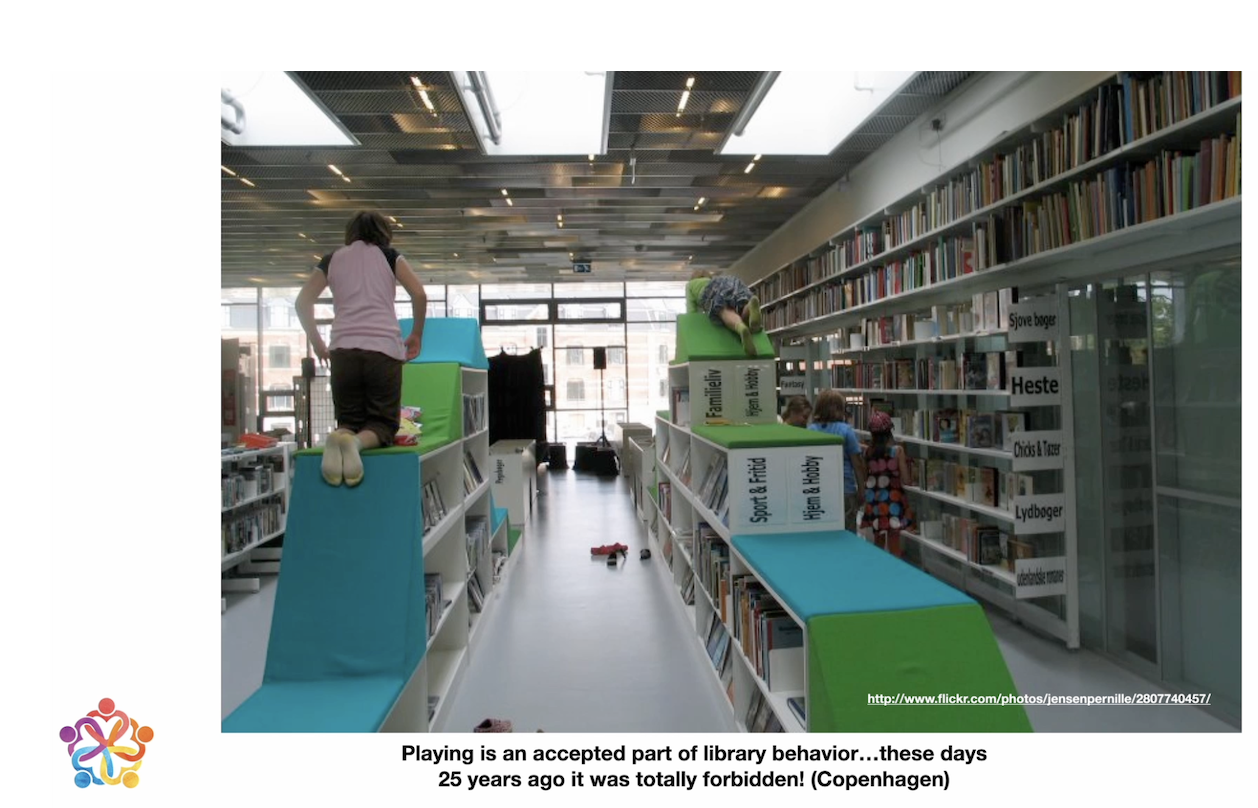
As I reviewed different global libraries, it became apparent this is being done. The Dokk1 Urban Media Space houses, among more traditional library spaces like project rooms, halls, study cells, a playground and family picnic tables (LibraryBuildings.info, n.d.; Ni Riain & Engberg, 2019). I personally haven’t heard of such spaces in a library in the United States. The space seems to be inclusive for all community members – materials are available in multiple languages and the space is wheelchair-friendly (Ni Riain & Engberg, 2019).

A library in Australia started Conversation Clubs to help combat a loneliness epidemic growing in Australia (Hasan, 2022). Another Australian library, in the Northern Territories, reclassified its materials “in consultation with the local community” to organize materials “according to key cultural aspects of Yolngu life [such as] art, language, culture and customs [as well as] the natural environment” (Thompson & Trevaskis, 2018).

Overall, I think this module’s materials helped me reflect on how important it is to connect with your surrounding community as a librarian. Only then can you hear directly what patrons need and want. Going forward, I hope to be curious, facilitate communication with community, and be creative in meeting community needs!

References:

Hasan, T. (2022). How Your Library is a Sanctuary of Health and Wellness.

LibraryBuildings.info (n.d.) Dokk1.

Ni Riain, C. and Engberg, J. (2019). DOKK1 Main Library, Aarhus: So Good They Put It On a Stamp.

Thompson, J. & Trevaskis, L. (2018).  A Remote Library Dropping Dewey to Use Local Indigenous Concepts Instead.

Reflection Blog: Module 5 – Hyperlinked Communities

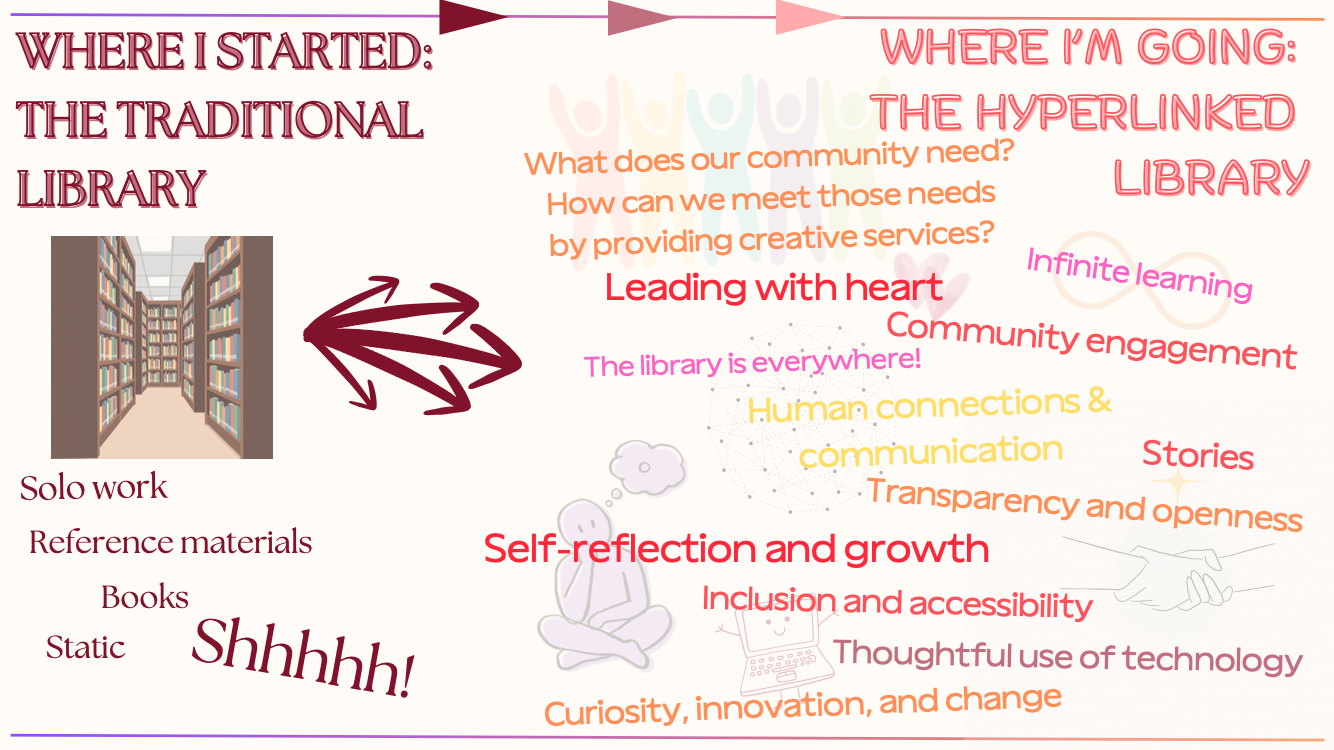
The readings and materials in this week’s module made me question how we can—or should—define a “library.” Merriam-Webster defines “library” as “a place in which literary, musical, artistic, or reference materials (such as books, manuscripts, recordings, or films) are kept for use but not for sale.” After reflecting on the materials in Module 5, this traditional definition feels static, stale, and outdated.

Programs like “Wash & Learn” and bookmobiles challenge the idea that a library is a physical place. A bookmobile in Denmark moves around and stops in 25 places every week (Lauersen, 2025). The Halifax Public Library recently opened a library kiosk at a local airport, clearly not a traditional library physical space (Warner, 2024). Libraries are also reaching out to communities through online or non-physical means, such as through TikTok videos or Instagram posts (Stephens, 2025).

Even within the four walls of a more traditional library space, services provided go beyond merely “keeping for use” books or other reference materials. For example, libraries might employ “photo walls, zines, short videos, [and] shared prompts” within their spaces to build community (Stephens, 2025). Some libraries have organized Conversation Clubs for patrons to connect with each other and find community (Hasan, 2023). These services show that libraries have moved beyond the provision of information and now also create, provide, and sustain communities. Some believe libraries are inherently political spaces, from the books provided in a collection to exhibits curated (Jensen, 2017).

I do like that the definition above references that materials are “kept for use but not for sale.” I think the free, open, and accessible aspect of libraries is key, especially in ensuring equal access to information and services. The recent movement of removing fees or other monetary penalties from libraries seems in line with this definition.

Overall, the libraries seem to have expanded beyond the traditional, physical provision of reference material in one location. As someone looking towards a future in librarianship, this expansion is exciting – our possibilities for how we can build and serve our communities are varied and creative!

References:

Hasan, T. N. (2023, June 27, 2023). Free, non-judgemental, accessible: How your local library is a sanctuary of health and wellness. https://www.sbs.com.au/language/bangla/en/article/free-nonjudgmental-and-accessible-how-your-local-library-is-a-sanctuary-of-health-and-wellness/t15blzsi9

Jensen, K. (2017, February 10). Libraries Resist: A Round-Up of Tolerance, Social Justice, & Resistance in US Libraries. Book Riot. https://bookriot.com/libraries-resist-round-tolerance-social-justice-resistance-us-libraries/

Lauersen, C. (2025, February 5). The necessary nearness – an ode to bookmobiles. https://christianlauersen.net/2025/02/05/the-necessary-nearness-and-ode-to-bookmobiles/

Stephens, M. (2025). Beyond Buzzwords: Ten invitations to build library connection and community. https://www.dropbox.com/scl/fi/f05u6l0d50k8js28vgokz/Beyond-Buzzwords-Ten-Invitations-to-Build-Library-Connection-and-Community.pdf?rlkey=2i1b76g18h9t2qxmq3s1y7q90&st=of4tisuf&e=1&dl=0

Warner, L. (2024, January 17). Three ways that alternative service delivery strategies can meet the challenges of a booming population. https://medium.com/@lauracwarner/revolutionizing-public-libraries-ff7fed3d12c5

Assignment X: A Library’s Role in Creating Human Connection in the Face of Isolating Technology

A recurring theme that has popped out to me in our readings and lectures so far is the idea of participatory librarianship, openness, and human connection. That is, humans (librarians) engaging with humans (patrons), and vice versa, to fill information needs and to build community. Another recurring theme in our materials is the idea of evolution, change, and forward progress (Stephens, 2016, p. 2). That could be through experimentation, adaptation, and embracing technological change.

It seems to me that these ideas are currently in opposition. With technological change—specifically, the increased use of generative artificial intelligence models (“AI”)—the human component of things like reference services is diminishing. Individuals who previously might have approached a reference librarian in-person to find a resource can now pull up Gemini on their cellphone to find an answer. Individuals can ask ChatGPT for book recommendations instead of using a library’s readers’ advisory services. But, if libraries embrace this technological change, will they eventually become obsolete?

This “changing user behavior,” which hyperlinked libraries want to track and engage with, seems to pose a large threat to the current workings of many libraries (Stephens, 2016, p. 2). To be sure, this is not the first time that technology has disrupted library models. The dawn of “the computer age” and smartphones raised similar questions (Denning, 2015). Prior reports have found that students are using library services less and less (Stephens, 2016, pp. 6-7). However, it seems these changes are currently accelerating.

In my own albeit limited (so far!) librarian work, I saw this firsthand. While working at a reference desk at a law library, I had numerous patrons approach me asking for more limited forms of help, such as printing a legal form or finding a specific book they already had in mind. After engaging with them, it turns out that they had used some AI model to find what they needed. And, after further questioning, it turns out that the AI model had either pointed them to a resource inapplicable to their situation or had overlooked helpful resources we had in the law library, including in-person services and seminars. This makes sense. After all, these AI models frequently are imperfect and would not know a library’s collection as well as trained librarians.

But the fact remains that AI is being used with increasing frequency by patrons. Given this, I am not sure what the future of libraries looks like. It likely depends on the type of library, its community, and what its patrons need. A university library serving predominantly 18–22-year-olds will encounter different uses of and challenges with AI than a small local library located in rural America. Throughout this semester, I hope to think deeply about how libraries can evolve and adapt given our changing environment.

I enjoyed reading about how libraries have already changed in recent years, providing a broad array of services for communities. For example, the Los Angeles Public Library system added job hunting resources, immigration and citizenship resources, and financial literacy workshops (Mack, 2013). The San Francisco Library system now provides classes, museum passes, and vinyl records rental services to patrons (Ferrell, 2022; O’Brien, 2019). This gives me hope that librarians have the ability and drive to adapt to the challenging changes with which we are currently faced.

 References:

Denning, S. (2015, August 28). Do we need libraries? Forbes. https://www.forbes.com/sites/stevedenning/2015/04/28/do-we-need-libraries/?utm_campaign=ForbesTech&utm_source=TWITTER&utm_medium=social&utm_channel=Technology&linkId=13831539

Ferrell, J. (2022, September 15). 13 awesome free things you can do with an SF Public Library card. Select San Francisco. https://secretsanfrancisco.com/sf-public-library-card/

Mack, C. (2013, February 17). Crowdsourced design: Why Los Angeles is asking the public to create the library of the future. Good. https://www.good.is/crowdsourced-design-why-los-angeles-is-asking-the-public-to-create-the-library-of-the-future/

O’Brien, C. (2019, June 24). How San Francisco’s public libraries are embracing their changing role. Shareable. https://www.shareable.net/how-san-francisco-public-libraries-are-embracing-their-changing-role/

Stephens, M. (2016). The Heart of Librarianship: Attentive, Positive, and Purposeful Change.
Introducing Me

Hi everyone, I’m Gemma! I’m originally from the Bay Area but have lived in LA for 10 years and love it here. There’s always so much to do and, after living in Canada for 7 years, I do not miss having seasons! My undergraduate degree is in Political Science and Economics from McGill University and I also have a Juris Doctor from USC Gould School of Law. After being a practicing attorney for several years, I am pursing my MLIS to move toward law librarianship.

In my free time, one of my favorite things to do is be outside, hiking and exploring. I have two cats, Lily and Annie – they bring me joy daily!

I look forward to learning with you all!