“…more hyperlinks than container…”
“Our buildings matter. Our services matter. But they don’t matter on their own, and we do not determine their value – that is a job for the community. It is only in the advancement of those we serve that we find our impact. It is only in the potential realized that we can measure our contribution. Our buildings, our books, our services, our catalogs must not be channels of assistance we provide, but part of a powerful platform that enables our communities to succeed. This platform is our infrastructure, but it is also the infrastructure of the community – co-owned.” – R. David Lankes About R. David Lankes – R. David Lankes
“The library becomes a platform for making things happen.” – Megan Ingle and Sally Pewhairangi (WEVE Writers & Editors)
WEVE_May_2014.pdf (Module 5 Hyperlinked Communities) resource
I really enjoyed reading this magazine (for lack of a better word) and particularly the section that explores the idea of looking at the lives of library patrons outside of the library as an interesting concept: that libraries offer can offer the space, resources, and support, but the community brings its own knowledge, interests, and imagination. It seems like WEVE was a publication by Heroes Mingle, a community-focused creative platform. The above issue included articles about library community engagement and new ways of thinking about library services. It directly discusses Dr. Stephens who led a Massive Open Online Course (a “MOOC”, which is a cool concept that I had not heard of before) on the Hyperlinked Library, and other forward-thinking educators and librarians such as R. David Lankes and David Weinberger, co-director of Harvard’s Library Innovation Lab Bio: David Weinberger: Speaker and co-author of the Cluetrain Manifesto.
Libraries ask people what they want through surveys, or suggestion boxes, or program evaluations. My own library has done this several times. The information can be useful, but there’s a difference between asking people for feedback on a service that librarians have already designed and inviting them to help shape the service from the beginning. What does it mean to share ownership of a library service? The WEVE article asks how community members can help design programs, develop collections, and identify needs that librarians may not have recognized.
Cost: Libraries invest considerable effort in developing collections, designing services, and planning programs. But a service that looks successful from the library’s perspective might not be meaningful to the community it’s intended to serve. A resource being available doesn’t automatically mean it’s accessible, useful, or valuable to patrons- real value depends on how people access it, use it, and incorporate it into their lives. The library isn’t only a physical location; it is also the connections that form around its resources, programs, staff, and users. What happens when a library’s role shifts from delivering services, to helping people build relationships with information and with each other? Are we designing services around what we think people need, or what they tell us they need?
Value: What makes a library valuable to its community? Is it collections, programs, technology, or the welcoming and safe space it provides? These offerings truly matter and play important roles within a library setting; however, as we have been exploring a Hyperlinked Library’s philosophy, we see that great and important value lies in what people are able to do, discover, and create through the use of the tools above. In the magazine, David R. Lankes describes the library as a platform that enables communities to succeed. The focus shifts towards a place where patrons and community can make things can happen, rather than presenting the library as a place that simply provides services and space. We can ask ourselves then, what are people possibilities- not just library possibilities- within this conversation? Libraries provides infrastructure, but community brings it to life.
Community members bring to the table knowledge, interests, experiences, and ideas that library administration and staff may never think to consider on their own. Weinberger’s description of a library as “more hyperlinks than container” is what we are aiming towards- more connection, more community, more creativity than a four-walled information container. Yet connection (and community and creativity) is not always be easy to measure in nuts-and-bolts sorts of ways. What does library value look like outside of numbers and stats? As part of working in a library and running a program, I am well aware of submitting the numbers of attendees who participated. There are ways to measure a library’s success by attendance, circulation, program participation, and such- but what is the measurement for experiencing, learning, and accomplishing through their use of the library? We can count the number of people who attend a program, but those numbers don’t show us what the program meant to them, what they took away from it, or what became possible because it existed. Meaningful library/community collaboration begins by being willing to reconsider assumptions about what a library service should look like and who gets to shape it, build it, and keep it thriving.
“A library as platform would give rise to messy, rich networks of people and ideas, continuously sparked and
maintained by the library’s resources. A library as platform is more how than where, more hyperlinks
than container, more hubbub than hub.” – David Weinberger
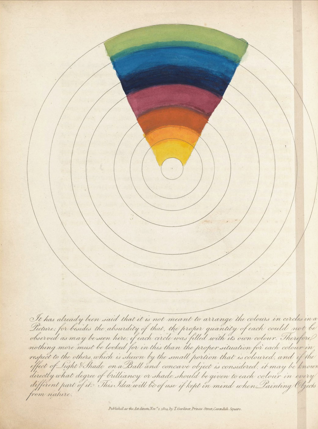
Image: Untitled Image by Mary Gartside from New Theory of Colours (1808) | Public Domain Image Archive



3 Comments
Timothy Burton Goodwillie
@collectingtjp Hey Tara! Love the idea of “… more hyperlink than container …” It reminds me of masu in Japanese culture: the wooden box that a sake cup sits in to catch the overflow of a sake pour, which acts as a symbol of abundance and generosity. It is similar to the classic burger joints in East LA and those small red and white gingham french fry boats: other restaurants fill to the low rim, the joints in East Los put at the bottom of a bag and then fill the whole bag, much like the Japanese masu box. These symbolic actions lead me to the practical, yet still generous and abundant, archival idea of MPLP, “More Product, Less Process,” which enables more information to reach the user with less archival processing. As always, it all brings me back to DIY-culture, which doesn’t let lack of skills and/or dough get in the way of communal creative expression. Anyways … NEAT!!!
Tara
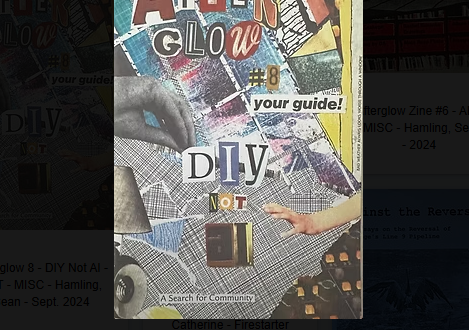
@tbgoodwillie I love the connection of libraries, sake, and french fries! I’m in! Thank you for bringing up DIY culture as well- I’m really into the zine culture of the 70’s-90’s and like that I am seeing resurgence of interest in DIY information/expression- or in your words- “communal creative expression.” Community is key!
Timothy Burton Goodwillie
@collectingtjp Witness!!!