Innovation Roadmap: Teens & Zines
Reason: Teens are an underserved demographic at the public library where I work, particularly when it comes to programming designed specifically for their age group. The few programs offered tend to lean toward crafts- friendship bracelets…and more friendship bracelets…Meanwhile, children and adult programming is active and engaging, drawing patrons into the library and generating continued interest. Teens, by contrast, have access to a strong collection of physical materials but are gapingly absent from the programming scene. There seems to be some skepticism among supervisors about investing time and energy in teen programming unless it can be combined with adult programming, leaving this age group without many opportunities to engage with the library in ways that speak directly to their interests.
Action Statement: Convince teens that by using the library’s zine-making resources, they will discover that the library can be a space for independent publishing and creative expression, which will encourage them to see the library as a place where their voices belong, because the library supports free expression, creativity, and access to information.
The Idea/ Program Overview: Introduce a zine-making program that would provide an opportunity to expand teen programming beyond traditional crafts by combining art, writing, research, and self-expression in an informal, welcoming environment.
A what-making program?? Zines are small, self-published books that can incorporate writing, drawing, collage, photography, and other visual elements. Their flexible, low-cost format allows participants to explore personal interests, share ideas, experiment with different forms of communication, and create something entirely their own. No previous or particular art experience is needed. (pronunciation: zine rhymes with teen!)
Goals & Objectives: The primary goals are to create a teen-centered library program that encourages creative expression through analog art processes; builds connection among participants; and introduces the library as a space for exploration, discovery, inspiration.
Primary objectives: Encourage creative expression; give teens an opportunity to explore their interests, experiences, identities, and ideas through writing and visual art. Ideally, teens see that adults in their community value their voices and contributions as creators and collaborators.
- Develop information and visual literacy: Introduce participants to zines as alternative forms of publishing and communication, while exploring how images, text, and design convey meaning. Learn about copyright, fair use, transformation/not copying, artists books, DIY publishing, zines in museum collections, citing sources, and such.
- Connect teens with library resources: Demonstrate how books, magazines, digital resources, and other library materials can serve as sources of research and creative inspiration. Participants build supportive relationships with library staff.
- Build community and connection: Create a relaxed, collaborative environment where teens can share ideas, learn from one another, and connect through common interests. Team up with a peer group mentor to co-facilitate the program with library staff.
- Promote youth participation: Give teens greater ownership of their library experience by inviting them to contribute ideas, suggest future themes, and share their creations if they choose. Program is analog-focused, speaks to subversive expression, viewpoints, communities, and creative information sharing.
Mission & Institutional Context: (From the Goleta Valley Library | Goleta, CA: Mission – “The Goleta Valley Library is a community center that serves our diverse community by leveraging public assets to support the joy of lifelong, multi-generational learning, civil engagement, and the respectful exchange of ideas and information – both within the physical walls of the library and far beyond.”)
A teen zine-making program would align with the Goleta Valley Library’s mission to support lifelong learning, civic engagement, and the respectful exchange of ideas. Giving teens a space to explore their interests, express their perspectives, and share ideas through art and writing in a program format, would encourage creative learning and increase library familiarity. It would expand opportunities for teen participation, helping the library connect with an underserved demographic- reinforcing the library’s role as an inclusive community space where diverse voices are valued.
Guidelines & Policies: Guidelines would focus on balance safety, accessibility, and respectful participation with creative freedom. Policies will address age eligibility, registration, supervision, behavior expectations, and the safe use of materials. Teens would be encouraged to explore diverse interests and perspectives without being required to share personal experiences or display their work. Content guidelines follow existing library policies while respecting intellectual freedom and maintaining a welcoming environment. Privacy and copyright are also important considerations. Photography and public sharing of zines would be made voluntary- with participants receiving a basic introduction to public-domain materials, Creative Commons licenses, attribution, and fair use. Accessibility to be supported through varied supplies, clear instructions, assistance when needed, and multiple ways to participate, regardless of artistic experience or ability.
Timeline for Implementation: A 10 to 12 week implementation timeline. Key phases:
- Weeks 1–2: Planning. Identify the target age group, consult supervisors, review existing policies, establish goals, and assess teen interests.
- Weeks 3–4: Preparation. Set a date and location, establish guidelines and a modest budget, gather supplies, prepare sample zines, and determine staffing needs.
- Weeks 5–7: Outreach. Promote the program through library displays, the website, social media, schools, and community partnerships. Consult teens about convenient scheduling.
- Weeks 8–9: Launch. Hold a pilot workshop where teens explore zine examples, learn basic folding and assembly techniques, and create in a relaxed environment.
- Weeks 10–12: Evaluation. Review attendance, collect optional feedback, assess costs and staff workload, and use participant suggestions to plan future workshops.
Marketing & Promotion: Within the library- Staff promotion would focus on demonstrating how a teen zine-making program supports the library’s mission of lifelong learning, creativity, and community engagement. A brief presentation could outline the need for teen-centered programming, program goals, low supply costs, and manageable staffing requirements. Sharing zine examples would help staff understand the program’s creative potential. Outside the library- Promotion outside of the library would focus on partnerships with local middle and high schools, school librarians, art teachers, and youth organizations through flyers, announcements, newsletters, and possibly even classroom visits. Community centers and local arts organizations could also share information. Signage, flyers, and social media content would originate through the library.
Staff Training & Readiness: Tables, chairs, good lighting, and space for teens to explore supplies. Materials may include paper, pencils, pens, glues and tapes, collage materials, scissors, stickers, staplers, rubber stamps and ink, stencils, and other such art supplies. Technology to include digital scanner and copier. Training would be fairly minimum for one staff member and teen volunteer. The main training would be learning about folding styles, assisting teens with copier and scanner if needed, having an interest in making things, as well as a familiarity/overview of the history of zine-making and themes. Physical examples, as well as a slide show of zine styles, would need to be gathered.
Evaluation & Future Expansion: Meaningful evaluation of the program at the program would look beyond attendance numbers to assess participants’ experiences, learning, and engagement. Optional surveys and informal conversations could gather feedback about what teens enjoyed, what they learned, and what they would change. Staff could observe how participants experiment with writing, collage, and design, focusing on creative exploration rather than artistic skill. Repeat participation and recommendations to friends could indicate continued interest. Inviting teens to suggest themes or help plan future workshops would encourage ownership and provide insight into their interests. Potential expansion could include zine displays, exchanges, or a library collection- additional guidelines would address permissions, distribution, and collection procedures.
Inspiration:
About the Collection | Barnard Zine Library
Featured Researcher Spotlight On: Violet Fox – The Librarian Parlor
Sherwood Forest Zine Library | Austin
Social: Feelin’ on the Fifth Zine Club | San Francisco Public Library October 2026
Tell a Story: Zine Making Workshop With Darrell Fusaro | Los Angeles Public Library May 2025
Zines, E-Zines: The History and Characteristics of Zines, Part I
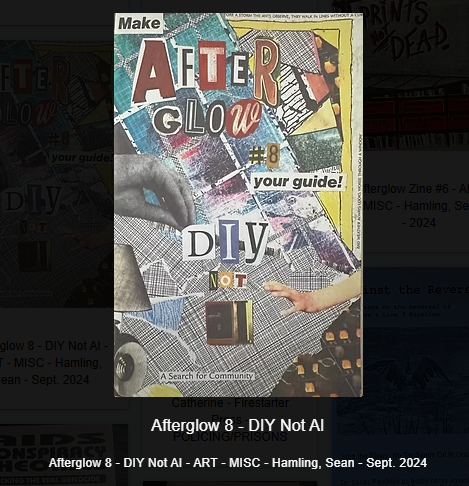
Featured image is from The Sherwood Forest Zine Library: Afterglow 8 – DIY Not AI – ART – MISC – Hamling, Sean – Sept. 2024

You May Also Like
Welcome
“…more hyperlinks than container…”