What Is the Idea?
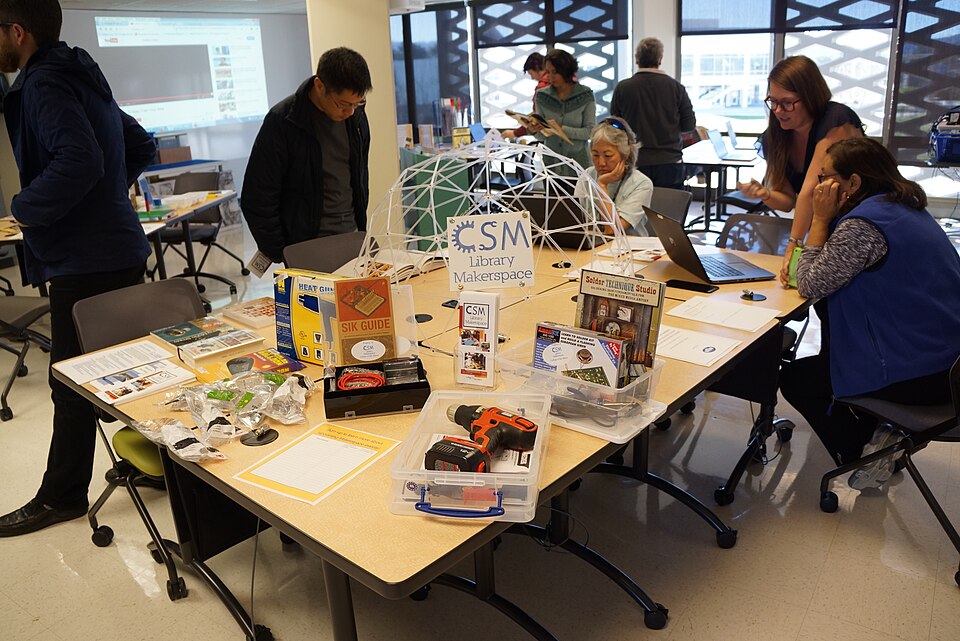
We propose converting a newly available 800-square-foot room adjacent to the Teen Zone into “The Fabrication Station”, a staffed makerspace built around three entry-level 3D printers, a laser-safe vinyl cutter, and hardware loaded with free design software (Tinkercad, Blender for advanced users), and open shelving for hand tools and craft supplies.
Goals: Give teens hands-on access to fabrication technology they likely can’t afford or reach at home or school, foster interest in STEM; and turn the library into a creation destination.
Who we are helping: Local teens (ages 12-18).
How it helps: Teens gain transferable skills (CAD literacy, prototyping, patience with iterative failure) that feed directly into college and career pathways. Rather than a one-off “cool gadget” purchase, this is a recurring, mentored program with open lab hours, guided project nights, and a teen advisory board. The technology becomes a platform for ongoing relationship-building with our teen community, not a novelty that barely gets used and gathers dust.

Mission & Institutional Context
Our library’s mission centers on equitable access to information, lifelong learning, and community connection. Our teen population is currently underserved relative to children and adult programming. Most teen engagement drops off after age 11, and our last community survey identified “nothing to do here for my age” as a top complaint from local teens and their parents.
At the same time, the local school district has cut shop class and reduced computer lab access, and the nearest paid makerspace is a 40-minute drive away.
Why now?
We have just received space and starter funding. We are not chasing makerspaces because it is trendy. We are responding to a documented, community-identified need (teen engagement, STEM access, equity of tool access) that maps onto our strategic plan’s pillar of “Library as Community Workshop.” This is a technoplan, not technolust, Stephens (2008) defines technolust as an irrational love of new technology paired with unrealistic expectations for what it can deliver and cautions that new technology alone “will not save your library”. We are starting from the need and the mission, then choosing the tool, not the reverse.
Action Brief Statement
ACTION BRIEF — Tobyville Public Library WILL:
| CONVINCE | THAT BY | THEY WILL | WHICH WILL | BECAUSE |
| Teens ages 12–18, both current library users and non-users | dropping into the library’s new makerspace and designing something of their own( a phone stand, a cosplay prop, a gift, a prototype) | discover that the library is a place where they can build and create, not just borrow and read | increase regular teen visits, build maker/STEM confidence, and create a peer community around the space | our library’s mission is to give everyone, regardless of what they can afford at home, the tools to learn, create, and grow |
Staff Action Brief:
ACTION BRIEF — Tobyville Public Library WILL:
| CONVINCE | THAT BY | THEY WILL | WHICH WILL | BECAUSE |
| Frontline and teen-services staff | completing a short maker-tech training series and co-facilitating open lab hours | gain a new, low-barrier way to connect with reluctant teen patrons and build their own tech confidence | make teen programming easier to sustain and staff turnover less disruptive to the program | staff development and community-facing innovation are core to how this library grows its relevance and impact |
Where Did You Find Inspiration?
- YOUmedia — Chicago Public Library, a teen-focused digital media lab model now running at a dozen CPL locations, offering a strong model for teen-only maker/media space design: https://www.chipublib.org/programs-and-partnerships/youmedia/
- Made@NPL — Newark Public Library, whose “Made for Teens: 3D Printer Basics” program specifically onboards teens in grades 7–12 to Makerbot printers and .stl/.obj workflows: https://www.npl.org/made-for-teens-3d-printer-basics/
- MPL Creates — Milwaukee Public Library, which runs teen-staffed Makerspace “Open Maker Time” across multiple branches with teen interns as facilitators, funded in partnership with its library foundation: https://www.mpl.org/library/makerspace/
- Rockwood Makerspace — Multnomah County Library, a makerspace explicitly oriented around middle/high schoolers with mentor support: https://multcolib.org/hours-and-locations/rockwood-library/hours-locations/rockwood/rockwood-makerspace
- Pop-Up Makerspace toolkit — California State Library / Mission Viejo Library, a practical, replicable model for low-cost pop-up maker programming (Tech Petting Zoo, TinkerCAD + printing) that grew out of a community survey: https://www.library.ca.gov/services/to-libraries/ideas/pop-up-makerspace/
Guidelines & Policies
- Age & supervision rules: Define a minimum independent-use age (many peer libraries set this at 12–13) and clarify when parent/guardian sign-off is required versus when teens can use the space unsupervised. Younger siblings tagging along need a clear policy as well.
- Safety & liability waivers: A signed waiver (with parent/guardian co-signature for minors) covering equipment use, similar to models at Garland and Michigan City public libraries, should be reviewed by legal/risk management.
- Content & copyright policy: No printing of weapons, IP-infringing designs, or anything violating library conduct policy; align with existing library “reproduction equipment” language.
- Let go of control: Stephens (2008) argues that libraries guided too tightly by one department or gatekeeper (“IT does not allow that”) stall good projects, and recommends an open, collaborative planning space. For us, that means the Teen Advisory Board and frontline staff help shape rules, not just receive them from the top down.
- Ethical/access issues to address: Equity of access if the space is popular (sign-up/reservation system), accessibility for teens with disabilities (adjustable-height tables, screen-reader-compatible design software), and avoiding a “tech-savvy insiders only” culture by pairing peer mentors with beginners.
Timeline for Implementation
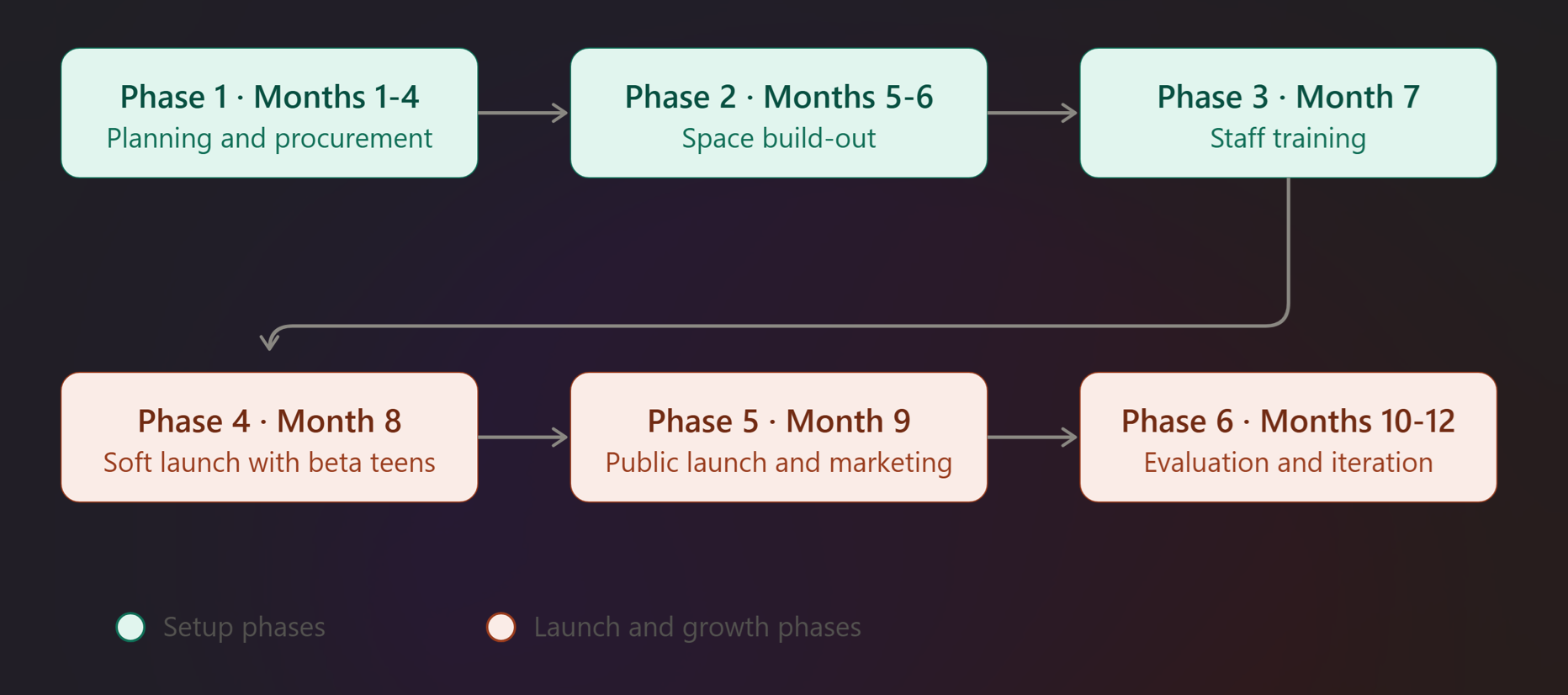
Phase 1 – Planning & Procurement (Months 1-4): Finalize budget, select and order equipment (printers, cutter, laptops, filament), draft policies with committee input, identify and train a program lead.
Phase 2 – Space Build-Out & Soft Policies (Months 5-6): Renovate/furnish the room, install ventilation and safety equipment, finalize waivers and sign-up systems, run internal staff pilot sessions.
Phase 3 – Staff Training (Month 7): Run hands-on training series before any public opening.
Phase 4 – Soft Launch (Month 8): Invite and take feedback from the Teen Advisory Board and a small cohort of “beta tester teens” for feedback before a full public opening. This follows Stephens’s (2008) advice to “let beta be your friend”.
Phase 5 – Public Launch & Marketing Push (Month 9): Grand-opening event tied to promotion and open regular weekly hours.
Phase 6 – Evaluation & Iteration (Months 10-12): Collect usage data and feedback quarterly; adjust hours, staffing, and equipment based on real demand; plan expansion.
Marketing & Promotion
- Internal buy-in first: Present the plan (with this action brief) at an all-staff meeting; give circulation and reference staff simple talking points and a one-page FAQ so every staff member can promote it confidently.
- Teen-facing channels: Social media posts of builds and prints (following the model of MPL Creates’ @MPLCreates account), flyers and QR codes in the Teen Zone, partnerships with local middle/high school librarians and STEM teachers for class visits and announcements, and word-of-mouth via the Teen Advisory Board.
- Community-wide channels: Library newsletter and website landing page, local press release, signage at the circulation desk and building entrance, and a booth at any local community/maker fair.
Staff Training & Readiness
- Who needs training: Teen Services staff (primary facilitators), circulation/reference staff (basic awareness so they can answer questions and refer patrons), and IT/facilities staff (for equipment maintenance and safety).
- What they need to learn: basic 3D-printer operation and troubleshooting, Tinkercad/basic CAD walkthroughs, safe use of the craft cutter, incident/safety response.
- Who trains them: the program lead (possibly a hired specialist or an existing staff member with maker experience) can run internal sessions; equipment vendors often include training in purchase contracts; nearby library systems that already run maker programs can offer a practical study visit.
- Support materials: a laminated “quick-start” guide at each station, a shared troubleshooting doc/wiki, a sign-up/reservation cheat sheet, and a clear escalation path for equipment failures or behavioral issues.
Evaluation & Future Expansion
- Usage metrics: Number of unique teen visits/month, print jobs completed, program attendance at guided sessions, repeat-visit rate, and demographic reach compared to the library’s overall teen population.
- Qualitative benchmarks: Teen exit surveys/interviews, Teen Advisory Board feedback sessions, and staff observation notes on engagement and confidence growth.
- Growth path: Expand hours based on demand, add a laser cutter or embroidery/sewing equipment (as seen in several peer library makerspaces), extend programming to adult or family maker nights using the same space during off-peak hours, and eventually pursue grant funding or Friends-of-the-Library support for equipment refreshes. Always guided by demonstrated need rather than wanting a shiny new tool, in keeping with a sustainable, participatory approach to innovation.
- Mission-first evaluation: Following Stephens’s (2008) tenth step, “evaluate your service,” our return on investment will not be measured only in print counts. Qualitative data such as user stories and increased teen participation will count just as much as usage statistics when we report back to the board. A clear cost analysis will be created for the committee approval, so the “technolust” of new equipment never outruns our budget realities (Stephens 2004).\
References
Stephens, M. (2004). Technoplans vs. technolust. Library Journal, 129(18), 36–37. https://www.libraryjournal.com/story/technoplans-vs-technolust
Stephens, M. (2008). Taming technolust: Ten steps for planning in a 2.0 world. Reference and User Services Quarterly, 47(4), 314–317. https://tametheweb.com/2012/05/30/taming-technolust-ten-steps-for-planning-in-a-2-0-world-full-text/


One thought on “Innovation Strategy & Roadmap: Making It Real – A Teen Makerspace & 3D Printing Roadmap for Tobyville Public Library”
Hello Toby,
This is such a great idea! My hope is to become a young adult librarian, so I found this especially interesting. I really like how you identified a need by recognizing that school funding is becoming more limited and that libraries can help fill the gaps by providing opportunities for creative learning spaces like this.
What a fantastic Innovation Strategy and Roadmap project! I really enjoyed reading it.
@aniellafields