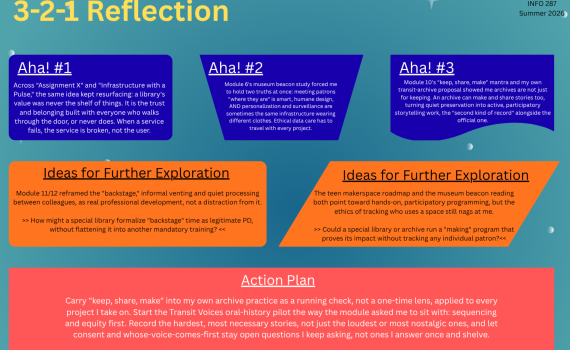

Going into this sub-module, I expected “professional learning experiences” to mean the usual subjects: conferences, webinars, something I might bookmark and finish if I was interested in it but potentially never finish. What stuck with me from this module was that instead it highlighted the quieter side. The realization that […]
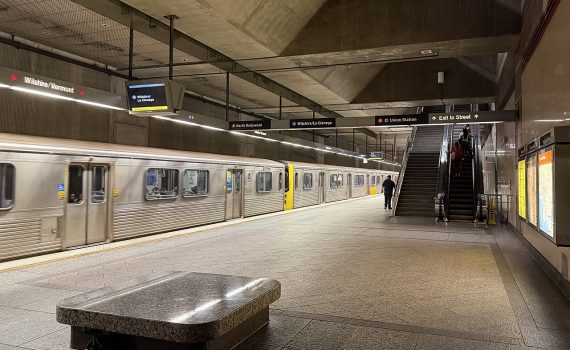
Riding Through Memory The Power of Stories in a Public Transit Special Library and Archive Focus Area: The Power of Stories Prepared for: Library Director & Archives Leadership Team INFO 287 — The Hyperlinked Library Objective This report is a proposal for a storytelling and oral history initiative for a […]

While reviewing module 10 my mind kept circling back to one idea: Erik Boekesteijn’s mantra, quoted by Michael Stephens, that libraries should keep stories, share stories, and make stories. Reading the documents from module 10, I started to think about the actual framework for the work, so I want to […]

Going over this module put two ideas next to each other that I had not thought to pair before: “social infrastructure” and hygge as a service philosophy. Read separately, one feels architectural and the other feels emotional. Reading them together however, they started to feel like the same argument told […]
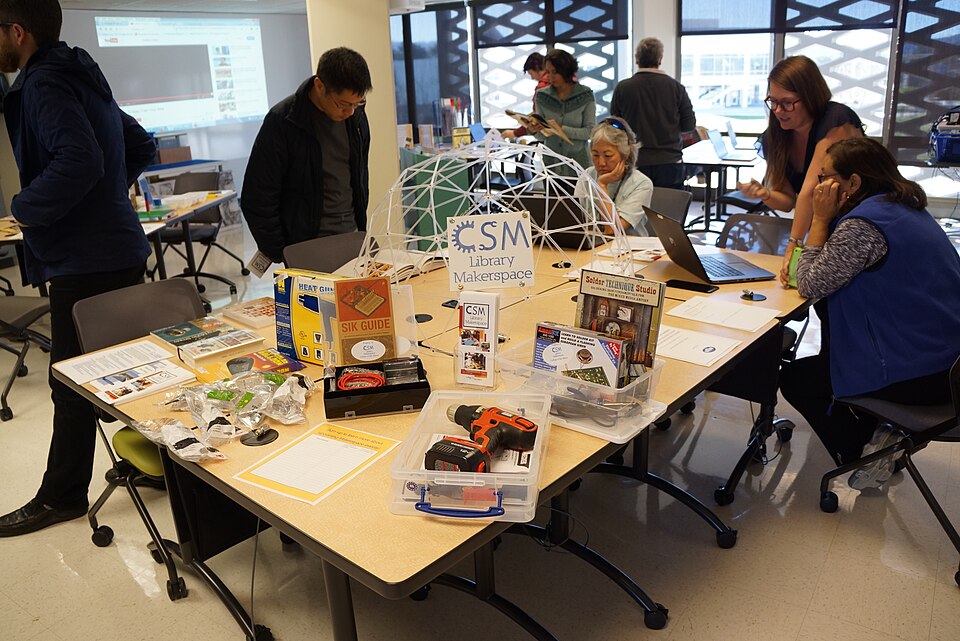
What Is the Idea? We propose converting a newly available 800-square-foot room adjacent to the Teen Zone into “The Fabrication Station”, a staffed makerspace built around three entry-level 3D printers, a laser-safe vinyl cutter, and hardware loaded with free design software (Tinkercad, Blender for advanced users), and open shelving for […]

I started exploring module 6: Hyperlinked Environments expecting a straightforward piece on museum tech, and came out pondering which kind of visitor I actually am. The reading that stuck with me was Eduardo Araujo Oliveira and Paula de Barba’s “How does learning happen in museums?”, where University of Melbourne researchers […]
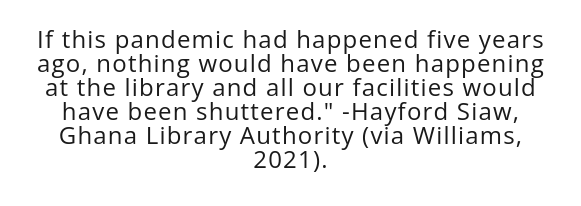
The Archive at the Edge of the Network On digital equity, the discomfort of balance, and what special collections owe to the communities that made them. Digital equity and community networks felt, at first glance, like the domain of public librarianship. Important and urgent work, but not quite park of […]
When I read about Karen Schneider’s original argument from her blog post “The User Is Not Broken” that libraries should think of themselves as a service and not a format, it really resonated with me (Kenney, 2014). It is such a simple concept and statement and yet it is almost […]