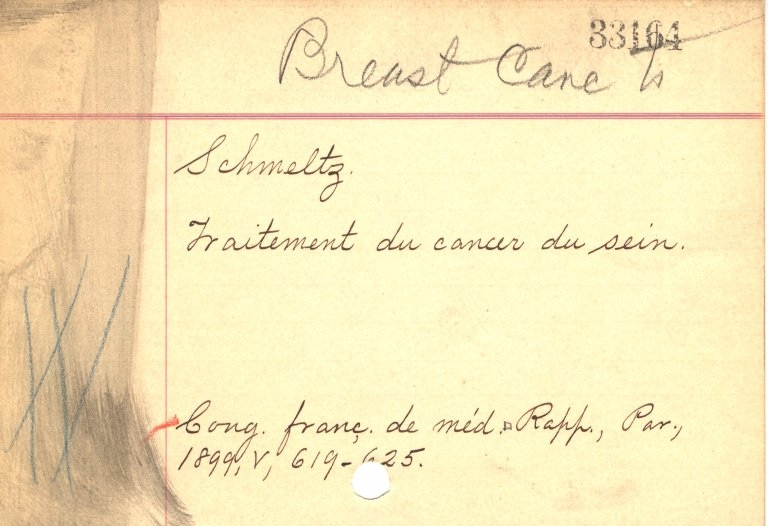
Handwritten subject card. Public domain image from Wikimedia Commons.

When I read about Karen Schneider’s original argument from her blog post “The User Is Not Broken” that libraries should think of themselves as a service and not a format, it really resonated with me (Kenney, 2014). It is such a simple concept and statement and yet it is almost too simple. Regardless of its simplicity, it cuts straight through years of professional anxiety about print versus digital, catalogs versus search engines, and “real” library work versus everything else. This idea really resonates with the idea of the participatory library that is discussed in the first four modules of this course. The idea that a library’s value is not the stuff on its shelves, but the relationship that is built with all the patrons who walk through its doors or never do.
What stands out to me about this theme of the participatory library is how it reframes failure. Thinking in a more traditional way, if a service does not get used, it is assumed that the user did something wrong. The user did not search correctly, or did not read the sign(s), and/or did not ask for help. Scheider’s piece revisited eight years later by Kenney flips these ideas. If a service is not working, the service is the problem, not the user. This is a very fundamental and humbling shift for an institution built on expertise and authority. It asks librarians to treat every dead end as a design flaw rather than a patron flaw.
My first reaction was relief. I have worked under a manager who would be rude about the way they assisted patrons or answered emails because the service they put together was not flawed but the user just was not looking at the right things or “not getting it”. Participatory service asks us to do the opposite. Build feedback into the system itself so that the user’s confusion becomes information rather than an inconvenience. The Library 2.0 examples make this more concrete. Ann Arbor District Library lets patrons scribble marginalia on virtual card catalog cards, while Gwinnett County Public Library built a teen concert by working directly with local teens and listening to what they wanted (Casey & Savastinuk, 2007). Neither of those required a new format. They required asking, listening, and building the answer into the structure and the text frames that structure around two recurring questions. Is the service constantly evaluated and updated? And was customer input built into its creation and review (Casey & Savastinuk, 2007)?
Structure is where I think the deeper challenge lies. It is easy to add a comment box or a feedback form and call it participatory. The harder, more interesting work is what Fons describes. Libraries need to meet people where they already are, by following the same rules search engines use to make information accessible, rather than insisting that people come to the library’s own systems first. A participatory library does not just listen when someone walks in. It shows up in the search results, the RSS feed, and even before the person has decided to come at all. Fons makes that stakes very clear, warning that failing to declare a clear, user-centered outcome risks libraries getting lost in the process and technical detail instead of pursuing long-term goals. Visibility, in a way, is a form of participation. The library through visibility shows up on the user’s terms before a single word is exchanged.
This I believe is how this theme connects to the future trajectory of libraries, especially in higher education. Academic libraries are shifting from a transactional model toward partnership models, positioning themselves as collaborators embedded in teaching, learning, and research rather than gatekeepers of a collection (Mathews et al., 2024). That is participatory service taken in a logical direction. They are not just asking users what they want but inviting them to build alongside the institution.
References
Casey, M. E., & Savastinuk, L. C. (2007). Library 2.0: a guide to participatory library service. Information Today.
Kenney, B. (2026). The User Is (Still) Not Broken. PublishersWeekly.com. https://www.publishersweekly.com/pw/by-topic/industry-news/libraries/article/60780-the-user-is-still-not-broken.html
Fons, T. (2016, August 1). Making libraries visible on the web: to ensure that library content is conveniently accessed, libraries must give search engines what they want. Library Journal, 141(13), 44+. https://link-gale-com.libaccess.sjlibrary.org/apps/doc/A459804903/AONE?u=csusj&sid=bookmark-AONE&xid=e0d05f0e
Mathews, B., Metko, S., & Tomlin, P. (2024). Empowerment, Experimentation, Engagement: Embracing Partnership Models in Libraries. EDUCAUSE Review. https://er.educause.edu/articles/2018/5/empowerment-experimentation-engagement-embracing-partnership-models-in-libraries