
In the New Models module, we heard a lot about the Anythink Libraries of Rangeview Library district in Colorado. We saw through their Nature Library, their Treehouse Model, and even their decision to rely on urban goats to mow their grass that they do not shy away from thinking outside of the box. Their inclination to experiment in pursuit of better serving their community’s needs is what has continued to set them apart (TEDx Talks, 2013). In this blog post, I want to highlight another bold initiative from Anythink that centers their users above all else: WordThink.
A lot of us are stuck in Dewey Decimal Land. To us library workers, this is a system that we’re used to and that we know how to make sense of. The effort it would take to upend this system and reclassify our materials under a different one can seem insurmountable to some. For just a moment, though, consider some past interactions you’ve had with your library users regarding the Dewey Decimal Classification System (DDC). How many times have you seen their eyes glaze over as you explain how it works and how to navigate it in the future? Personally, this is an unfortunately common scenario in the library where I work. DDC is not the only option, and it is possible to switch to other means of classification. One alternative method that has arisen in recent years is BISAC or genre-based classification systems that more closely resemble what you see inside of a bookstore. Before Anythink libraries even rebranded as Anythink, they developed their own genre-based classification system called WordThink and implemented it in all seven branches of the Rangeview Library District.
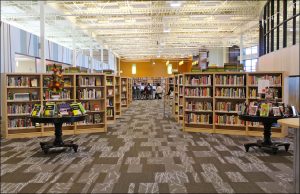
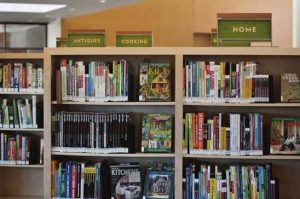
In WordThink, word labels on book spines display a broad category, such as “science” or “art,” as well as a narrower term for further division. Within these narrower sections, the titles are shelved alphabetically by title (Fister, 2009). For the Rangeview Library District, the decision to leave DDC in the past stemmed from years of feedback from focus groups and patrons complaining about how confusing it was to find a book. Patrons stated that they found the original organization (DDC) unclear and consistently struggled to find materials without assistance. Since WordThink went live, the libraries have received an abundance of positive feedback from their users, describing how simple it is to understand the new library organization system (Whaley, 2009). Across their library system, they saw their circulation and visitor counts quadruple. Due to the success of their classification system, they chose to draw more inspiration from bookstores and other retail models, recentering their library focus entirely on customer service and working towards creating an experience culture (Sandlian Smith, 2011).
If, as library architect Caitlin VerKuilen (2023) writes, the main objective behind library design is “understanding and providing for the needs of the communities the library serves,” shouldn’t creating a classification system that our users can navigate independently also be a top priority? We have to step outside of our library staff boxes and truly put ourselves in the shoes of our patrons if we want to construct spaces that suit them. Brian Mathews (2015) reflects that “when we appreciate and participate in our communities outside of a pre-defined role, that’s when we become partners, advisors, and consultants.” Maybe it’s time for the rest of us to take a page out of Anythink Libraries’ book and step away from Dewey Decimal too.
References:
Anythink Libraries. (2009, December 11). WordThink [Video]. YouTube. https://www.youtube.com/watch?v=-0IS1IrXrrE
Fister, B. (2009). The Dewey dilemma. Library Journal, 134(16), 22.
Mathews, B. (2015, April 6). Think like a startup: 3 years later. The Ubiquitous Librarian. https://www.chronicle.com/blognetwork/theubiquitouslibrarian/think-like-a-startup-3-years-later
Sandlian Smith, P. (2011). How one library system was transformed on a tight budget. The Guardian. https://www.theguardian.com/public-leaders-network/2011/nov/02/transforming-libraries-anythink-america
TEDx Talks. (2013, December 16). What to expect from libraries in the 21st century: Pam Sandlian Smith at TEDxMileHigh [Video]. YouTube. https://www.youtube.com/watch?v=fa6ERdxyYdo&t=444s
VerKuilen, C. (2023, February 9). Centering your library around the community. Library Journal. https://www.libraryjournal.com/story/centering-your-library-around-the-community-lj230207
Whaley, M. (2009). Adams County libraries shelving Dewey Decimal. The Denver Post. https://www.denverpost.com/2009/06/07/adams-county-libraries-shelving-dewey-decimal/