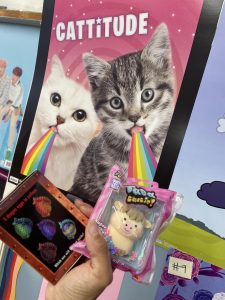
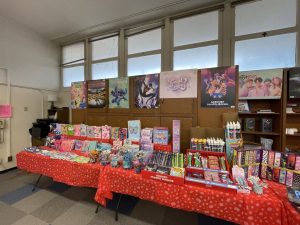
This week, I hosted my sixth Scholastic Book Fair as an elementary school librarian (Library Media Assistant, aka LMA). For many, the mere mention of the book fair brings nostalgia for chocolate calculators, scented erasers, posters of kittens in flower fields, and cheap paperbacks with charm necklaces embedded on the cover to entice even the most reading-resistant. But for others, it stirs painful memories of being without. From the register, I see the kid standing by the entrance, whispering to a friend to get her something too. I see the kid who scrounges up nickels, only to find out that sales tax exists, and not even a dollar can buy a bookmark. And then, I see the kid with lost library book fines, whose dad won’t let him step foot in the fair, because “he’s irresponsible and doesn’t even know how to read.” How could this beautiful space—the book fair, the library—be a source of joy and thrill for some, and for others, a source of shame and scarcity? When did I, the voice of that space, become an enforcer of barriers and inequities? How do I reclaim the principle of Library 2.0: “the library is human”—and proclaim, full-throated and wholeheartedly, that the library is for everyone (Stephens, 2019, p. 8)?
When I started as an LMA in 2023, my first report of lost library books returned pages upon pages of delinquent fines. Some children had over $100 worth of lost books, sometimes dating back from when they were in kindergarten. I worked to resolve the fines, first by doing inventory and finding that many of the books our school claimed had been lost were sitting right there on the shelves. I allowed kids to donate any book they had at home as a replacement. As I weeded our aged collection, I let kids take those books, read them, and return them to forgive their fines, even though I would put the books right back on the free cart. I waived fine after fine, without asking for any permission because in my mind, it was the compassionate thing to do—to give kids a chance, to trust that they could try again, and to welcome them back to a space that maybe they had feared. Some of those kids never lost a book again and became avid library users. But some kept losing book, after book, after book.
Teachers quickly told me to ban these students from borrowing. Perhaps more knowledgeable of their students’ personalities, they told me who was trouble and who couldn’t be trusted. But I talked to the kids and some of the reasons they lost books was harrowing: “My mom and I keep having to move to different friends’ houses” (they were homeless). “My dad thought it was trash and threw it away” (he was in a manic episode).” “We have too much stuff and I just can’t find it” (hoarder situation). It’s not that the students were irresponsible; they were children whose home lives were out of their control. But slowly, I obliged to teachers’ requests, restricting the kids to our free cart of library discards, and watched as kids slowly disengaged from library services.
Many public libraries eliminated late fees during the 2020 Covid shutdown, but others had begun long before. Library Journal’s 2022 Fines and Fees Survey reached out to libraries and asked their reasons for implementing fine-free services or choosing not to. Ultimately, it came down to equity: “we realized the poorest in our community were paying the most,” Cassandria Crane, director of American Fork Library in Utah shared (Gerber, 2022). For some, the cost of collecting fines, both financially and on the morale of staff, was not worth the effort. Alicia Blake, assistant branch manager at Worcester County Public Library raised the question, “Would you rather collect 0.4 percent profit or let a child take books home to read with [the adults in their lives], increase literacy rates in your county, and ultimately change the way your community approaches library use (for the good)?” (Gerber, 2022). Unrein (2020) in “Overdue Fines: Advantages, Disadvantages, and How Eliminating Them Can Benefit Public Libraries” elaborates on the disproportionate impact: “when a library cuts off a lower-income patron from the library, they may be cutting off any access they have to books…or the many other unique items that libraries offer.”
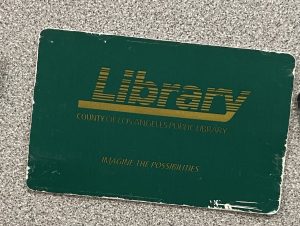
Like Unrein, I ask myself – is teaching civic responsibility the library’s job? I introduce our youngest patrons, 3- and 4-year olds, to the library by showing my LA County Public Library card that I’ve held onto lovingly since I was their age, and say “the library is the best place to learn how to share.” Taking part in this shared community resource involves a deep level of radical trust. It is my job to model responsibility, but to do so by trusting the kids and helping them be successful in whatever way I can. This means being transparent with their teachers, with their parents and stating—I will work with you in whatever way I can to get these kids back to checking out books. Schmidt (2013) writes, “transparent libraries set themselves up to build long-lasting relationships” (p. 28). And when our school district bars high school students from graduation because of library fines they accrued in the second grade, how can their relationship with libraries be anything but damaged?
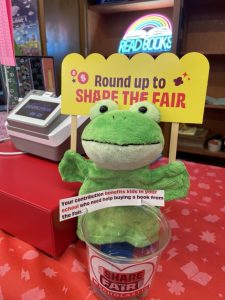
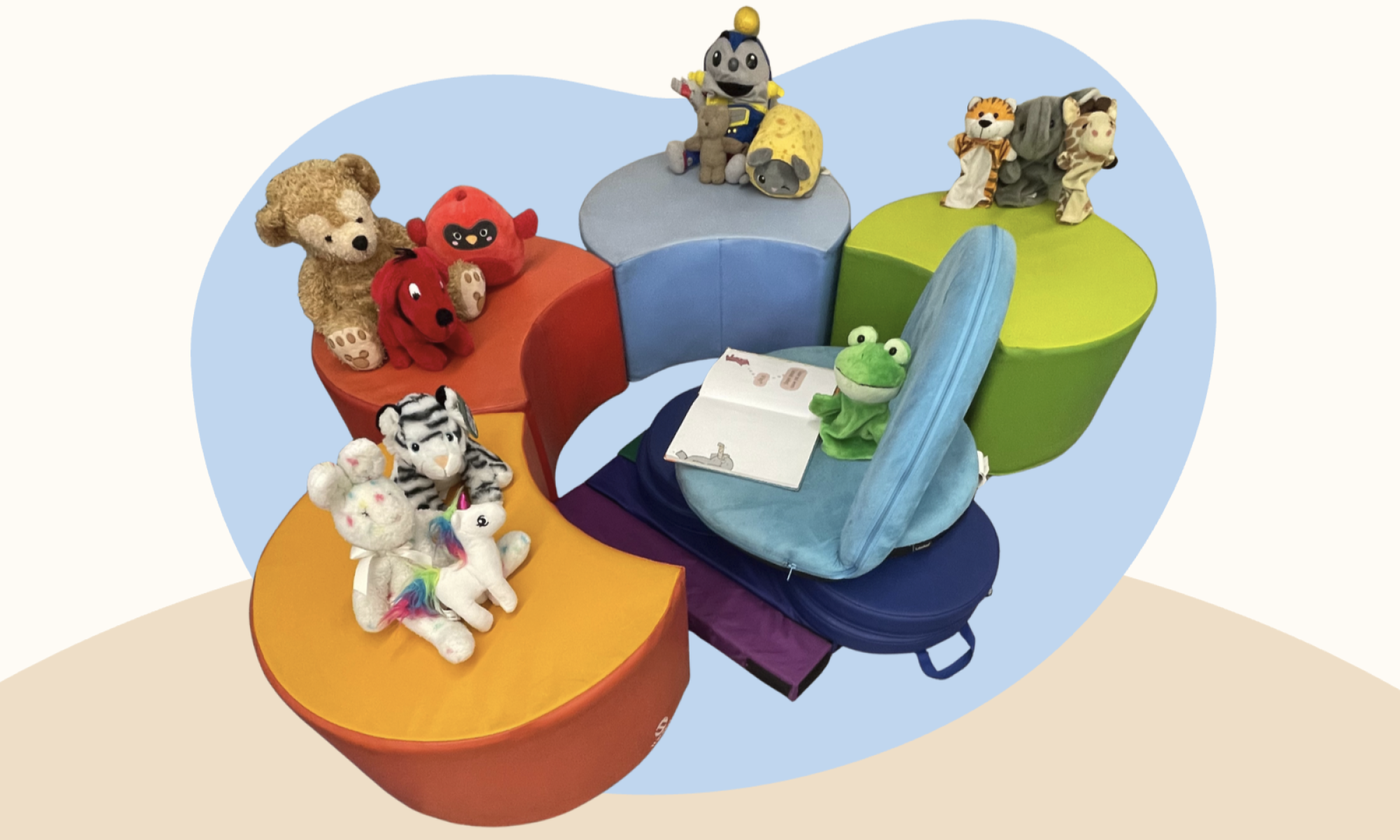
We have a “Share the Fair” fund at the book fair, funded solely by kids, parents, and teachers rounding up at the register. At the end of every fair, I buy as many trinkets and books as I can with the funds and give them to those kids who looked longingly at the fair, wishing to come in. This year, our library mascot, Cupcake the Frog, held the fund jar. Our littlest patrons at the register would sing our library song “Hello friends, hello friends, hello friends, I’m so glad that you are here” and drop their coins in. Radical trust is a little like this—giving what you can, and expecting nothing but a little joy in return. Would a concept like this in which we all come together to help welcome our lost book friends back into the library work? I think so, and I’m willing to try.
References:
Gerber, A. (2022, September 28). Fine farewells: LJ’s 2022 fines and fees survey. Library Journal. https://www.libraryjournal.com/story/Fine-Farewells-LJs-2022-Fines-and-Fees-Survey
Schmidt, A. (2013, November 1). The user experience: Earning trust. Library Journal. 28.
Stephens, M. (2019). Wholehearted librarianship: Finding hope, inspiration, and balance. ALA Editions.
Unrein, S. (2020, April). Overdue fines: Advantages, disadvantages, and how eliminating them can benefit public libraries. Syracuse, NY: iSchool Public Libraries Initiative at Syracuse University.
Hello,
I agree wholeheartedly with you. You’ve brought up some valid points, and I think that you are doing a great job by waiving those fees. I love that you had a fund that kids and staff could donate to so those who can’t enjoy the book fair could have a chance of receiving something that could very well impact them positively.
You’re doing a great job!
Hello Mae! I really enjoyed reading your post. It was heartfelt and well-written. Making sure the library is accessible and equitable is important.
One thought I had for students who are repeatedly losing books was that I’ve heard of some school libraries dealing with lost books in this way: still let the student check out the regular library books, but it stays in the classroom to be read there, so it doesn’t get lost or damaged by going home. What do you think about that? Is it still too restrictive, or a good compromise? I think using weeded books is also a nice alternative, though I hear you when you say it can make some student patrons lose interest when they can’t have the new and popular books.
Wow, Mae—
I love everything about this. Every effort that you have made to bridge this divide has undoubtedly been seen, felt, and appreciated by your young patrons and their families. This was such an inspiring and beautifully written read. Thank you for being willing to stick your neck out and try new approaches to problems that have been bandaged with tired, ineffective solutions for far too long. Your spirit is exactly the type of energy we should all strive to bring into our libraries.
—Caitlin
Thanks for posting about this! I have volunteered at Scholastic Book Fairs through PTA (sadly, my children’s elementary school does not have a library). After my first one, when I had not yet even considered working in a library or getting my MLIS, I had so many thoughts about how book fairs teach students about everything BUT books. I may consider this as a topic for a future INFO287 reflection post or assignment!
Hi @missmae, you have a wonderful talent for writing library stories! It transported me back to when I wished to buy something at the book fair, too. The part that carries on for me is when you wrote, “But I talked to the kids and some of the reasons they lost books was harrowing: “My mom and I keep having to move to different friends’ houses” (they were homeless). “My dad thought it was trash and threw it away” (he was in a manic episode).” “We have too much stuff and I just can’t find it” (hoarder situation). It’s not that the students were irresponsible; they were children whose home lives were out of their control.” Thank you for writing out these stories.
I’ve worked at my children’s elementary school Scholastic Book Fair before clocking in to work at the library.
It’s so nice not to see the consumerism, disappointment, confusion, and tears at the library!