Reflection Blog: Hyperlinked Environments
In my two and a half years working as a teacher librarian, my understanding of the space of the library has drastically changed. Growing up, I only used the public library to check out books. Similarly, I used my school libraries to check out books but also for computer labs. Though I’m sure there were makerspaces and programming activities, I cannot recall ever participating in them. Now, working in a school library, I realize how many opportunities I have to create a welcoming, fun space for students. Buffy J. Hamilton mentions that makerspaces encourage participatory learning, which gives students “Opportunities for creating using a variety media, tools and practices” and creates “Learning that feels relevant to students’ identities and interests.” Previously, I had not realized how much makerspaces encourage learning; I thought of them as just fun activities for students to do outside of class time. After exploring this module, I see how these activities encourage learning through creativity and appealing to student interests. The picture below represents something I would love to incorporate into my school library. I really like how the activity encourages critical thinking while also being engaging.
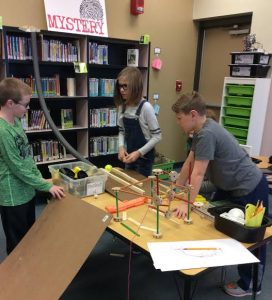
It’s funny to think how the stereotype of a library is that it is a place that must always be quiet. In a school library, I have found that this is often quite the opposite of what I want. Although of course I would love for every student who comes to the library to check out a book, I also love when students visit just to hangout or engage in other activities. Sara Luster writes that “Librarians across the country are working to create innovative spaces for their students, to enhance their learning process and nurture their imaginations.” I really resonate with the idea that libraries are a place that foster imagination. While books may be the primary source of fostering imagination in the library, there are other platforms we can encourage students to use as well. For example, an art station encourages creativity and provides an outlet for students. Similarly, so does a station like the one in the image above where students must use their imagination to build something. All in all, I am looking forward to trying new ways to encourage students to come to the library through makerspace activities that foster their critical thinking and imagination while also creating a space for them to be creative and have fun.