As I explored the Hyperlinked Environments module, one thing that stuck with me was The Hive branch of Spokane Public Library. As someone born and raised in Washington, it was exciting to see a #hyperlinked example from my home state. Also, and more importantly, The Hive seems like such a wonderful space, and a perfect example of a hyperlinked environment!
Spokane Public Library advertises The Hive as “a non-traditional library centered around arts education and free, public event space” (Spokane Public Library, n.d.). Without any books or public computers, The Hive helps the public expand their understanding of what library spaces can be. It was built intentionally for meeting, connection, and learning.
The Hive and the Four-Space Model
The four-space model, as explained by Skot-Hansen (2017), is a model for public library spaces to be built on four different, overlapping intentions: inspiration, learning, meeting, and performing. I see many of these intentions and their overlaps in The Hive.
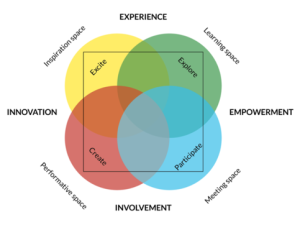
Photo from Skot-Hansen (2017)
The Hive is, at its core, a meeting space. It has multiple events spaces for residents to reserve, free of charge. These spaces have been used by a wide variety of groups, including knitting and other art clubs, and social justice campaigns (Urban Library Council, 2021). When reading about The Hive, I immediately thought of my friend group that is always looking for new places to meet and play board games. It can be a burden for someone to always host, and having a free event space like this would be perfect.
The Hive is also a space for learning, creating, and exploring. On top of meeting rooms, The Hive has a public art studio, and four art studios dedicated to an artist-in-residence program. The studios were created as a space for artists to explore ideas and pursue new projects. As part of their residency, artists participate in open-studio times and lead a community art program of their creation. The Hive also hosts other educational library programs, like genealogy classes (Spokane Public Library, n.d.).
 Photo from Urban Library Council (2021)
Partnerships
As I read more about The Hive, I learned it started as a partnership between Spokane Public Schools and Spokane Public Library. The space was created with the needs of both organizations in mind. The Library was able to build “a location for 21st century public library services” (Spokane Public Library, 2021). The Schools was able to build a space for their teacher trainings and a headquarters for their Virtual Learning division. There was community buy-in from the start, as the space was funded by a voter-approved bond issue (Urban Library Council, 2021).
This kind of partnership seems like a great idea for public libraries to explore. Creating and sharing a communal space helps facilitate closer relationships. It give a chance to really understand and support each other’s’ missions and values. It could also be helpful in times of tight budgets. When asking for public funding, I think there could be power in a two-in-one proposition. A multi-purpose, community centered space sure seems like a great investment to me.
References
Skot-Hansen, D. (2017, August). Library development: from collection to connection. University of Copenhagen, Faculty of Humanities.
Spokane Public Library. (n.d.) The Hive ®. Spokane Public Library. https://www.spokanelibrary.org/hive/
Spokane Public Library. (2021, August 9). Spokane Public Library Opens First Building from 2018 Library Bond Issue and Selects The Hive™ Artists-in-Residence [Press Release]. https://www.spokanelibrary.org/wp-content/uploads/08092021_HiveOpening_PressRelease.pdf
Urban Library Council. (2021). The Hive. Urban Libraries Council. https://www.urbanlibraries.org/innovations/the-hive