Hyperlinked Symposium: 3-2-1 Hyperjump!
For Modules 11 & 12, I really enjoyed the concept of “Embracing Messy Learning”. Joshua Block advocates for nonlinear processes that emphasize students’ agency, their focus and commitment through growing pains, stretching, and struggle. As a late-diagnosed neurodivergent, I’ve had many years of studying to reflect on why my process, being different from the conventional approaches expected, is not inherently bad. When I have to adhere to the exact steps and outcomes planned for a different learning style, the material has less impact and a shorter lifespan in my memory. The course output becomes less potent as juicy knowledge mulled into wisdom, and feels like something I just graze past, like viewing famous destinations on a bus tour.
If I don’t allow learning to be messy, I eliminate authentic experiences for students as thinkers and creators (Block, 2014).
That is why I will always be a proponent of creative problem-solving, real case studies, and experiential opportunities. We want the content we offer to stick! We want to engage in a way that gets our hands dirty with the gritty details. To embody the challenges to understand why something is approached a certain way. An easy way to relate to this (as an older sibling) is: no matter how much I explain to my little brother, I’ve learned that talking at him is futile. Sometimes we just have to let them bump their heads, trip over those rocks, and blunder in order to get it. Designing learning spaces is similar. Even though we want to see a wall of projects that celebrate participants’ abilities to produce tangible outcomes that look a certain way, sometimes we’re only teaching them to refine skills of re-creation or replication. If we allow meandering and experimentation, they gain texture and ripen in their own due time (even if it may look like throwing spaghetti on a wall). I understand that it’s not always possible due to time constraints and other systems and structures we have to adhere to, but it feels so validating to come across advocacy work like Block’s article.
Secondly, I want to relate to the Professional Learning Experience content. I have found it so eye-opening to follow the amazing blogs, vlogs, and social media content created by librarians and archivists. They are very honest about career expectations and serve as a more informal Personal Learning Network (PLN). For example, @ablacklibrarian on IG recently made this clip speaking up about vocational awe: https://www.instagram.com/p/DbW5ttIpQnj/
I definitely think this topic should be amplified loud and early in our MLIS journeys. In the course readings, Kelsey Simon introduces the concept of emotional labor. I also relate this to a recent episode of Code Switch in recognition of how important it is to have relevant career advice that viscerally understands your specific lived experiences and identities. As a recovering high achiever who has experienced burnout in my first career, I wish for younger professionals to enter the workforce equipped with this wisdom:
Jodi-Ann Burey, a disabled black author, writes about the barriers and biases Black women face in workplaces: compassion fatigue, nervous system disease, and compounding discriminatory stressors that worsen their health outcomes…just to name a few! This brings me to my last point: for all managers and future leaders out there, please commit to continuous learning about cultural humility as PLE. That way, marginalized and underrepresented workers don’t have yet another hurdle and layer of advocacy to take on. Especially in positions of power, it will be crucial to set aside capacity specifically to address and prioritize the pain points of the staff who uphold your institution. It’s 2026! It’s about damn time we raise the bar for better, safer workplaces with more empathetic management.
References
Block, J. (2014, January 7). Embracing messy learning. Edutopia. https://www.edutopia.org/blog/embracing-messy-learning-joshua-block
KayKay [ABlackLibrarian]. (2026, July). Vocational awe and libraries [Video]. Instagram. https://www.instagram.com/p/DbW5ttIpQnj/
NPR Podcasts. (2026, July 31). Work does not deserve your full self | Code Switch [Video]. YouTube. https://www.youtube.com/watch?v=FVaHELOk2is
Simon, K. (2020). Emotional Labor, Stressors, and Librarians Who Work with the Public. School of Information Student Research Journal, 10(1). https://doi.org/10.31979/2575-2499.100106
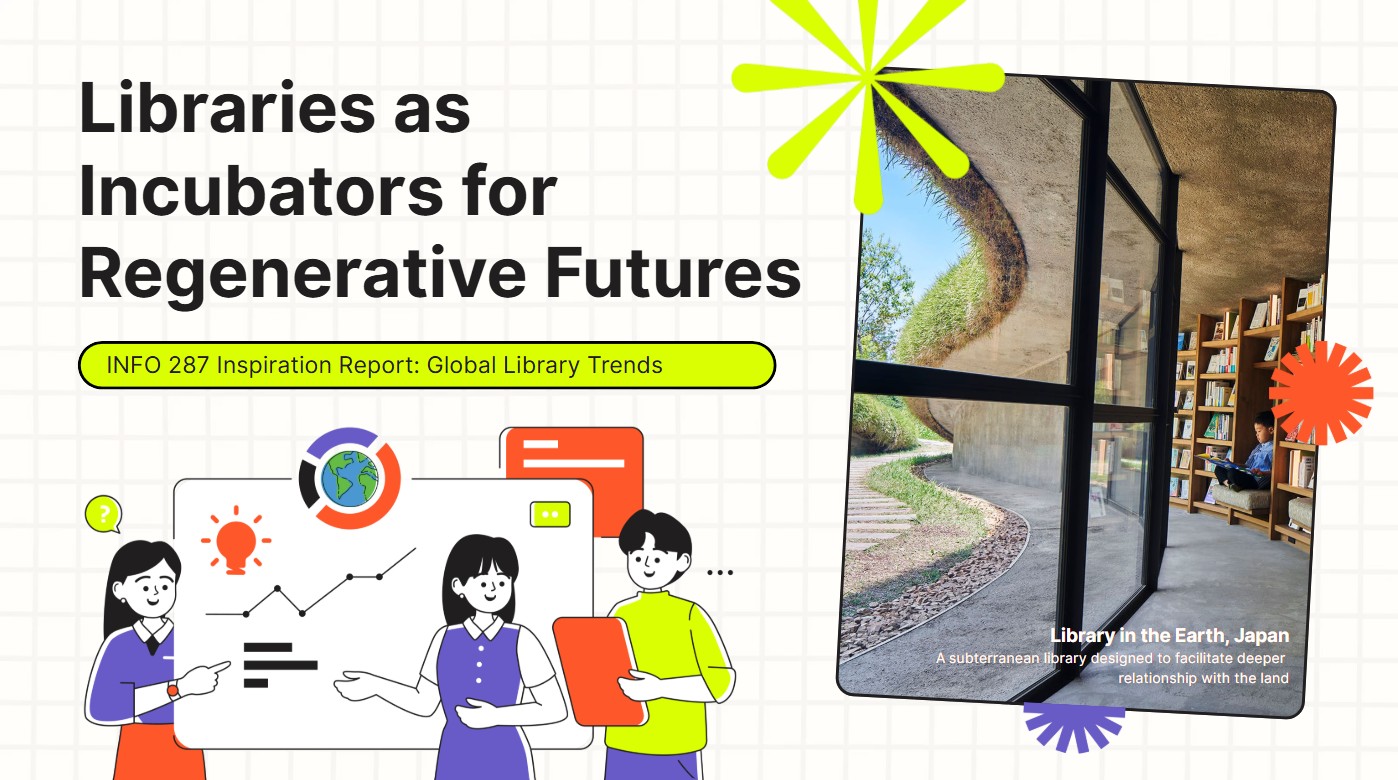
View here – https://canva.link/jannaw287inspirationreport
Note: Slide 4 includes a text-as-audio clip (experimenting with Canva AI). You’ll have to unmute the presentation by hovering your mouse over the bottom edge of the screen until the control bar appears.