
“You’re an information professional, you are qualified to teach about this. You don’t have to know everything about all of the very rapidly changing developments in artificial intelligence to teach people the basics of how probability models work” (Cyrus, 2026, 39:04-39:23).
When I explored the AI & ChatGPT module this week, I learned about AI agents, and it transported me back to a time before my life in libraryland, when I studied computer science. I used the chance to foster curiosity and increase practical skills for talking to library patrons about AI products.
I enjoyed and recommend this free webinar Refusal as Instruction: Talking to Library Patrons About AI. It helped me work through few roadblocks I had about researching about AI products in libraries. Librarian Cyrus gives talking points when serving the patrons or admins who are
- Concerned
- Curious
- Uncritical
- Enthusiastic
- Assessing AI Products
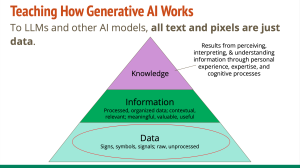
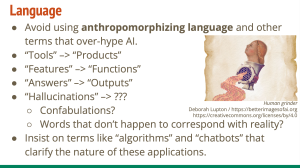
“[T]hose with lower AI literacy are more likely to believe that AI actually possesses these humanlike attributes, leading to greater perceptions of AI as magical and feelings of awe” (Tully et al., 2025, p. 16). This means the more you know about AI, the more skeptical you will be about AI (Cyrus, 2026). Although I consider myself a digital native and hold a computer science degree, I found myself feeling way more comfortable discussing AI products after taking the webinar. One takeaway I had was that large language models and other AI models generate language, not information. Another takeaway I had was how to talk about AI in a way that avoids humanizing or over-hyping AI products. For example, referring to AI as AI products is something I’m trying in this post.
The Public Library Association has a webinar called Listening First When Your Community Is Skeptical of AI, which costs $45 to $80 to attend. It seems the target audience is library leaders. The host is King County Library System’s Emerging Technology Administrator who focuses on “digital equity and responsible technology adoption” and previously worked at Amazon for 6 years. An antifacist news outlet summarized their experience of attending a KCLS Board of Trustees meeting, where allegedly no AI products got discussed, and allegedly although 18 attended, no time was allotted for public comment. It raised an interesting question: Should public libraries be corporatized? A lot of this class talks about hyperlinked library culture, which seems to be the antithesis of a corporate library culture.
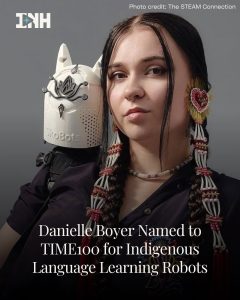
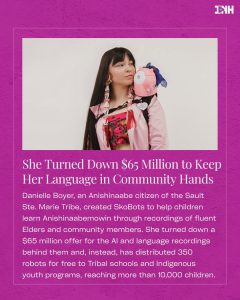
What could AI products look like rooted in the culture of a hyperlinked environment or hyperlinked community? As a Cantonese American, language revitalization interests me, specifically for Cantonese and other Chinese dialects. I found an example of building AI products for language revitalization. Time (2026) names Danielle Boyer one of the most influential people in AI products in 2026. “Indigenous communities need self-determination in technology, Boyer argues, not tools built on their behalf” (Time, 2026).
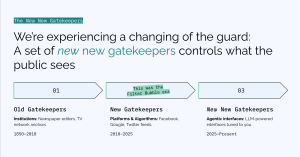
I explored New _ Public, a nonprofit product studio. They argue that trust is replacing the attention economy, and furthermore, AI agents are replacing social media. When I read that New _ Public is launching an online community app and website, I wondered: In practice, how will this be different from another social media company? What cultures influence this product’s guidelines for trust-building and community moderating? How would you choose who to steward the communities?
When I was a computer science major, mentors told us we were studying for jobs and technology that do not exist yet. In a similar vein, information professionals and future librarians are studying for a library jobs that may not exist yet. We can learn, create, teach, and pivot.
References
Cyrus, H. (2026, September 30). Refusal as Instruction: Talking to Patrons about AI [Webinar]. https://www.nicheacademy.com/blog/webinar-refusal-as-instruction-talking-to-patrons-about-ai
Time. (2026, August 27). Danielle Boyer: The 100 Most Influential People in AI 2026. https://time.com/collection/time100-ai/2026/danielle-boyer/
Tully, S. M., Longoni, C., & Appel, G. (2025). Lower artificial intelligence literacy predicts greater AI receptivity. Journal of Marketing, 89(5), 1–20. https://doi.org/10.1177/00222429251314491
2 responses to “Reflection on Hyperlinked Environments: Talking to Public Library Patrons About AI”
This is the post I needed today! THANK YOU!
(https://people.com/mom-calls-out-school-for-making-ai-generated-photo-of-6-year-old-daughter-as-adult-12184403)
@innerchildlibrarian I really enjoyed reading your post and learning about Danielle Boyer. Very cool and inspiring. Thank you!