
In order to support the hyperlinked library, designing a hyperlinked environment is necessary. Traditional library set-ups do not entirely support a hyperlinked library. To be sure the stacks and rows of computers will still be a component of the library for now but there are important tools that a hyperlinked environment can offer to ensure that the library remains a vital community resource. There are plenty of examples of hyperlinked libraries developing new areas in their libraries for different kinds of makerspaces such as stem labs, recording studios, and even growing into different buildings that don’t resemble a traditional library at all. As a public librarian, I’m most interested in learning about public libraries and finding out how they are answering the call of the hyperlinked library. What is most fascinating is that no matter the budget you have, there are steps you can take to start developing a hyperlinked environment right now.
You can think of a hyperlinked environment as a transition from an environment focused on collections to one that is focused on connections. One way of looking at your library environment is through examining the “four space model.” These four spaces are defined as “excite” which is a space that offers inspiration to patrons; “explore” instills learning; “participate” offers a space that encourages meeting and socializing; and “create,” a space that allows performance (Skot-Hansen, 2017). These spaces don’t live in a vacuum, instead they interact with each other allowing for experience, empowerment, involvement, and innovation (Skot-Hansen, 2017).
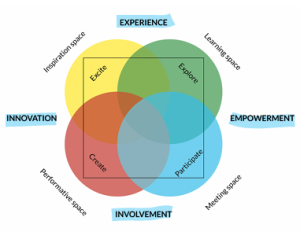
Think of your library, does it offer spaces like that described in the four space model? Can you think of how you can create and support these kinds of spaces in your library? It can be overwhelming to think of what others have done and how you can’t possibly do that; but, what can you do?
Dokk1 is a great example of how having this kind of environment can foster a hyperlinked library. You may not be able to design your own building to make this environment but what you can take away from Dokk1 is inspiration on how you can connect to your community. Maybe you can weed out outdated reference materials and move a bay of shelves to offer an area that can be used for meetings or a small maker space. Maybe you can begin to draw inspiration from programs and events that hyperlinked libraries offer in order to build a community that realizes their potential to reach their goals together through fostering connections that would otherwise not be possible. There is a lot of inspiration out there. Go out there and make those connections to your community and find out what they are looking for, then see how you can transform your environment into a place that can help meet those needs. Maybe it’s time to start using the “four space model” to guide you on your journey as you start creating a hyperlinked environment to support your hyperlinked library. I know I will.
Works Cited
Skot-Hansen, D. (2017, August). Library development: From collection to connection. University of Copenhagen Faculty of Humanities. https://287.hyperlib.sjsu.edu/wp-content/uploads/2025/02/4-Spaces-Model-from-Univ-Copoenhagen.pdf